

Following the general trend of transformation in provinces and cities in the region, Tien Giang province has now formed specialized areas for cultivating key and specialty fruit crops.
In response to the strong trend of shifting towards fruit tree cultivation, Tien Giang province has reviewed, adjusted, and developed investment plans and projects to develop concentrated fruit-growing areas, aiming for sustainable consumption.
PRODUCTION SUPPORT
Cai Be District is a locality with a large area of fruit trees in the province, boasting many types of specialty fruits. Among them, durian trees occupy a large area and have been increasing rapidly in recent years. According to the Cai Be District People's Committee, the district currently has approximately 10,000 hectares of durian trees; of which, about two-thirds are bearing fruit.
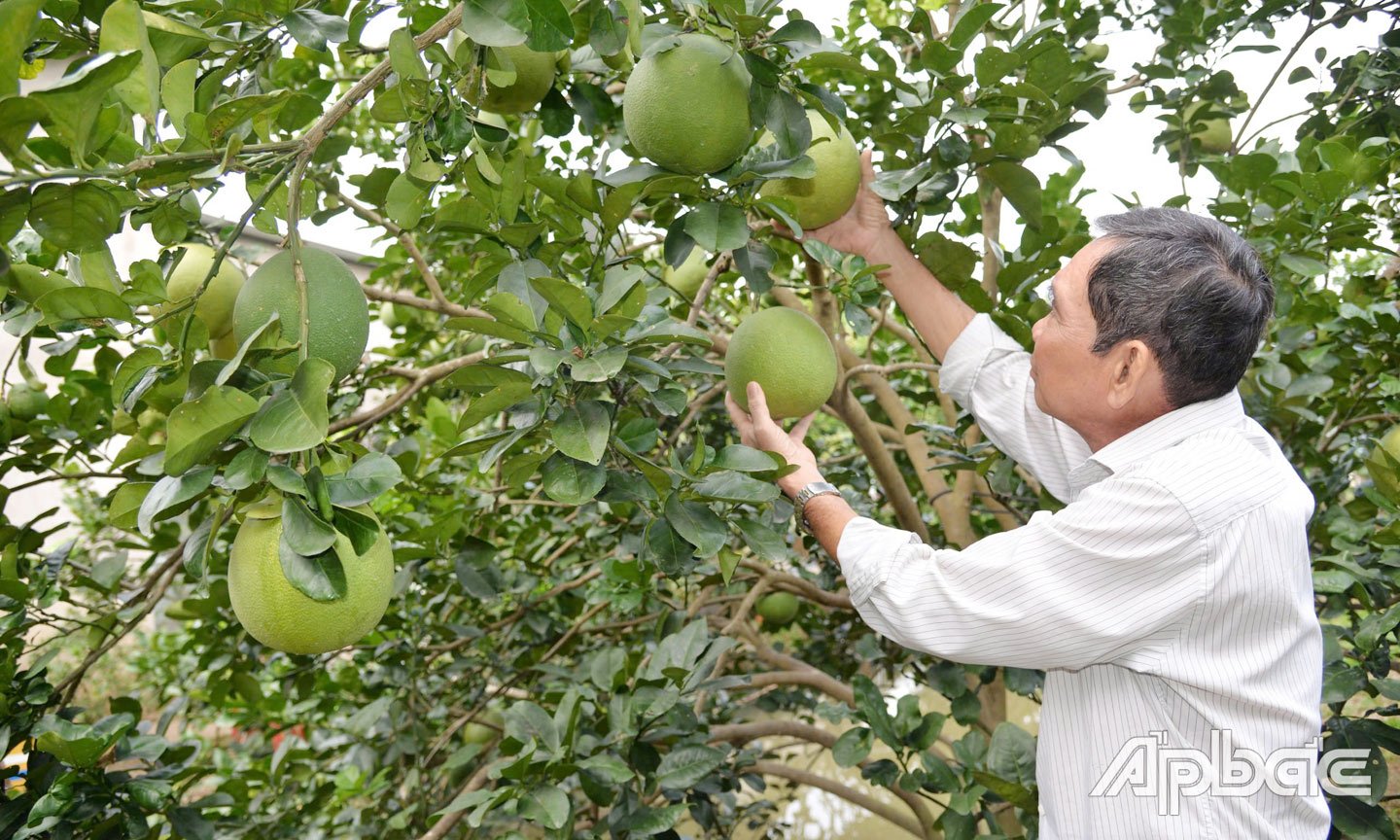 |
| Tien Giang has been focusing on supporting the production of the "billion-dollar" industry. |
To develop durian cultivation, Cai Be district has implemented many solutions in recent years, including focusing on completing a comprehensive irrigation infrastructure system. Simultaneously, the locality has focused on guiding farmers to apply science and technology to production. The district has also concentrated on disseminating information and guiding farmers to produce according to VietGAP standards to enhance product value.
Every year, the agricultural sector develops plans for training, workshops, and technology transfer on fruit trees, primarily durian. In addition, the locality focuses on guiding businesses and cooperatives in the area to establish planting area codes (MSVT) and packaging facility codes (CSĐG) to facilitate the official export of durian.
By the end of 2024, the entire district had 60 durian cultivation permits issued, covering an area of over 1,500 hectares. Six years ago, Mr. Nguyen Van Dong (Hau Thanh commune, Cai Be district) decided to convert 1 hectare of rice land to durian cultivation.
Mr. Dong shared: "The rice paddies in my area are located within the dike system, so it's suitable for growing durian. The durian trees grow very well, no less so than those in the area south of National Highway 1. The first harvest coincided with a time when durian prices were high, so I made a lot of profit."
To help ensure the sustainable consumption of fruit products, the agricultural sector has recently coordinated with localities to promote the issuance of export permits and certifications. According to the Department of Agriculture and Environment, to date, the province has 464 fruit tree varieties for export with an area of over 28,380 hectares, including: 68 jackfruit varieties, covering more than 8,500 hectares; 97 dragon fruit varieties, covering over 6,250 hectares; 57 mango varieties, covering more than 1,800 hectares; 15 star apple varieties, covering nearly 90 hectares; 5 watermelon varieties, covering 819 hectares; 3 rambutan varieties, covering more than 388 hectares; 7 longan varieties, covering more than 220 hectares; 155 durian varieties, covering more than 6,927 hectares; 13 pomelo varieties, covering more than 178 hectares; 40 coconut varieties, covering nearly 3,120 hectares; and 4 lemon varieties, covering over 80 hectares. The entire province also has 323 geographical indication codes, of which 316 are for export to the Chinese market, including 60 codes for durian, and 251 codes for other fruits such as jackfruit, mango, dragon fruit, etc.; there are 7 codes for export to markets such as the US, Australia, New Zealand, etc., for fruits such as dragon fruit, mango, rambutan, star apple, and pomelo. |
Agricultural production is one of Cai Lay town's strengths, especially the development of fruit tree production. According to the Department of Economy, Infrastructure and Urban Development of Cai Lay town, in recent times, the unit has coordinated with relevant units to promote and encourage people to change their crop structure, especially to specialize in high-economic-value crops.
The town has transformed its crop structure on rice land according to the province's Crop Structure Transformation Project north of National Highway 1, combined with training in production techniques, building and replicating effective agricultural extension models, and good agricultural production practices. As a result, the locality has formed large-scale concentrated fruit production areas such as durian (3,420 hectares, an increase of 1,212 hectares compared to 2020) and jackfruit (1,700 hectares).
Cho Gao District is the largest dragon fruit growing area in the province, with an area of approximately 6,600 hectares. The area currently bearing fruit is 5,545 hectares, with an annual harvest of 180,000 tons. Of this, about 2,200 hectares are cultivated according to VietGAP standards, and over 300 hectares according to GlobalGAP standards.
Currently, the entire district has 101 dragon fruit export products covering an area of 5,923 hectares in markets such as South Korea, China, the United States, Australia, and New Zealand, along with 5 dragon fruit quality control codes. According to Cao Tan Huong, Vice Chairman of the People's Committee of Cho Gao District, to sustainably develop dragon fruit cultivation, the district has issued a specialized resolution on dragon fruit development and a resolution on the development of collective economic activities, with the "One Commune, One Product" initiative.
Local authorities combine these two thematic resolutions, assigning specific roles in implementing the supply chain. Accordingly, farmers strive to produce according to GAP and organic standards to create high-quality products for the market. The State will create favorable conditions for businesses and cooperatives to develop, playing a linking role and finding markets for product consumption through guaranteed purchase agreements.
The district has concretized the two thematic resolutions into annual plans for implementation. The key solution is to invest in upgrading infrastructure such as electricity, transportation, and irrigation to support production development…
FORMATION OF SPECIALIZED CULTIVATION ZONES
According to the Department of Agriculture and Environment of Tien Giang province, thanks to its geographical location along the Tien River, fertile alluvial soil, and favorable water resources, specialized crop production areas have been established early on in the province.
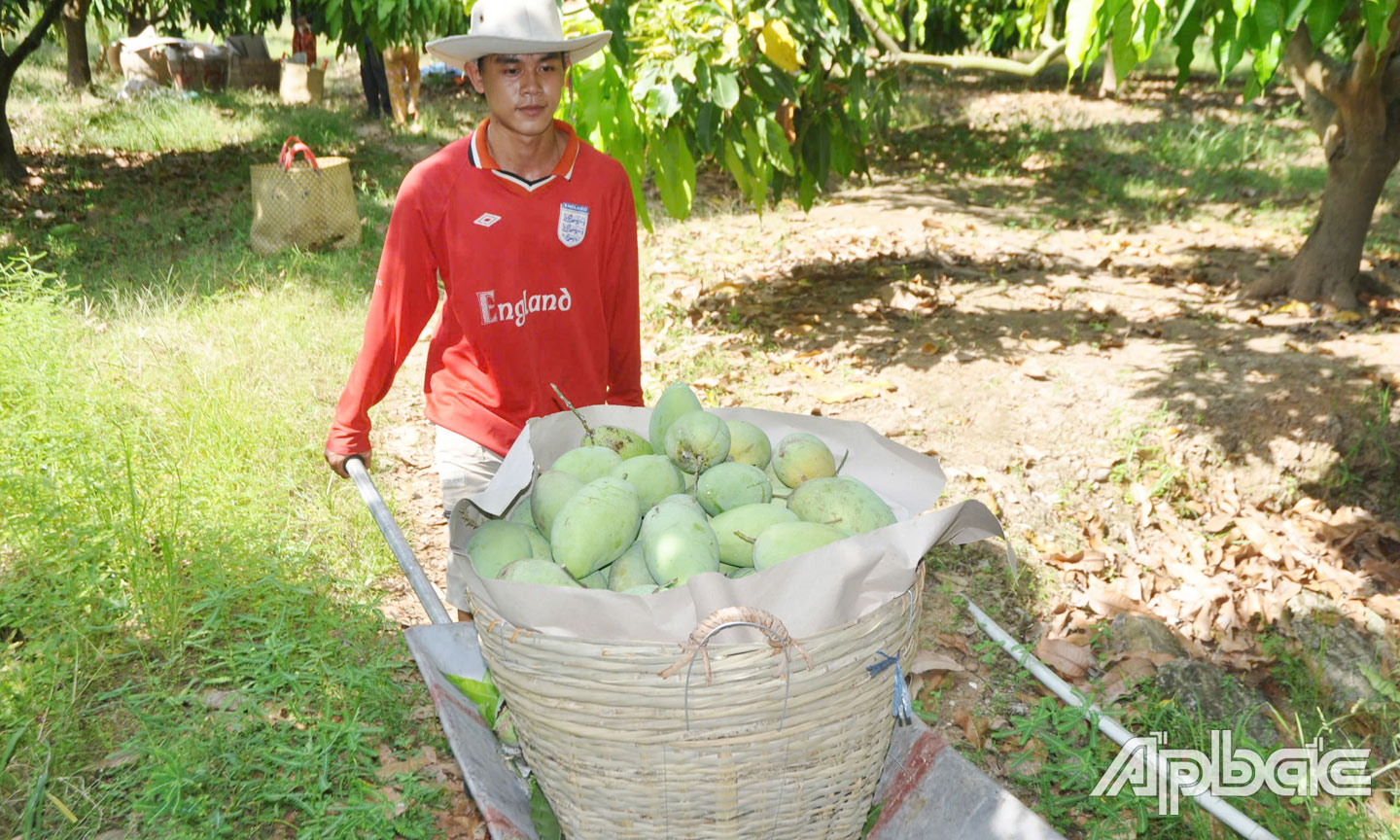 |
In the province, concentrated growing areas have been established for famous specialty crops such as: Hoa Loc mangoes (Cai Be district), Ngu Hiep durians (Cai Lay district), Tan Lap pineapples (Tan Phuoc district), dragon fruit (Cho Gao district), Co Co pomelos, etc.
These conditions and opportunities for fruit production for export contribute to the socio-economic development of the locality. Key fruit crops with export potential include: durian (24,585 hectares, yielding 457,892 tons), jackfruit (15,832 hectares, yielding 332,080 tons), dragon fruit (8,537 hectares, yielding 300,107 tons), pomelo (4,102 hectares, yielding 61,710 tons)... mainly concentrated in the districts of Cai Lay, Cai Be, Chau Thanh, Tan Phuoc, Cho Gao, Cai Lay town, and My Tho city.
According to the Department of Agriculture and Environment, in recent years, to develop the province's key fruit crops with export potential, the province has implemented projects such as: the "Development of Durian in Tien Giang Province until 2025" project, the "Development of Dragon Fruit in Tien Giang Province until 2025" project, the "Crop and Livestock Restructuring Project in the area north of National Highway 1 in Tien Giang Province", the Project to Build a Production-Consumption Chain for Dragon Fruit in the period 2020-2025 and orientation to 2030, the Project to Build a Production-Consumption Chain for Durian in the period 2020-2025 and orientation to 2030, and the Project to Build a Production-Consumption Chain for Hoa Loc Mango in Tien Giang Province in the period 2020-2025 and orientation to 2030.
In addition, the province also has plans to support the development of key agricultural products, including the implementation of the "Scheme for the Development of Key Fruit Crops until 2025 and 2030" and the "Directive on Sustainable Development of Durian and Passion Fruit Production" of the Ministry of Agriculture and Rural Development (now the Ministry of Agriculture and Rural Development).
Over the years, to promote the development of the fruit industry, improve product quality, and increase agricultural productivity and output, the province has reviewed and adjusted its policies; at the same time, it has researched and developed investment projects to develop concentrated fruit-growing areas based on exploiting the advantages and competitiveness of each ecological zone in the province.
Tien Giang province has calculated and determined development goals and implementation solutions suitable to the development requirements of each production area. In addition, the agricultural sector has strengthened the transfer and application of high technology in production; issued certificates of origin and quality control for agricultural products for export; and implemented policies to support production and production-consumption linkages.
Despite significant progress in transforming production and establishing large-scale concentrated production areas, the "billion-dollar" industry still harbors many shortcomings and risks. Efficient and sustainable production remains the ultimate goal for agriculture in general, and fruit farming in particular.
A. THU - T. AN
(to be continued)
Source: https://baoapbac.vn/kinh-te/202503/huong-di-nao-cho-nganh-hang-ty-do-bai-2-khai-thac-toi-da-loi-the-1038407/











![[Image] The traffic congestion hotspot at Dien Bien Phu roundabout is being proposed for demolition.](https://vphoto.vietnam.vn/thumb/1200x675/vietnam/resource/IMAGE/2026/03/18/1773824789952_01-975-jpg.webp)









































Comment (0)