

| Article 1: The Silence of Vietnamese Rice Grains Agricultural Exports: 80% Still Lack Brand Building |
Difficulties arising from national-level brands.
In accordance with the Government's orientation in the socio-economic development plan, and the orientation of key agricultural product lines at the national, provincial, and local levels, the Ministry of Agriculture and Rural Development issued Circular No. 37/2018/TT-BNNPTNT dated December 25, 2018, identifying 13 key national agricultural products, including: rice, coffee, rubber, cashew nuts, pepper, tea, fruits and vegetables, cassava and cassava products, pork, poultry meat and eggs, pangasius fish, shrimp, wood and wood products.
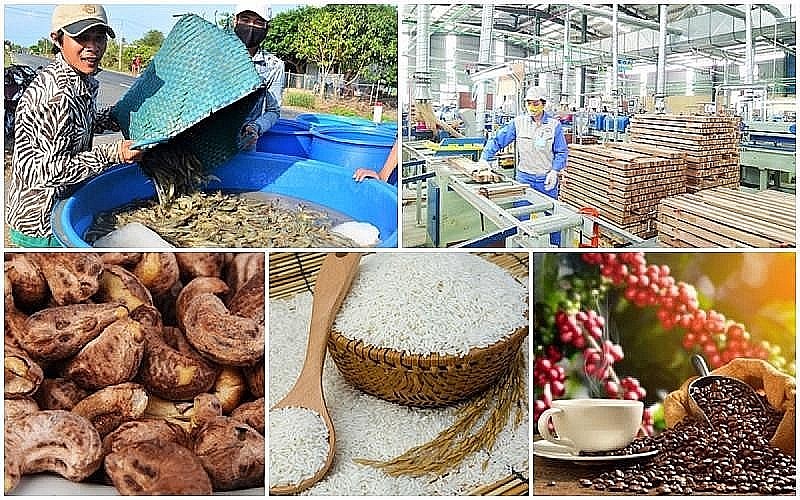 |
| Agricultural, forestry, and fisheries products are present in 180 markets. |
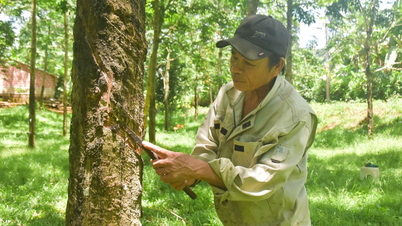
However, after 6 years of implementing Circular No. 37/2018/TT-BNNPTNT, only 2 out of the 13 key national agricultural products have been registered for protection in Vietnam: the certification mark "Vietnamese Rubber" (owned by the Vietnam Rubber Association) and the certification mark "Vietnamese Rice" (owned by the Ministry of Agriculture and Rural Development). The remaining products such as coffee, shrimp, and pangasius fish are still in the process of being registered.
Regarding the "Vietnamese Rice" certification, Mr. Le Thanh Hoa - Deputy Director of the Department of Quality, Processing and Market Development (Ministry of Agriculture and Rural Development) - informed that, in accordance with Government Decision No. 706/QD-TTg dated May 21, 2015, the Ministry of Agriculture and Rural Development has developed a rice certification mark and issued regulations on the use of the rice certification mark in Decision No. 1499/QD-BNN-CBTTNS dated May 2, 2018.
On August 9, 2018, the Ministry of Science and Technology granted the National Certification Mark Certificate "VIETNAM RICE" to the Ministry of Agriculture and Rural Development as the owner, valid for 10 years. Subsequently, the Ministry of Agriculture and Rural Development submitted an application to register the certification mark "VIETNAM RICE" internationally in over 100 countries under the Madrid System, and the application was forwarded to the World Intellectual Property Organization (WIPO). As a result, 21 countries recognized the Vietnam Rice trademark in both ordinary and certification forms.
Although the process from establishing and registering a trademark to building and developing it into a reputable and well-known brand requires considerable time, investment in human and material resources, and persistent and proactive efforts from the entity and stakeholders, the announcement of the VIETNAM RICE trademark has encountered some difficulties since 2018, leading to delays in implementation.
Firstly, regarding the management and implementation of the "VIETNAM RICE" trademark, the Ministry of Agriculture and Rural Development issued Decision No. 1499/QD-BNN-CBTTNS dated May 2, 2018, on the Regulations for the Use of the National Certification Trademark VIETNAM RICE.
According to these Regulations, Chapter II, Articles 7 and 8 stipulate national standards (TCVN) for white rice, fragrant white rice, and white glutinous rice. The regulations require that the development and application of standards or regulations for agricultural products in general, and national rice standards in particular, be assessed by a council of experts who evaluate and evaluate the technical, socio-economic, and other requirements to ensure the clear identification of theoretical and practical needs for the development of a standard/regulation.
However, specifically regarding the review of administrative procedures, on June 16, 2018, the Government Office issued Official Letter No. 5722/VPCP-KSTT stating that the regulations on the procedure for certifying the right to use the national certification mark for Vietnamese rice in the Regulations issued together with Decision No. 1499 of the Ministry of Agriculture and Rural Development contain administrative procedures and do not meet the criteria for regulating administrative procedures to be implemented (based on the Law on the promulgation of legal normative documents and Article 8 of Government Decree 63/2010/ND-CP dated June 8, 2010 on Control of administrative procedures).
Therefore, the implementation and use of the "VIETNAM RICE" trademark in the domestic market has not yet been achieved. Furthermore, because Decision 1499/QD-BNN-CBTTNS is not a legal document, it has not assigned a management unit to implement the procedures for granting permission to use the rice trademark.
Secondly, the trademark "VIETNAM RICE" is currently owned by the Ministry of Agriculture and Rural Development. Between 2019 and 2021, there were several suggestions regarding transferring ownership/management rights from the Ministry of Agriculture and Rural Development to the Vietnam Food Association.
However, according to Clause 4, Article 87 of the 2019 Intellectual Property Law, the agency/organization managing and using the certification mark must have the function of controlling and certifying products, and must not engage in production or business activities. Therefore, the transfer of ownership of the national certification mark VIETNAM RICE to the Vietnam Food Association for management and use requires amending the Association's operating charter to include the function of controlling and certifying products.
Therefore, in accordance with the Intellectual Property Law, the Ministry of Agriculture and Rural Development, as the owner of the VIETNAM RICE trademark, needs to submit to the Government a document outlining the legal framework for the use and management of the VIETNAM RICE trademark.
According to the amended Intellectual Property Law of 2022 and related laws and legal documents, the regulations on trademark registration (ordinary trademarks, collective trademarks, and certification trademarks) and geographical indications are quite clear and comprehensive.
It is evident that trademark and geographical indication registration applications for rice from localities and businesses must ensure all legal and technical requirements are met to prevent duplication or conflict with any already registered trademark/geographical indication. In practice, many agricultural trademarks/geographical indications have been successfully registered and are therefore protected by law throughout Vietnam, preventing trademark infringement such as counterfeiting or imitation of similar agricultural products.
However, subsequent investment in developing those brands into established brands has been inadequate and insufficient due to a lack of resources and a shortage of skilled branding personnel. This has resulted in unclear and incomplete promotion and communication of many brands to consumers and distribution, wholesale, and retail channels.
Therefore, it is necessary to seriously consider whether the trademark registration applications submitted by owners to the Intellectual Property Office (Ministry of Science and Technology) have followed the correct and complete procedures. Most importantly, it is crucial to invest in developing these trademarks into reputable and well-known agricultural product brands in the minds of consumers and across distribution and commercial channels.
To local brands, businesses
Meanwhile, at the business level, the course on protecting the ST25 rice brand, led by Labor Hero Ho Quang Cua, is also very challenging and costly. According to Mr. Ho Quang Cua, after ST25 rice won the award for the best rice in the world in 2019, for the past four years, his business (Ho Quang Tri Private Enterprise) has continuously had to deal with intellectual property infringement worldwide and domestically.
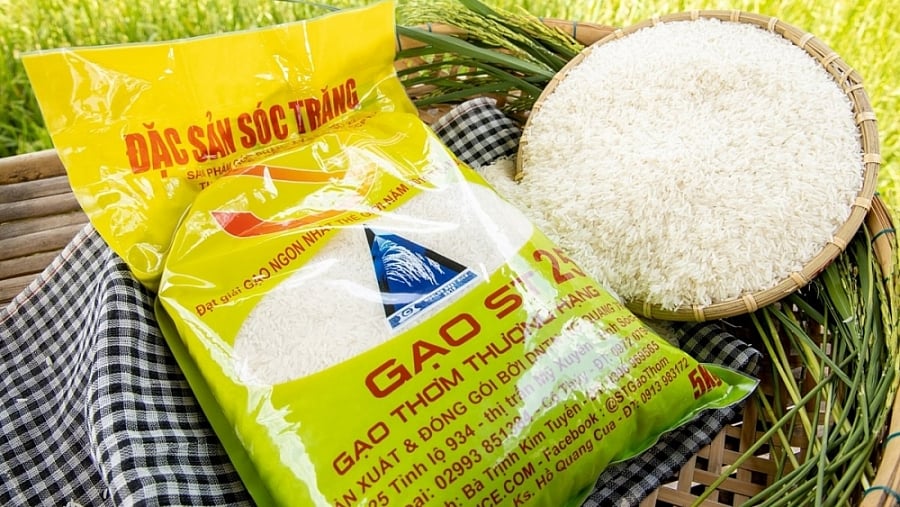 |
| Vietnam's ST25 rice wins award for best rice in the world. |
Mr. Ho Quang Cua shared that six months after ST25 won the award for the world's best rice, a company in the US registered the ST25 brand exclusively. If this move is not stopped, it means that protection from the US will spread to other countries, making it difficult for Vietnamese ST25 to appear on the global rice market.
According to Mr. Ho Quang Cua, under the guidance of the Intellectual Property Office and the Vietnamese Trade Offices abroad, it wasn't until September 2022 – 28 months from the time they registered until the application was closed – that we had to be patient and work with international lawyers and relevant parties. There were a total of 35 applications for exclusive protection of the keyword ST25, including 11 from the US, 7 from Australia, and 17 from Vietnam. They weren't trying to create a rice brand; they wanted exclusive protection for the ST25 name to resell it.
At the end of December 2023, the "battle" finally concluded when the ST25 brand was officially recognized in the US (previously recognized in the UK, EU, Hong Kong (China), China, Australia, Vietnam, etc.). Now, any Vietnamese business that registers ST25 rice products under its own name is protected in the US.
Returning to the story of the ST25 rice brand, Mr. Tran Thanh Nam - Deputy Minister of Agriculture and Rural Development - said that he himself had learned a painful lesson. The VIETNAM RICE brand, established in 2018, was recognized and protected in 2020. He wanted to apply this protection to ST25 rice to reach the global market, but many obstacles prevented him from doing so. “That is a painful waste of a brand, while businesses are scrambling to promote their own brands,” Mr. Tran Thanh Nam added.
Meanwhile, regarding the results of regional/local brand building, specifically the development of geographical indications, according to the Ministry of Agriculture and Rural Development, there are currently 130 geographical indications protected in Vietnam, including 13 foreign geographical indications and 117 Vietnamese geographical indications.
Phu Quoc fish sauce is the first geographical indication from Vietnam to be protected in Europe under strict European regulations. Currently, there are 39 geographical indications protected under the mechanism of the Free Trade Agreement between Vietnam and the EU (EVFTA), 3 geographical indications protected in Thailand (Shan Tuyet Moc Chau tea, Buon Ma Thuot coffee, Van Yen cinnamon) and 2 geographical indications protected in the Japanese market (Luc Ngan lychee and Binh Thuan dragon fruit).
Despite initial positive results, the lack of a national-level policy framework means that the management of geographical indications is delegated to local authorities, leading to inconsistencies in the issuance of management documents among different localities.
Although the State still plays a central role, the organizational and management models are very diverse. 65.7% of geographical indications are managed by the Department of Science and Technology, while the remainder are managed by district/town/city People's Committees or associations. Regulations on the control system exist only on paper and have not been applied in practice due to incompatibility with the production conditions of the products, lack of resources (financial and human) for organization and operation, and lack of participation from various sectors, especially agriculture, in control activities.
Meanwhile, the role and capacity of collective organizations are limited, lacking the capacity to participate in the organization and management of geographical indications. This leads to many difficulties in implementing geographical indication management models at the local level, with many models unable to operate in practice, and only managing to grant usage rights.
| According to Associate Professor Dr. Nguyen Quoc Thinh - Senior Lecturer in Brand Management (Faculty of Marketing, University of Commerce), building a corporate brand is the responsibility of the business itself, not of government agencies. For businesses to operate effectively, they must proactively develop and enhance their value. However, to help Vietnamese businesses stand firm in the market and build a reputable brand for both the business and the national brand, government agencies play a crucial role. |
Lesson 3: Brand Building: Experiences from Other Countries and Lessons for Vietnam
Source
































































































Comment (0)