

The thousand-year-old drum dance
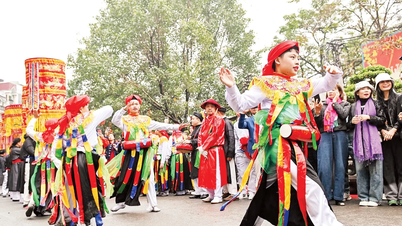
“Our village holds its traditional festival/Visitors from all over, near and far/Gather here as one family/First, to worship the Saint, then to enjoy the spring/Music blends with the ringing of bells/Phoenixes fly, dragons dance, unicorns soar…” , having just finished her introduction about her hometown, Meritorious Artist Nguyen Thi Xuyen, from the Da Trach Drum Club, Khoai Chau district ( Hung Yen province), tapped her hand on the armrest of her chair and sang the beginning of the song “Celebrating the Spring Festival” and many other traditional songs of the Da Trach village drum-singing tradition. Her lively and energetic singing filled the space with excitement and joy.
Artist Nguyen Thi Xuyen said: "It's a pity that today the club members couldn't participate in the performance so that the children could fully appreciate the beauty and charm of the 'Trong Quan' folk singing. Here, I'm singing a few examples with common rhyming rhythms to help the children visualize it, but the performance style characteristic of this type of singing is still lacking in terms of music , the number of participants, and the performance space…"
Although we didn't get to experience the traditional setting, for us—those hearing the drum-accompanied folk songs for the first time—we could somewhat imagine the vibrancy, excitement, and passion of the artists who created the soul of this thousand-year-old folk song.
The "Trống Quân" singing style is a popular call-and-response style of love song in the Red River Delta. According to legend, during the reign of King Hung III, Princess Tien Dung, while traveling along the Red River, had a fateful encounter with the poor young man Chu Dong Tu. Later, the couple, along with the local people, transformed the vast reed-covered areas and barren sandbanks into prosperous villages. Princess Tien Dung also taught the people how to cultivate rice, raise silkworms, weave cloth, and even taught them the "Trống Quân" singing style.
The "Trống Quân" folk singing style easily captivates people's hearts because of its flexible, improvisational melodies, rising and falling according to the atmosphere of the festival night. With its intimate, simple style and strong sense of community cohesion, this singing style quickly developed and became a shared cultural product of many regions. Besides Hung Yen, neighboring provinces such as Hai Duong, Bac Ninh , and Vinh Phuc also have this art form.
Compared to drum-singing in other regions, Hung Yen's drum-singing is unique in that it combines call-and-response singing with creative question-and-answer singing, requiring quick improvisation and spontaneity, pushing the performance to a climax and leaving a positive impression on both singers and listeners. Notably, in 2016, Hung Yen's drum-singing was recognized by the Ministry of Culture, Sports and Tourism as a National Intangible Cultural Heritage. This is a source of pride for the people of the "longan" homeland and also motivates each citizen to take greater responsibility in preserving this traditional folk art and culture.
The folk songs of Khuoc Village will forever resonate.
If you want to learn about the art of Cheo (traditional Vietnamese opera) and witness the performances firsthand in the "5-ton" homeland, there is one place that visitors from afar certainly cannot miss: Khuoc village, Phong Chau commune, Dong Hung district (Thai Binh province), located beside the clear blue Tuoc River.
From the moment we entered the village, we could hear the sounds of traditional Vietnamese opera (cheo) echoing from afar. Seeing our surprise, Mr. Vu Le Nham, Vice Chairman of the Khuoc Village Cheo Club, smiled and said, "Cheo singing is a specialty of Khuoc village. When they have time, from children to adults, everyone listens to and sings cheo. If you come here on a village festival day, the whole village is bustling with drums and percussion, and the cheo troupes compete to show off their skills – it's a lot of fun."
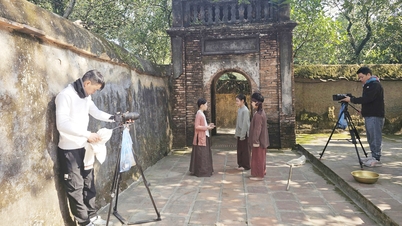
Today, tourists have come to order a traditional Vietnamese opera mat from Khuoc village, so People's Artist Bui Van Ro, Chairman of the Khuoc Village Opera Club, and its members are busily preparing in the village's ancestral temple. An opera mat is spread out in the middle of the village's cultural center courtyard. The sounds of stringed instruments, flutes, drums, cymbals, and wooden clappers begin to resound as the sounds are tested, bringing back the atmosphere of the old riverside and village courtyard.
While quickly applying makeup to be ready for the performance, artist Bui Van Ro shared, his voice filled with pride: "Khuoc Village is known as one of the seven cradles of Vietnamese Cheo (traditional opera) art. We are always proud that Khuoc Village is a village of cultural heritage, once awarded the titles 'Excellent Customs Worthy of Commendation' and 'Pure Customs and Traditions' by the imperial court. These titles are inscribed on stone tablets placed at the village temple."
According to the elders in the village, Khuoc village's traditional opera (cheo) originated very early, around the 17th century. From small troupes of a few people, Khuoc cheo entered the royal court to serve the feudal dynasty. Today, in the hustle and bustle of modern life, the people of Khuoc village no longer travel around performing with their troupes, but have formed clubs of like-minded individuals to practice this ancient culture and create new cheo pieces.
After a few minutes of preparation, the amateur actors from Khuoc village stepped onto the stage to the welcoming applause of visitors from afar. These amateur actors transformed themselves into famous characters from ancient Cheo plays, such as Thi Mau, Thi Kinh, Tu Thuc, Luu Binh, Duong Le… Watching these village artists perform, everyone could feel their genuine nature and love for traditional national art through each role.
Along with staging new plays that reflect contemporary life, Khuoc Village Cheo still preserves the essence of traditional Cheo. Ancient stories such as "Tu Thuc Meets the Fairy," "Truong Vien," "Luu Binh - Duong Le," "Quan Am Thi Kinh," "Suy Van," "Tong Chan - Cuc Hoa," etc., are admired by the people and tourists.
The people of Khuoc village love traditional Vietnamese opera (cheo), so in the cheo clubs that operate in the village, there are clubs with four generations. People's Artist Bui Van Ro said: Cheo has seeped into the blood of the people of Khuoc village. Not only do the elderly and middle-aged appreciate ancient culture, but even young children love the art of cheo and sing the ancient songs with their grandparents and parents. The people of Khuoc village can perform cheo anywhere, even in the rice fields.
Ancient folk songs endure through time.
On our journey to the lands along the Red River, what captivated us and made us reluctant to leave was the warmth of the people and the incredibly rich cultural and spiritual life, with ancient folk songs preserved and promoted since time immemorial. Among them, many forms are recognized as National Intangible Cultural Heritage, and many others have been inscribed by UNESCO as Representative Intangible Cultural Heritage of Humanity…
Hanoi, the capital city, is considered the largest center of Ca Tru (traditional Vietnamese singing) in the country, home to some of the "most beautiful Ca Tru voices in Southern Vietnam." Since Ca Tru was inscribed by UNESCO as an Intangible Cultural Heritage in need of urgent safeguarding in 2009, Hanoi has undertaken many active efforts to protect it, contributing to its removal from the list of urgently protected heritage. Today, this traditional art form has experienced a strong revival, attracting significant attention, especially from young people.
Meritorious Artist Phung Thi Phuong Hong, Head of the Ca Tru Club under the Center for the Development of Vietnamese Musical Arts (Vietnam Musicians Association), is one of those deeply committed to the art of Ca Tru. She shared: "I love Ca Tru very much. Besides actively participating in performances to directly showcase Ca Tru art, I also encourage many people to participate in preserving this intangible cultural heritage by promoting and publicizing the uniqueness of Ca Tru art on various forums."
Ca trù, also known by other names such as ả đào or đào nương ca, originates from folk songs and music combined with some folk performances and dances. It began with ritual singing at temples, celebratory singing, and funeral singing, and gradually became professionalized. The uniqueness of ca trù lies in its comprehensive art form, a diverse, sophisticated, and skillful combination of poetry, music, and sometimes even dance and performance.
This is a World Cultural Heritage site with the largest area of influence in Vietnam, spanning across 16 provinces: Phu Tho, Vinh Phuc, Hanoi, Bac Giang, Bac Ninh, Hai Phong, Hai Duong, Hung Yen, Ha Nam, Nam Dinh, Thai Binh, Ninh Binh, Thanh Hoa, Nghe An, Ha Tinh, and Quang Binh. Many villages in provinces and cities such as Hanoi, Ha Tay, Bac Ninh, Vinh Phuc, Ha Tinh, etc., are the cradles of Ca Tru folk songs.
When mentioning folk songs recognized by UNESCO, one cannot fail to mention Phu Tho Xoan singing. In 2011, Phu Tho Xoan singing was recognized by UNESCO as an intangible cultural heritage in need of urgent safeguarding. Subsequently, with the joint efforts of the entire community in preserving and promoting this ancient culture, Phu Tho Xoan singing was removed from the list of those in need of urgent safeguarding and transferred to the list of Representative Intangible Cultural Heritage of Humanity.
Ms. Nguyen Thi Thanh Hoa, a cultural officer of Kim Duc commune, Viet Tri city (Phu Tho province), said: "Xoan singing has existed for over 2,000 years and is an extremely valuable folk cultural heritage. Currently, Phu Tho still has four ancient Xoan singing troupes: Kim Doi, An Thai, Phu Duc, and Thet in Kim Duc and Phuong Lau communes, Viet Tri city. In our local development goals, we always link it with the development of traditional culture, creating opportunities for people to practice folk culture and enrich the spiritual life in each village."
Xoan singing, also known as Khuc Mon Dinh (singing at the temple gate), is a style of singing dedicated to deities, traditionally believed to have originated during the time of the Hung Kings. In ancient times, the people of Van Lang organized Xoan singing performances in the spring to welcome the new year, pray for a bountiful harvest, pray for health, and also as a form of courtship between men and women.
It can be said that, throughout thousands of years of history, the Red River has deposited fertile land, becoming a place where Vietnamese people settled and lived, forming prosperous villages. Living in peace and happiness provided the conditions for folk composers to create folk songs that embody the cultural essence of the rice-farming civilization.
Final article: Preserving and developing these sources of inspiration.
Source: https://baolaocai.vn/bai-3-lang-sau-giai-dieu-dan-ca-post399556.html






























































Comment (0)