

Folk art makes its way to the city streets.
Around 10 PM on Saturday, the Ho Guom pedestrian street was still bustling with people. In front of the O Quan Chuong gate, a group of young artists performed traditional Vietnamese opera in a new style, drawing many onlookers. Some stood, some sat, and others took out their phones to record the familiar yet novel melodies. Bui Minh Nam, 35, a tourist from Ho Chi Minh City, shared: “I’ve been to Hanoi many times, but this is the first time I’ve witnessed folk art performed so intimately. My grandchildren were also incredibly delighted with this experience.”
Beyond just traditional folk music genres like chèo, xẩm, hát văn, and quan họ, these forms are gradually emerging and integrating into the city's nightlife. At the Ô Quan Chưởng area and Kim Ngân Temple, every Friday to Sunday evening, audiences can enjoy free folk music performances organized by Hoàn Kiếm ward in collaboration with the Thăng Long Traditional Music Center. Artist Vũ Thị Hậu from the Thăng Long Traditional Music Center shared: "We hope to contribute to preserving and promoting traditional cultural values in a new way, so that folk art truly lives within the community." Associate Professor, Dr. Dương Văn Sáu, former Head of the Tourism Department, Hanoi University of Culture, commented: "The combination of traditional and contemporary culture along with creativity has created a diverse and distinctive development trend. Nighttime cultural activities in the capital are undergoing a new transformation and receiving widespread public support."
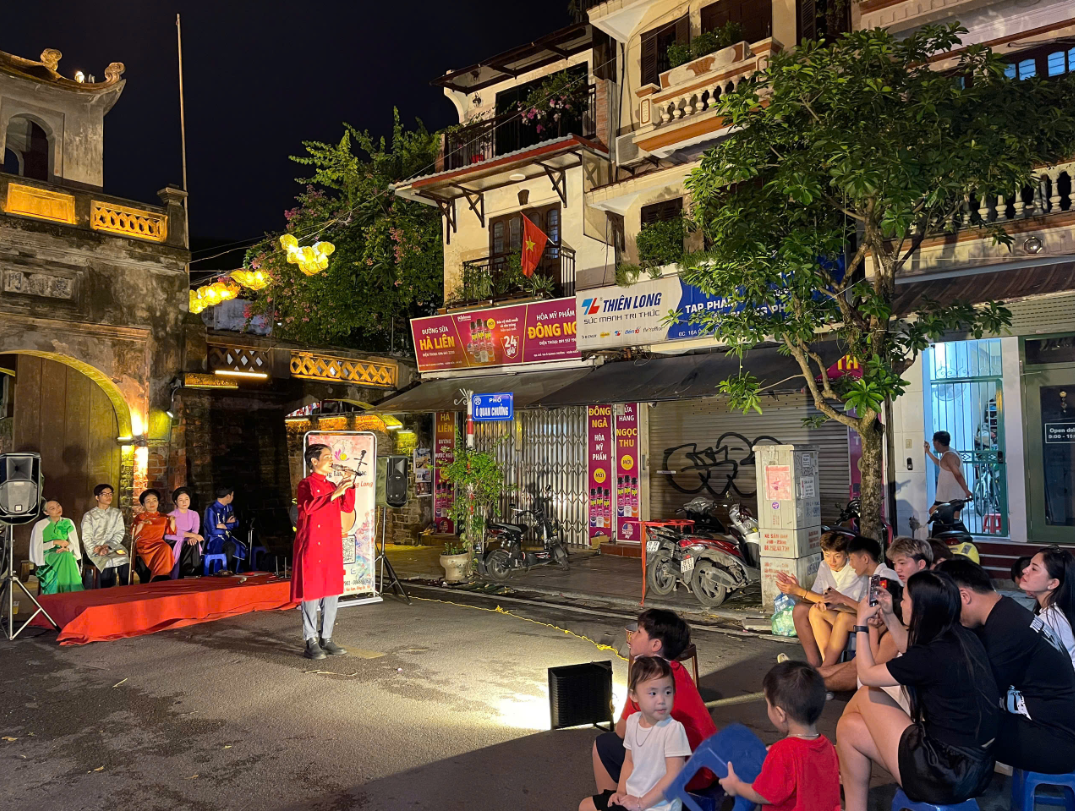 |
People enjoy traditional music performances on O Quan Chuong Street (Hoan Kiem Ward, Hanoi). |
Cultural and historical experience
Besides artistic performances, cultural and historical night tours are increasingly attracting tourists . At the Temple of Literature - National University, the "Essence of Learning" program is designed as a journey through time. Combining light shows, interactive storytelling, and staged installations, visitors experience the learning, examination, and self-cultivation paths of ancient Confucian scholars. "Hoa Lo Prison at Night" takes visitors through the chilly corridors of Hoa Lo Prison, where historical stories are retold using modern projection technology, evoking a range of emotions. Meanwhile, the "Decoding Thang Long Imperial Citadel" tour allows viewers to explore the architecture, archaeology, and cultural layers beneath the ancient Thang Long citadel...
Another important factor contributing to Hanoi's vibrant nightlife is its creative spaces and contemporary art. While not overly noisy, outdoor documentary screenings, photo exhibitions about Hanoi, poetry readings, and cultural exchanges are becoming increasingly common in open spaces like cafes and creative centers such as Manzi and Complex 01. Ms. Nguyen Thu Trang, a long-time tour guide in Hanoi, believes that: “Hanoi has a young generation who deeply love the city and want to share cultural memories in their own way. They are the driving force that keeps the nightlife alive and more attractive to international tourists.” These activities not only allow young artists to unleash their creativity but also provide opportunities for the Hanoi-loving community to participate and contribute to the overall cultural development.
Recently, the Hanoi Department of Tourism announced 20 new night tourism products aimed at celebrating major national and capital city holidays. Among them, the most notable are the "Tran Vu Bell" program – a spiritual and cultural space at Quan Thanh Temple; and the two routes, "South Thang Long Heritage Route" and "The Path of Learning," which will take visitors to a series of historical sites, temples, pagodas, and ancient villages associated with the history of education and culture of Thang Long-Hanoi. Associate Professor, Dr. Duong Van Sau stated: "These efforts show that the city identifies night culture not just as a simple tourism product but as a long-term development strategy. However, this requires synchronized investment in mechanisms, infrastructure, communication, and human resources. In particular, more substantive activities are needed to ensure the sustainable development of artists and the creative community."
Text and photos: LAM ANH
Source: https://www.qdnd.vn/van-hoa/doi-song/ban-sac-van-hoa-dem-ha-noi-849051
![[Photo] Da Nang: Mountainous commune adorned with flags and flowers, ready for election day.](https://vphoto.vietnam.vn/thumb/1200x675/vietnam/resource/IMAGE/2026/03/10/1773113803384_ndo_br_9-jpg.webp)

![[Photo] Meeting of the Standing Committee of the National Assembly Party Committee with the Standing Committee of the Government Party Committee on the First Session of the 16th National Assembly](https://vphoto.vietnam.vn/thumb/1200x675/vietnam/resource/IMAGE/2026/03/10/1773107502031_ndo_br_thu-tuong-pham-minh-chinh-va-chu-tich-qh-tran-thanh-man-dong-chu-tri-hoi-nghijpg-jpg.webp)





























































Comment (0)