

Once home to 17 families practicing traditional Dong Ho folk painting, now only three families remain in the village. Among them, the family of artisan Nguyen Huu Qua is one of the rare remaining families that still preserves the full techniques, materials, and spirit of traditional Dong Ho paintings.
Born amidst the scent of sticky rice paste, raised to the sound of pounding clams.
Born in 1963, Mr. Quả is the second son of the late Meritorious Artisan Nguyễn Hữu Sam, the tenth generation of the Nguyễn Hữu family, a family deeply connected to Đông Hồ paintings for centuries. From a young age, he was familiar with the paper drying yard, paint basins, and printing molds; by the age of seven or eight, he knew how to color and dry paintings. By the age of 12, he knew each woodblock print, understood the order of color printing, and knew that even a small deviation could ruin the harmony of the painting.
 |
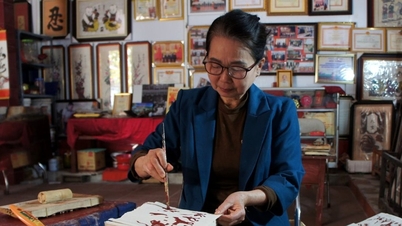
Distinguished artisan Nguyen Huu Qua meticulously applies each brushstroke of color to the gilded paper used in Dong Ho folk paintings. |
Having graduated from the University of Finance and Accounting, artisan Nguyen Huu Qua once faced the choice of pursuing a different path. However, when the Dong Ho Folk Painting Cooperative dissolved in 1990, amidst the major upheavals in the craft village, under the guidance of his father, the late Meritorious Artisan Nguyen Huu Sam, he and his wife decided to return and dedicate themselves to the family craft.
For over 30 years, despite market downturns and numerous difficulties in the painting profession, Mr. Quả and his wife have persevered, quietly creating paintings as an inseparable part of their lives.
Preserve each layer of color, each engraving.
In his time-worn workshop, amidst sheets of lacquer-coated paper and ancient woodblock prints, artisan Nguyen Huu Qua quietly maintains the rhythm of his craft using traditional methods. For him, each Dong Ho painting is not just a work of art, but the culmination of persistent and serious labor.
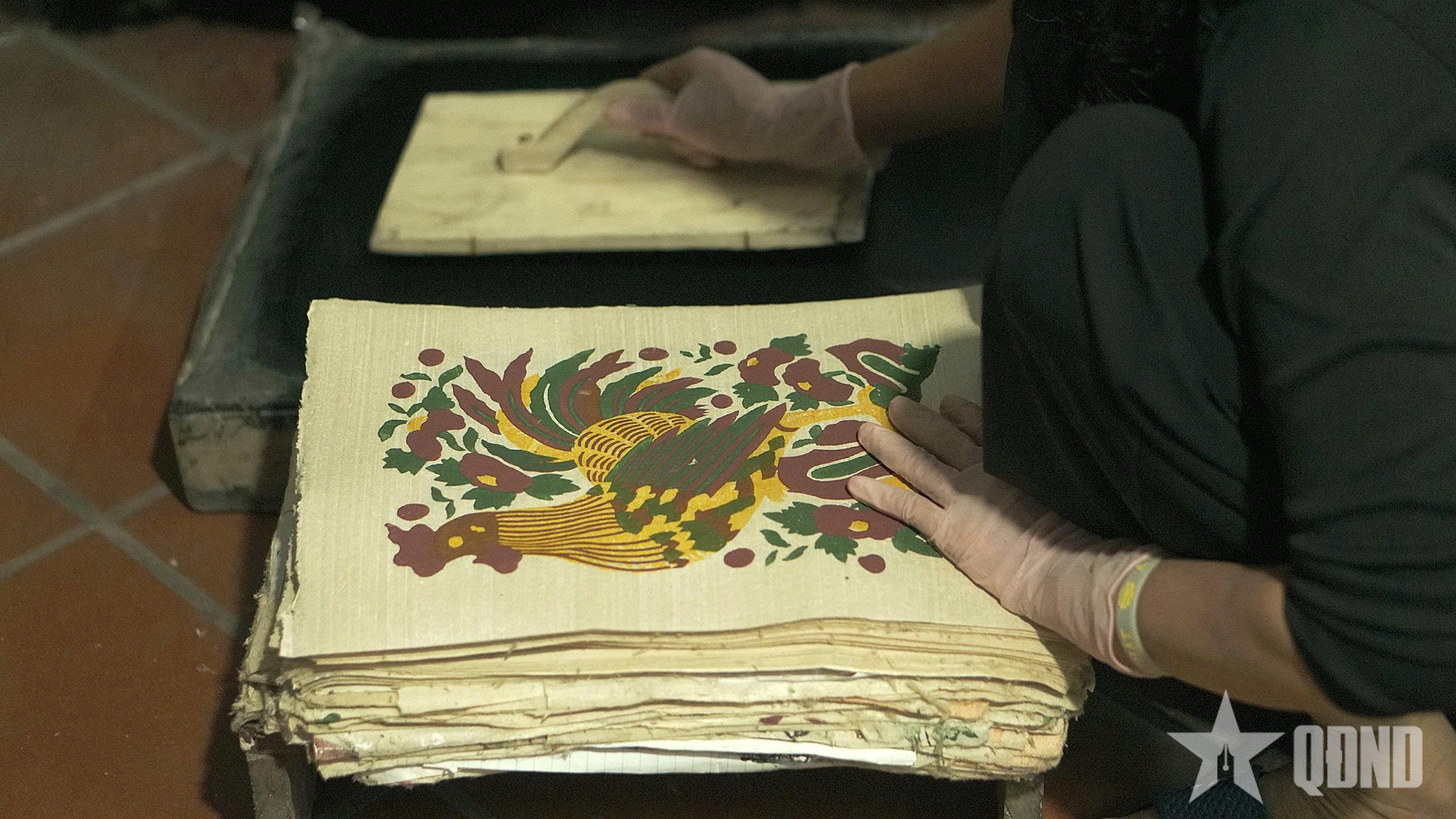 |
| Each layer of color is printed by hand, creating the distinctive effect of Dong Ho folk painting. |
According to artisan Nguyen Huu Qua, "Dong Ho paintings are printed with color first, then black outlines to define the shape. The layers of color are printed on top of each other, sometimes two or three layers, creating characteristic intermediate color tones. This effect can only be achieved with the traditional woodblock printing technique, requiring the aesthetics, experience, and skill of the artisan, thus creating the artistic value of Dong Ho paintings."
Therefore, he always believed that authentic Dong Ho paintings must first and foremost preserve their original form. He shared: "If it's called a Dong Ho painting, it must be true to the design, the materials, and the techniques. The paper must be Do paper coated with lacquer, the colors must be natural, and most importantly, it must be woodblock printed." He added that products incorporating Dong Ho paintings should only be considered a way to introduce and promote this folk art form.
 |
| Artisan Nguyen Huu Qua meticulously guides students through each step of woodblock printing. Photo: Provided by the artist. |
That spirit is clearly evident in the house where ancient woodblock prints are carefully preserved as family heirlooms, some of which have existed for hundreds of years. Besides restoring traditional prints, Meritorious Artist Nguyen Huu Qua has also created thousands of new printing molds, refreshing familiar themes such as "Returning Home in Glory" and "The Mouse Wedding," while also creating many new works, contributing to integrating Dong Ho paintings into contemporary living spaces while still preserving their folk essence.
Spreading the spirit of Dong Ho folk paintings.
Beyond simply restoring and preserving ancient woodblock prints, artisan Nguyen Huu Qua and his family are always concerned about how to ensure that Dong Ho folk paintings are not only "preserved" but also "live" in contemporary life, thereby widely promoting the quintessential values of Dong Ho painting to the public both domestically and internationally. Therefore, his family's house is not just a painting workshop but has gradually become an open cultural space where visitors can learn about the craft, listen to stories about painting, and directly observe each stage of the handcrafted woodblock printing process on dó paper coated with lacquer.
 |
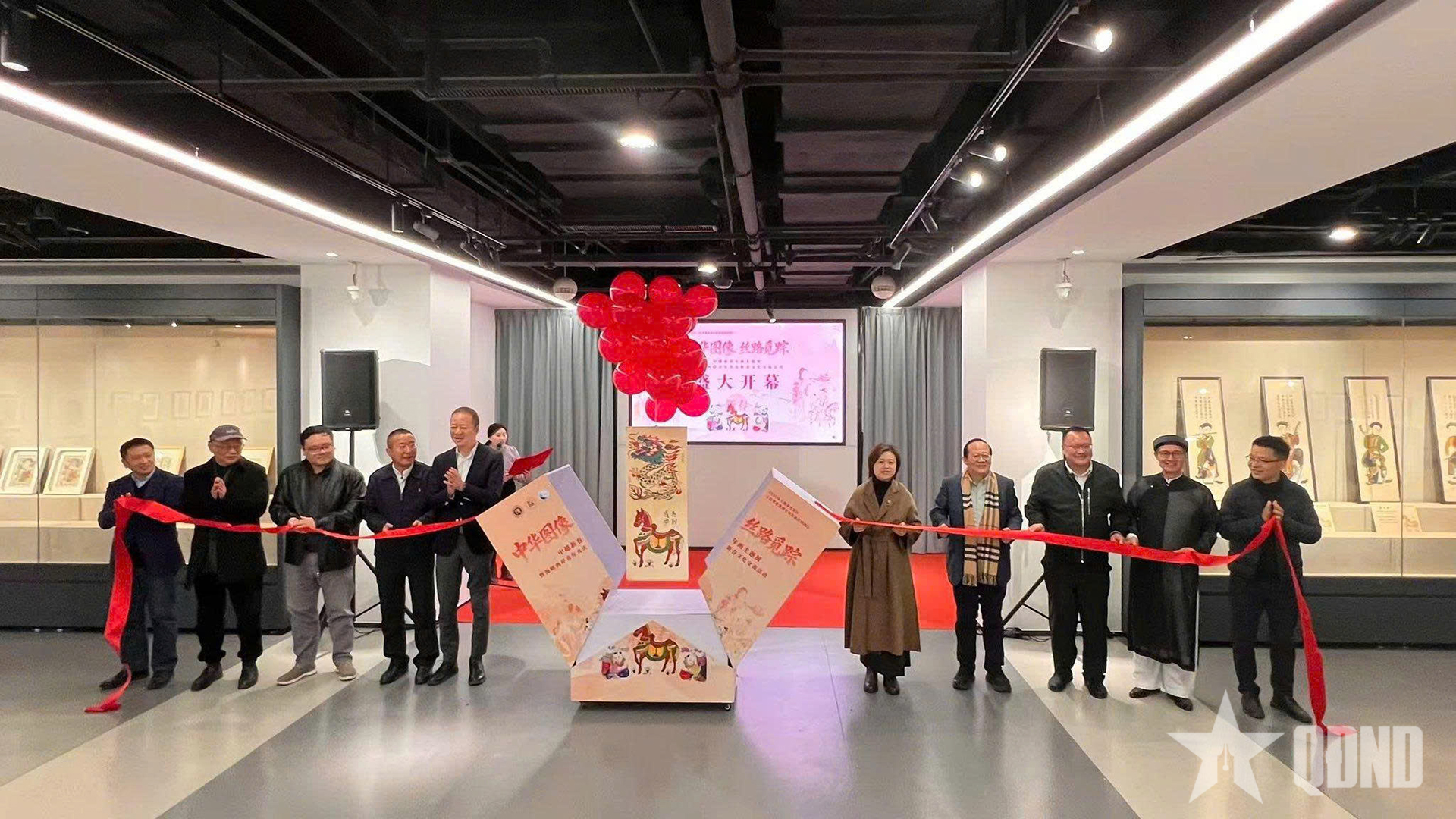 |
| Vietnamese Dong Ho Tet paintings, along with artist Nguyen Huu Qua, made a strong impression in Shanghai, China. Photo: Provided by the artist. |
He proudly stated: “I focus on introducing and conveying the value, beauty, and depth of Dong Ho paintings to the public, thereby creating a love for them and a need for their preservation, not only domestically but also internationally. In recent years, thanks to social media, many foreigners from Italy, Spain, China, and other countries have connected, learned about, and directly visited the Dong Ho painting research village.”
Besides promoting the craft, artisan Nguyen Huu Qua devotes much effort to passing on his skills to young artisans. Currently, his son, Nguyen Huu Dao (born in 1990), who has been awarded the title of artisan, is working alongside his father, continuing the traditional craft. His grandchildren also show early signs of passion, proactively learning and supporting the family in their work.
At the same time, over the years, artisan Nguyen Huu Qua has also directly guided students, university students, and domestic and international tourists in learning about Dong Ho paintings, from introducing documents and the history of their formation to practicing each stage of printing, contributing to spreading the value of this traditional craft to the community.
 |
| Young artist Nguyen Huu Dao, son of artist Nguyen Huu Qua, continues the family tradition of preserving the soul of Dong Ho folk paintings. |
Amidst the ever-changing pace of life in Dong Ho village today, the paintings are still printed daily, each brushstroke gently covering the shimmering paper, a reminder that there are values worth preserving, no matter how quickly time passes. As long as there are people like artisan Nguyen Huu Qua who hold onto their faith and passion for the craft, the heritage of Dong Ho paintings has the opportunity to live on, continuing to spread cultural values and enrich the spiritual lives of present and future generations.
Along with preserving the craft in the village, artisan Nguyen Huu Qua proactively brought Dong Ho paintings out of their traditional space through performances, workshops, and exhibitions both domestically and internationally. In 2015, his family donated 26 Dong Ho paintings to the Vietnamese Embassy in China, thereby opening up opportunities to display folk paintings (Dong Ho) in Shanghai and the Russian Federation, contributing to introducing Vietnamese folk paintings to the international community. |
Source: https://www.qdnd.vn/van-hoa/doi-song/ban-tay-gin-giu-hon-tranh-dong-ho-1019730

![[Photo] National Assembly Chairman Tran Thanh Man attends the policy seminar to promote Vietnam-Türkiye cooperation.](https://vphoto.vietnam.vn/thumb/1200x675/vietnam/resource/IMAGE/2026/04/16/1776351415367_vna-potal-chu-tich-quoc-hoi-tran-thanh-man-du-toa-dam-chinh-sach-thuc-day-hop-tac-viet-nam-tho-nhi-ky-8705791-jpg.webp)















![[Image] Bridges and roads connecting the eastern part of Ho Chi Minh City](https://vphoto.vietnam.vn/thumb/1200x675/vietnam/resource/IMAGE/2026/04/16/1776328595108_ndo_br_bh-vt5-jpg.webp)
























![[Infographic] Details of the Hanoi-Quang Ninh High-Speed Railway Project](https://vphoto.vietnam.vn/thumb/402x226/vietnam/resource/IMAGE/2026/04/16/1776338188424_anh-man-hinh-2026-04-16-luc-18-16-10.png)

![[Photo] National Assembly Chairman Tran Thanh Man meets with the Speaker of the Georgian Parliament](https://vphoto.vietnam.vn/thumb/402x226/vietnam/resource/IMAGE/2026/04/16/1776338494029_anh-man-hinh-2026-04-16-luc-18-21-21.png)










Comment (0)