


Traditional craft villages are shifting their focus.
Shifting development towards integration with tourism and cultural activities is a logical choice for restructuring the space of traditional craft villages.
Instead of focusing solely on end products, craft villages in Da Nang are expanding into experiences, showcasing techniques, and fostering direct interaction between artisans and tourists. When integrated into cultural tourism activities, craft villages not only sell products but also "sell" stories, memories, and identity.
This process creates an open space where history and culture are not only preserved as static memories but are also recreated through direct experience, and heritage is transformed into a resource for creative economic development.

The experience in Da Nang shows that this orientation is being implemented flexibly and adapted to local conditions. The collaboration of researchers, young people passionate about culture, traditional craft village owners, and cultural management agencies has facilitated the connection between preservation, creativity, and development.
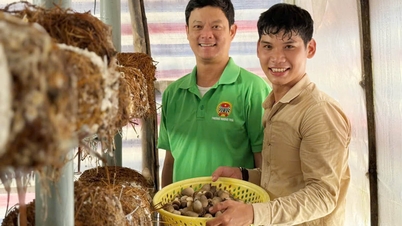
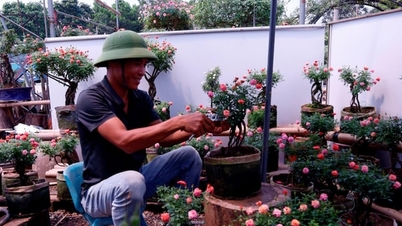
According to research by Dr. Le Ngoc Quang of Dong A University on community-based rural tourism, a survey of 97 households in Tra Que vegetable village showed that households participating in the community tourism model achieved higher incomes compared to those not participating, especially the group directly involved in production and service provision such as growing vegetables for tourism.
The benefits noted are primarily economic, manifested through increased income, boosted local economic development, expanded employment opportunities, and improved living standards for residents. Notably, the environmental impact of tourism in this case is assessed as low, contrary to the traditional view that strong tourism development inevitably leads to environmental degradation or damage.
Living cultural space
Cultural tourism transforms traditional craft villages from enclosed production spaces into open destinations, connecting the past with the present, and the local area with the global community. When craft villages are brought closer to the public, the number of people who access them increases significantly, thereby spreading awareness and cultural values more widely.

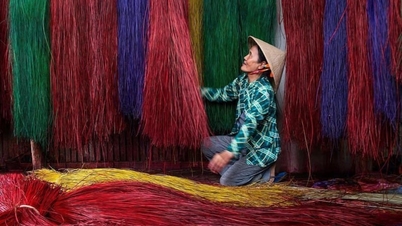
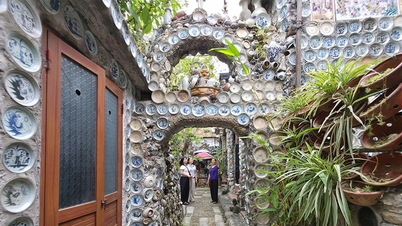
A prime example is the activities of "My Da Nang" - a community of young people passionate about local culture. From 2020 to the present, the group has organized many art exhibitions such as "Art" and "Street Vendors," vividly recreating traditional craft villages of Da Nang: Nam O fish sauce village, Tra Que vegetable village, Ban Thach mat weaving village, Thanh Ha pottery village, etc.
Combining traditional and modern art, from crafts to technology, from installations to interactive displays, craft villages are no longer confined within the administrative boundaries of a hamlet, but are expanding into urban spaces, exhibition spaces, and digital media spaces.
Expanding the craft village space in this direction increases the direct contact of tourists with the heritage. This contact goes beyond simply experiencing or consuming handcrafted products; it also involves the process of receiving emotions and understanding about the life stories of the artisans, the history of the community, and the evolution of local culture.
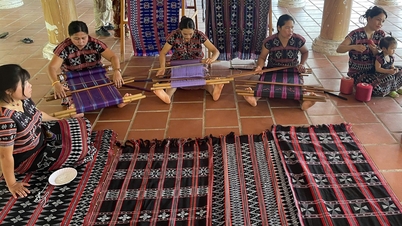
By participating in processes such as pottery making, mat weaving, or carving, tourists are no longer mere observers but become active participants in the cultural experience, thereby forming a deeper and more lasting connection with the regional identity.
Thus, when viewed as a living cultural space, craft villages can transcend the framework of traditional production and enter a new trajectory of development.
The combination of heritage preservation and cultural tourism development both sustains the livelihoods of artisans and expands opportunities for the public to access and understand the historical value of craft villages, contributing to the rediscovery of cultural layers in contemporary life.
Da Nang city currently has 30 traditional craft villages and 17 traditional crafts in operation, closely linked to the local history and cultural life.
Source: https://baodanang.vn/cham-vao-di-san-lang-nghe-3331855.html

![[Image] Nearly 125,000 Hanoi students completed the Literature exam for the 10th grade entrance exam.](https://vphoto.vietnam.vn/thumb/1200x675/vietnam/resource/IMAGE/2026/05/30/1780117233041_ndo_br_thiet-ke-chua-co-ten-2-png.webp)

















































































Comment (0)