


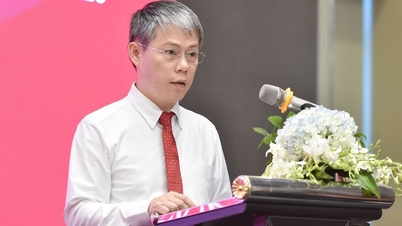
According to Mr. Le Duc Thinh, Director of the Department of Cooperative Economics and Rural Development, traditional craft villages are one of the "gold mines" for exploiting and developing socio-economic conditions in rural areas. Photo: Tran Van .
We need to reorganize the development space for traditional craft villages.
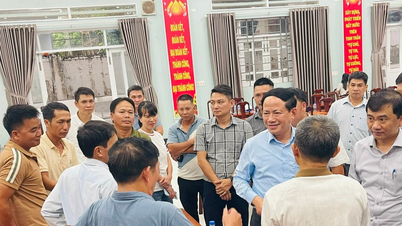
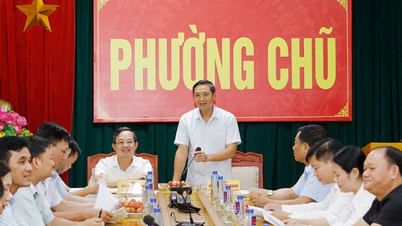
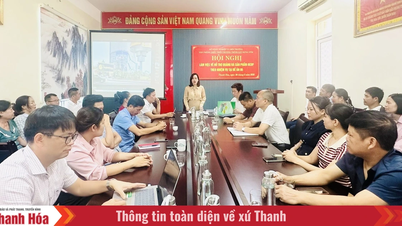
On May 27th, in Ninh Binh, the Department of Cooperative Economics and Rural Development ( Ministry of Agriculture and Environment ), in coordination with the Ninh Binh Provincial Department of Agriculture and Environment and the Vietnam Handicraft Export Association, organized a conference to provide feedback on the draft "Decree on the sustainable development of rural industries and craft villages, replacing Government Decree 52 dated April 12, 2018 on the development of rural industries".
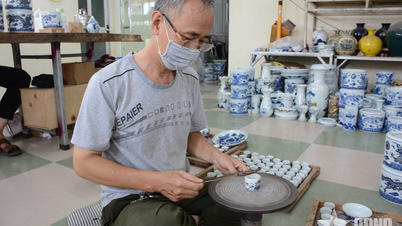
According to statistics, the country currently has thousands of craft villages, of which nearly 700 are recognized as traditional craft villages. These villages not only provide livelihoods for millions of rural workers but also preserve many unique cultural, historical, and indigenous knowledge values.
"This is one of the 'gold mines' for exploiting and developing socio-economic conditions in rural areas. In the context of the agricultural and environmental sectors facing significant growth pressures, the rural development sector and rural industries can contribute enormous value if reorganized in a modern and sustainable direction," commented Mr. Le Duc Thinh, Director of the Department of Cooperative Economics and Rural Development.
One of the key aspects of the Draft is the reshaping of the development space for craft villages, linked to environmental protection and a green economy. Accordingly, the State encourages the application of clean technologies, circular production models, environmental pollution warning systems, and efficient resource utilization. Facilities that cause pollution or pose a high risk of fire and explosion will be forced to relocate. Meanwhile, traditional crafts associated with community culture, tourism, and with minimal environmental impact will continue to be maintained within residential areas.
Mr. Thinh argued that, after more than 7 years of implementation, Decree 52 has revealed several limitations, such as: the criteria for recognizing rural occupations are now outdated, and many new occupations are no longer compatible with the old policy framework. In addition, this Decree has not yet addressed new issues such as environmental pollution, traceability, e-commerce, or post-inspection mechanisms.

Artisan Nguyen Ngoc Thach expresses his opinion at the conference. Photo: Tran Van .
Not only regulatory agencies, but also many artisans and businesses believe that the biggest problem today is the lack of organizational and quality management mechanisms within the craft villages themselves. Artisan Nguyen Ngoc Thach, from a traditional sedge weaving village, emphasized, "Without a village leader, there will be no one to manage the technical aspects or product quality. This is a matter of survival for the craft village."
According to Mr. Thach, many places currently lack technical management criteria, leading to the infiltration of counterfeit and substandard goods, seriously affecting the reputation of traditional craft villages. For example, the traditional sedge weaving craft requires many stages of raw material processing to ensure durability and prevent mold, but due to the pursuit of profit, many establishments have skipped these processes, causing customers to lose trust.
"We don't have any criteria for technical management teams in craft villages. This is a major shortcoming," Mr. Thach said.

Mr. Doan Van Lan, Director of Innovation Co., Ltd., proposed strengthening the links between traditional craft villages and experiential tourism. Photo: Tran Van .
Digital transformation to preserve the soul of traditional craft villages.
A notable new feature of the Draft is the promotion of comprehensive digital transformation in rural industries. Accordingly, a digital map of craft villages integrating cultural and tourism data will be built and connected to the market information system. Production facilities will be supported in tracing the origin and authenticating products in the digital environment, participating in e-commerce platforms, and connecting with domestic and international consumption.
Besides technology, many opinions at the conference suggested that craft villages should be placed within a broader rural economic ecosystem, encompassing tourism, trade, and raw material sources. According to Mr. Doan Van Lan, Director of Doi Moi Co., Ltd., handicrafts are not only a livelihood but also a "national culture." Based on his experience surveying many countries, he believes Vietnam needs stronger policies regarding taxation, infrastructure, credit, raw materials, and production space for craft villages.
According to Mr. Lan, the handicraft industry currently provides employment for a large number of unemployed, elderly, and disadvantaged rural workers. However, current vocational training policies still have gaps for the group of workers over 60 years old, who are heavily involved in handicraft production.
Business representatives also proposed strengthening the links between craft villages and experiential tourism. “International tourists visiting craft villages and purchasing products on-site is essentially exporting on-site. Furthermore, the draft regulations for the first time clearly stipulate a post-recognition inspection mechanism for craft villages and traditional crafts. Titles will be revoked if operations cease for an extended period, cause serious environmental pollution, or involve fraudulent documentation,” Mr. Lan stated.
Notably, the draft includes provisions for honoring artisans in rural crafts. Those with at least 10 years of practice, possessing traditional secrets, and contributing to the transmission of knowledge will be given priority in receiving support for intellectual property, digital skills, trade promotion, and experiential tourism development.
On behalf of the Department of Cooperative Economics and Rural Development, Mr. Thinh emphasized, "the new decree is not only a document managing rural industries, but also an important institutional framework for transforming the rural economic development model from small-scale and fragmented to an innovative, green, digital economy that is linked to national cultural identity."
Source: https://nongnghiepmoitruong.vn/xay-dung-khung-the-che-moi-cho-lang-nghe-d813493.html

![[Photo] The courage of new recruits of Brigade 144 on the training ground.](https://vphoto.vietnam.vn/thumb/1200x675/vietnam/resource/IMAGE/2026/05/27/1779881651341_anh-man-hinh-2026-05-27-luc-18-32-52.png)

![[Photo] General Secretary and President To Lam and his wife begin their official visit to Thailand.](https://vphoto.vietnam.vn/thumb/1200x675/vietnam/resource/IMAGE/2026/05/27/1779881249412_anh-man-hinh-2026-05-27-luc-18-10-51.png)



















































![[Photo] The courage of new recruits of Brigade 144 on the training ground.](https://vphoto.vietnam.vn/thumb/402x226/vietnam/resource/IMAGE/2026/05/27/1779881651341_anh-man-hinh-2026-05-27-luc-18-32-52.png)
























Comment (0)