

In South Korea, demand for attending universities "branded as Seoul" remains high, even though families have to spend up to five months' income to support a student for a year.
In Seoul, the high cost of education is a burden for most families. A report from the South Korean Ministry of Education in late April indicated that the average student in urban areas pays 7.7 million won in tuition fees per year (approximately 142 million VND), 20% higher than in other regions.
According to statistics from Decent News , an educational magazine, most prestigious universities in Seoul, such as Korea University, Hanyang University, and Sungkyunkwan University, charge tuition fees exceeding 8 million won per year. Yonsei University, in particular, charges over 9 million won. Including rent and living expenses, a student needs more than 24.3 million won per year.
Meanwhile, data from the Korean Statistics Office shows that the average household income in the second quarter of 2023 was 4.79 million won per month. To support a university student in Seoul for a year, a family would have to spend more than five months' income. This figure makes a university degree in Seoul a luxury for many.
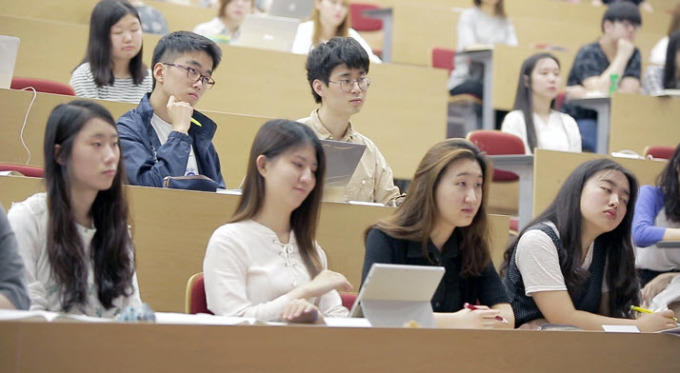
Students at Seoul National University, South Korea. Photo: SNU
Despite rising tuition fees and living costs in the capital, the appeal of Seoul universities remains undiminished.
According to statistics from the Korean Council for Higher Education in 2021, out of a total of 162 universities that failed to enroll enough students, less than 10% were located in Seoul. While many local universities risk closure due to low enrollment numbers, Seoul universities still received many times more applications than their quotas.
"Degrees from universities with Seoul branding are still considered more prestigious than those from other places, regardless of the major," said Kim Kyu Seok, head of admissions for the New York University System in Korea.
He said that the increasingly developed industrial economy in the Seoul metropolitan area has led many to believe that studying there will provide them with more job opportunities after graduation, as well as keeping them up-to-date with current trends.
According to John Lie, a professor of Sociology at the University of California-Berkeley, another reason is that most of the prestigious universities are located in the capital. Of the top 10 most prestigious universities in South Korea in 2024, according to the Times Higher Education ranking, seven are based in Seoul.
"Seoul is home to many elite universities, so by extension, people get the impression that any university in Seoul is better than those in other areas," he said, arguing that this is a misconception. He cited the world-renowned Korea Advanced Institute of Science and Technology (KAIST) located in Daejeon province as an example.
Many other prestigious universities, such as Pohang University of Science and Technology and Ulsan National Institute of Science and Technology, are also not located in Seoul, and their tuition fees are only around 5-6 million won per year.
The influx of students to Seoul is one of the reasons why local universities are suffering heavy losses, despite offering various incentives to attract students, such as free computers or tuition waivers for the first semester.
In 2021, Busan National University admitted over 4,500 students, but 83.7% of those admitted did not enroll. A similar situation occurred at Kyungpook National University in Daegu, where the rate was nearly 87% of the 4,300 students admitted.
Phuong Anh (According to Times Higher Education, Korea Jookang Daily )
Source link
![[Photo] National Assembly Chairman Tran Thanh Man attends the policy seminar to promote Vietnam-Türkiye cooperation.](https://vphoto.vietnam.vn/thumb/1200x675/vietnam/resource/IMAGE/2026/04/16/1776351415367_vna-potal-chu-tich-quoc-hoi-tran-thanh-man-du-toa-dam-chinh-sach-thuc-day-hop-tac-viet-nam-tho-nhi-ky-8705791-jpg.webp)

















![[Image] Bridges and roads connecting the eastern part of Ho Chi Minh City](https://vphoto.vietnam.vn/thumb/1200x675/vietnam/resource/IMAGE/2026/04/16/1776328595108_ndo_br_bh-vt5-jpg.webp)

























![[Infographic] Details of the Hanoi-Quang Ninh High-Speed Railway Project](https://vphoto.vietnam.vn/thumb/402x226/vietnam/resource/IMAGE/2026/04/16/1776338188424_anh-man-hinh-2026-04-16-luc-18-16-10.png)

![[Photo] National Assembly Chairman Tran Thanh Man meets with the Speaker of the Georgian Parliament](https://vphoto.vietnam.vn/thumb/402x226/vietnam/resource/IMAGE/2026/04/16/1776338494029_anh-man-hinh-2026-04-16-luc-18-21-21.png)



















Comment (0)