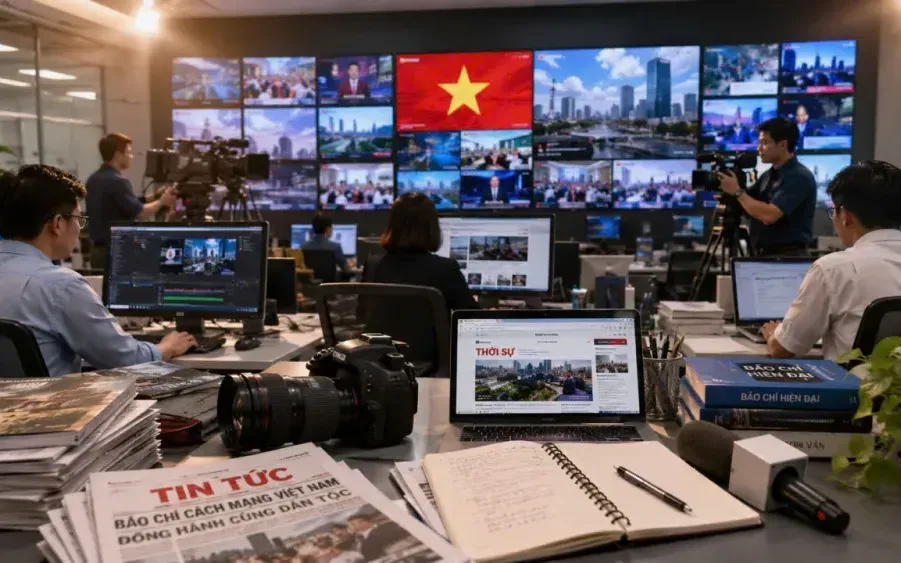
This tradition is not only a heritage to be preserved but also a reminder to every journalist to always be aware of their responsibility to the Fatherland, the People, historical truth, and the destiny of the nation. The value of revolutionary journalism is affirmed by the courage, political responsibility, and strict standards that writers themselves set for themselves.
It must live up to the name of Revolutionary Journalism.
After 101 years of formation and development, the word "revolutionary" in Vietnamese revolutionary journalism is not only a source of traditional pride but also affirms its political nature, ideals of service, and historical responsibility towards the country and its people. This is not a designation for the past, but a standard for each generation of journalists to constantly reflect on and improve themselves.
From the moment President Ho Chi Minh founded the Thanh Nien (Youth) newspaper in 1925, journalism was defined as a tool serving the revolutionary cause, taking the interests of the nation, the people, and the country as its guiding principles. Therefore, the core value of revolutionary journalism lies in truthfully reflecting reality, accompanying the people, and contributing to the development of the country.
Revolutionary character is not determined by name or tradition, but must be reflected in the information orientation, respect for truth, and social responsibility of each work. When journalism chases sensationalism, attracts readers, or pursues narrow interests, it will lose credibility and stray from its inherent nature.
In the context of digital media and increasingly fierce information competition, journalists must uphold their political integrity, professional ethics, and sense of responsibility. Only by always placing the nation, the people, and the truth above all else can journalism continue to live up to its glorious tradition and mission.
We must stand alongside the major issues facing the country.
The essence of revolutionary journalism is its connection to the nation's destiny; therefore, journalists cannot remain detached from the country's major issues. In the face of crucial moments, strategic policies, or developmental challenges, the press needs to demonstrate commitment, responsibility, and action; indifference or avoidance will diminish its social role and contradict the profession's mission.
To stand alongside the nation means, first and foremost, to stand alongside reality. Journalists must stay close to life, listen to the people, and truthfully reflect the achievements, difficulties, and aspirations for development in order to spread the spirit of innovation, encourage positive values, and inspire the will to strive for progress.
The press also needs to actively participate in political, economic , cultural, and social currents through its role in providing information, analysis, and connection, creating a forum for dialogue between citizens, experts, and government agencies, thereby strengthening social consensus and promoting national unity.
In the digital age, journalism must not only reflect but also guide public opinion with verified, objective, and responsible information. Especially in the face of complex issues, mainstream journalism needs to lead with speed, accuracy, and transparency, contributing to building trust and finding solutions to the country's common problems.
We must take the lead in explaining and shaping public opinion.
In the digital age, where information spreads by the second and social media creates instantaneous public opinion, revolutionary journalism cannot simply report after events occur. It must proactively provide accurate information, explain policies, analyze the nature of issues, and guide public perception. The timely presence of mainstream journalism is crucial in preventing fake news, speculation, and misinformation that disrupt public opinion.
Being ahead of the curve isn't just about speed, but also about being accurate, comprehensive, and persuasive. The press needs to quickly identify issues of public concern, reflect people's sentiments, provide verified information, and create a space for constructive dialogue. Simultaneously, explaining policies and guidelines in clear, scientifically-based language will help bridge the gap between policy decisions and reality, strengthening social consensus.
In a multi-faceted media environment, shaping public opinion is not about imposing one's own way of thinking, but rather about helping the public access the truth through accurate information, objective reasoning, and comprehensive analysis. Through this, journalism contributes to improving the ability to distinguish between true and false information, and increasing society's resistance to harmful information.
Therefore, revolutionary journalism not only reflects reality but also has the responsibility to guide public perception with truth, reason, and a sense of responsibility, contributing to strengthening public trust, enhancing social consensus, and creating a foundation for the sustainable development of the country.



We must be courageous and brave in defending the truth for the development of the nation.
Courage and integrity are core qualities of a revolutionary journalist. This includes not only unwavering political stance but also the ability to maintain honesty, objectivity, and professional responsibility in the face of all pressure, always prioritizing truth and the interests of the people above personal gain.
Courage in journalism is not about creating confrontation or exploiting controversy for attention, but about daring to defend what is right, speaking out on necessary issues, and persistently pursuing the truth with a constructive spirit. Every journalistic work must be based on credible evidence, reflect truthfully and impartially, and not be influenced by prejudice or vested interests.
When uncovering negative issues or shortcomings, the press needs to reflect them objectively, contributing to promoting transparency, strengthening discipline, and enhancing social trust. At the same time, protecting the truth requires a comprehensive perspective, avoiding both glorifying achievements and exploiting negative aspects in a biased or sensationalist manner.
More importantly, the ultimate goal of journalism is not criticism but construction and creation. Fighting against wrongdoing to protect what is right, pointing out shortcomings to improve, and reflecting the truth to strengthen trust and create momentum for the sustainable development of the country are the highest expressions of the character and social responsibility of revolutionary journalists.
We must maintain the integrity of a revolutionary journalist in the face of all external pressures and influences.
In the context of globalization and the explosion of digital media, revolutionary journalists face numerous pressures regarding information, ideology, and economic interests. Therefore, maintaining political integrity, independent thinking, and unwavering commitment to serving the Fatherland and the People are crucial requirements.
This integrity is demonstrated by not chasing trends or unverified public opinion, but always analyzing and evaluating events based on facts, reason, and social responsibility. Only with a firm stance and independent thinking can the press effectively fulfill its role of guiding and shaping public opinion.
In the digital economy, despite increasing pressure for views and engagement, the value of journalism must still be affirmed by its reliability, accuracy, and positive contributions to society. Chasing sensationalism, attracting readers, or prioritizing algorithms over truth will diminish the educational, critical, and guiding functions of revolutionary journalism.
Maintaining integrity also means selectively absorbing international knowledge and experience, ensuring a balance between integration and preserving national interests and identity. Above all, journalists must be loyal to the truth, national interests, and the legitimate rights of the people, upholding professional ethics and independence in the face of all pressure. This is the foundation for the Vietnamese Revolutionary Press to continue playing a pioneering role on the ideological and cultural front in the new era.
We must spread goodness and ignite national aspirations.
The mission of revolutionary journalism is not only to reflect reality but also to contribute to building positive values in society. Every journalistic work should be carried out with a sense of responsibility, aiming to nurture faith, inspire dedication, and spread goodness, rather than chasing sensationalism or fleeting attention.
Spreading positive values does not mean avoiding limitations, but rather knowing how to properly honor ordinary role models, kind actions, innovative models, and individuals who quietly contribute. Upholding human values contributes to building a healthy social environment and inspiring the community.
The press also has the responsibility to inspire patriotism, national pride, and the aspiration for development by reflecting on the achievements of innovation, historical lessons, community initiatives, and people who dare to think and act. Through this, the press contributes to fostering self-reliance and motivation for building and defending the nation.
In a context of conflicting information, public trust must be built on truthful, objective, and in-depth information, not on sugarcoating the reality. Therefore, spreading positive values and inspiring national aspirations is a social responsibility and core value of revolutionary journalism, contributing to strengthening trust and creating momentum for the sustainable development of the country.
We must maintain a leading role on the ideological and cultural front.
In the context of rapidly developing digital media, where every individual can become a source of information dissemination, the role of revolutionary journalism becomes even more important. The value of mainstream journalism lies not in the advantage of monopolizing information, but in its ability to provide verified content, objective analysis, and to serve the common good of the country. It is professionalism, responsibility, and reliability that form the foundation for journalism to maintain its leading position on the ideological and cultural front.



To fulfill that role, journalism needs not only speed but also accuracy and depth. In the competition against fake news and misinformation, speed must go hand in hand with rigorous verification, multi-faceted analysis, and persuasive argumentation. Only by creating distinctive value in terms of quality and depth can mainstream journalism maintain trust and influence with the public.
Maintaining a mainstream role also requires the press to proactively protect the nation's fundamental values, strengthen social consensus, and refute misinformation with facts, evidence, and a spirit of responsible dialogue. The strength of the press does not come from imposing its views but from its ability to persuade the public through transparency and credibility.
More importantly, mainstream status is not an inherent privilege but the result of innovation and self-improvement. Every media organization and journalist needs to constantly enhance their expertise, master technology, innovate their communication methods, and strengthen interaction with the public, while remaining steadfast in professional ethics and social responsibility.
Ultimately, the strength of revolutionary journalism is measured by the people's trust. By consistently standing with the nation, defending the truth, and striving for the common good, journalism will continue to uphold its leading role on the ideological and cultural fronts and make practical contributions to the sustainable development of the country.
Over a century of formation and development has affirmed that the Vietnamese Revolutionary Press is not only a media institution, but also an important part of the ideological and cultural front, always accompanying the turning points of the nation. The core value of this press lies not in the speed of news delivery or the reach of technology, but in political acumen, a spirit of service, loyalty to the truth, and responsibility to the Fatherland and the People.
In the context of digital transformation and increasingly fierce information competition, the mission of journalists becomes even more challenging but also glorious. Revolutionary journalism must lead the way in identifying and explaining life's issues, persistently defending the truth, spreading positive values, strengthening social trust, and inspiring aspirations for national development. To achieve this, every writer must constantly cultivate their professional ethics, expertise, and innovative thinking, so as to both master modern technology and uphold the fundamental principles of journalism.
Ultimately, the strength of revolutionary journalism is not measured by the number of views or the level of media attention, but by its ability to build trust, guide public opinion, and contribute to the sustainable development of the nation. By always placing the interests of the country and its people above all else, remaining steadfast in its pursuit of truth, and constantly innovating to meet the demands of the times, revolutionary journalism will continue to live up to its glorious tradition and fulfill its noble mission in leading the nation steadily into the future.
Source: https://vtv.vn/bao-chi-cach-mang-phai-dong-hanh-cung-dan-toc-100260627081141444.htm










































![[Photo] Thousands of people participate in a run to show their support for the campaign "Sharing a common determination to build drug-free communes, wards, and special zones".](https://vphoto.vietnam.vn/thumb/1200x675/vietnam/resource/IMAGE/2026/06/27/1782554475933_0673e2a3df7b5e25076a-8283-jpg.webp)