

Negative phenomena exist in every era and in every part of society; they only vary in magnitude, severity, and frequency. This is similar to the natural and social law of the unity of opposites: yin and yang, good and bad, virtue and vice, black and white, hot and cold…
In the early years of the country's reform process, there were even articles by prominent figures in the fight against corruption. Two examples are the two "veterans" of the reform era: the late General Secretary of the Central Committee Nguyen Van Linh and the late Standing Member of the Party Secretariat Dao Duy Tung, who for a relatively long time was assigned by the Party to oversee ideological and theoretical work.
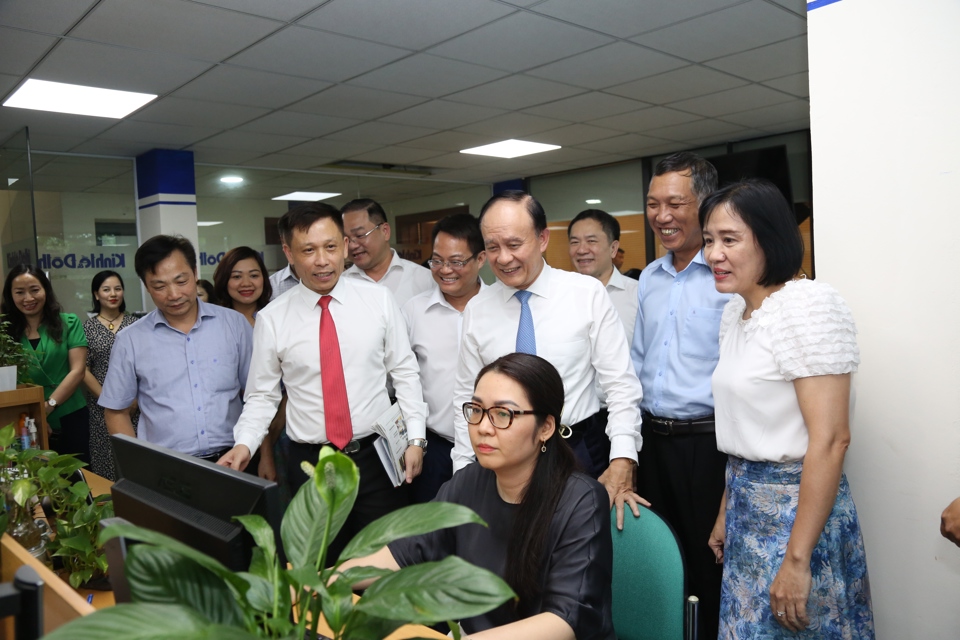
The late General Secretary Nguyen Van Linh was one of the most famous figures, known for his articles under the pseudonym NVL published in the "Things That Need to Be Done Immediately" section of the Nhan Dan newspaper in the late 1980s (31 articles, published from May 25, 1987 to September 28, 1990).
Regarding this pseudonym, initially many people guessed that NVL was the abbreviation of "Nguyen Van Linh"; some speculated that NVL stands for "Speak and Do"; and quite a few believed it meant "Jump into the Fire," because those articles touched upon the fight against corruption, that is, stirred up fires that were already burning.
Those articles truly caused a great stir at the time. Before and around that time, among artists and writers, there was also a saying by Comrade Nguyen Van Linh: "Untie yourself before God saves you." That saying did not make as much of an impression as the articles by author NVL.
At this time, the Nhan Dan newspaper "scored points" because of that appeal. Why? Because Comrade Nguyen Van Linh had early on recognized the diseases of corruption, waste, and bureaucracy that were hindering the rapidly advancing reform process.
Comrade Nguyen Van Linh's pen created a new wave of vitality in society: fighting corruption; promoting democracy, transparency, clarity, frankness, and truthfulness; and encouraging the press to actively participate in combating corruption.
The impact of NVL's articles conveyed a message to the revolutionary Vietnamese press: journalists must be courageous, dare to speak frankly and truthfully; their style of expression must be concise, easy to understand, and engaging; the press must be a forum for expressing the aspirations of the people; journalists must be honest, dedicated to their profession, upright, and love what is right, good, and virtuous; they must hate what is wrong, bad, and evil.
Those articles inspired the revolutionary Vietnamese press to venture into this challenging field.
Now, on the occasion of the 99th anniversary of Vietnam's Revolutionary Press Day (June 21, 2024), looking back at the articles of the late General Secretary Nguyen Van Linh, we can see glimpses of the journalistic style of the master revolutionary journalist Ho Chi Minh in three key points: articles must be concise; provide necessary and complete information according to the topic; and be written in a way that is engaging to the reader.
The guarantee of the newspaper's principles and objectives lies right there, nowhere else! Commercialization is never permitted; only articles that benefit the nation and its people are allowed.
Comrade Nguyen Van Linh learned three things from President Ho Chi Minh – things that are very simple but require very high standards, sometimes becoming a "difficult problem" for many journalists today, a lesson they may never fully grasp if their hearts are not pure, they lack ambition and courage, and they are negative, chasing after money and readily bending the pen.
Comrade Dao Duy Tung's case was different. The difference lay in his approach compared to Comrade Nguyen Van Linh. One wrote for newspapers, the other wrote for "the press." Comrade Dao Duy Tung was not only a magazine writer, but also a manager on the ideological and theoretical front.
On the ideological front, Comrade Dao Duy Tung had extensive experience and made significant contributions. He held positions such as Deputy Director and Director of the Training Department of the Central Party Propaganda Committee, Deputy Head and Editor-in-Chief of the magazine "Learning" (now the Communist Magazine), Director of the Institute of Marxism-Leninism, and Head of the Central Party Propaganda Committee.
Comrade Dao Duy Tung was elected to the Central Committee of the Party for four consecutive terms (the 4th, 5th, 6th, and 7th Congresses), in which he was elected a member of the Politburo and Secretary of the Central Committee for two of those terms. These positions defined Comrade Dao Duy Tung's responsibilities, as demonstrated in his well-structured, logical, and emotionally persuasive political essays, especially those specializing in ideological and theoretical work throughout the country.
Throughout his 30 years of ideological and theoretical work, Comrade Dao Duy Tung proved to be a sharp writer in the field of journalism; at the same time, in his professional capacity, he always paid attention to the Party's leadership, the State's management, and the work of all levels of government in the field of journalism, caring for the lives and creating all possible conditions for the ideological, theoretical, and journalistic cadres to carry out their work.
Comrade Dao Duy Tung's journalistic career was built on the foundation of promptly grasping and summarizing practical issues, meeting the requirements of the reform process. Partial reforms, groundbreaking actions at the grassroots level, and opinions that, if not listened to, surveyed, researched, and summarized, would make it impossible to formulate correct policies and guidelines.
Information from practical experience is invaluable material for formulating policies; therefore, Comrade Dao Duy Tung established specialized units for information and press work within the Party's committees, diversifying information, expanding transparency, emphasizing honesty and responsiveness, and bringing the voice of the people and the realities of life into the leadership and management activities of the country's political system.
Comrade Dao Duy Tung's journal articles provided a scientific and practical basis for perfecting the Party's guidelines and policies, and the State's laws and regulations, contributing to concretizing, supplementing, and developing our country's path to socialism.
Alongside praising what is good and right, Comrade Dao Duy Tung also emphasized using the press to criticize evil, wrongdoing, corruption, and bureaucracy; to criticize those with sinister intentions, those who spread doubt and distort history, and those who misrepresent the Party and State's policies and guidelines.
The press not only reflects social reality but also has the responsibility to guide public opinion in the right direction regarding every event and issue, both domestically and internationally.
According to Comrade Dao Duy Tung, journalists (both managers and writers) must have a simple, approachable, honest, and humble style; they must be imbued with a principled approach to innovation; they must know how to listen to and respect those they engage with, encouraging discussion to find the truth; and they must be vigilant against evil forces that exploit democracy and political opportunism.
Therefore, we must resolutely and persistently fight against all manifestations of political opportunism and against forces that betray the revolutionary cause of the Party and the People.
Source: https://kinhtedothi.vn/bao-chi-chong-tieu-cuc-ban-linh-sac-ben.html


![[Photo] General Secretary and President To Lam presides over a meeting on assessing national development resources.](https://vphoto.vietnam.vn/thumb/1200x675/vietnam/resource/IMAGE/2026/05/20/1779253785852_a1-bnd-2943-8519-jpg.webp)


![[Photo] National Assembly Chairman Tran Thanh Man working with the Standing Committee of the Economic and Financial Committee](https://vphoto.vietnam.vn/thumb/1200x675/vietnam/resource/IMAGE/2026/05/20/1779249584387_ndo_br_1-jpg.webp)



























































Comment (0)