

On the occasion of the 100th anniversary of Vietnamese Revolutionary Journalism (June 21, 1925 - June 21, 2025), Mr. Vinod Moonesinghe, Director of the Marxist Institute (Sri Lanka), offered insightful assessments of the role and enduring value of Vietnamese revolutionary journalism in the present and future context.
In an interview with a VNA reporter in South Asia, Mr. Vinod Moonesinghe stated that the Fourth Industrial Revolution, based on digital technology , is accelerating rapidly thanks to the remarkable development of artificial intelligence (AI).
Similar to how word processing technology completely revolutionized printed text in the 1980s and the Internet fueled the mass media boom in the early 2000s, AI is profoundly changing the field of journalism.
In this process, the press and journalists play a crucial role: bridging the gap between modern technological advancements and the public, while ensuring that information is conveyed accurately, ethically, and with depth.
According to Moonesinghe, these new technologies open up many opportunities for journalists, improving efficiency, as AI-powered tools automate repetitive tasks such as note-taking, fact-checking, and data analysis, allowing journalists to focus on in-depth investigations.
AI also assists in analyzing big data—something humans would find difficult to do manually—to identify trends and provide new perspectives.
News organizations can personalize content and enhance reader engagement by tailoring news to individual preferences.
Automatic translation and speech-to-text technologies also contribute to expanding access to information.
However, along with the opportunities come numerous challenges, most notably ethical issues such as misinformation, bias, and accountability for AI-generated content. AI tools sometimes provide inaccurate information.
Another worrying issue is the trend of entertainment-izing news, obscuring the true function of media. Transparency is also being questioned, especially as AI systems obscure sources and editorial decisions, potentially eroding public trust.
Furthermore, as many jobs become automated, journalists' career opportunities may decrease, requiring them to undergo extensive retraining to adapt. Unequal access to AI technology and retraining opportunities across regions can also create inequality.
The future of journalism likely lies in a combination of AI efficiency and human creativity. Therefore, journalists need to approach AI as a powerful supporting tool, while simultaneously maintaining ethical standards and human oversight.
However, in reality, maintaining this balance is not easy, especially in a high-pressure environment.
Regarding digital transformation in journalism, Mr. Moonesinghe believes that it is no longer simply a trend, but has become a reality encompassing the entire industry.
Newsrooms today have become technology hubs, combining AI with dynamic storytelling on mobile platforms, redefining how stories are told, shared, and received.
Journalists frequently need to update information in real time from the scene using smart devices.
Virtual reality (VR) and augmented reality (AR) technologies enable the public to experience information in a vivid and interactive way. Data analysis and reader feedback are gradually shifting the focus of journalism from "information delivery" to "dialogue" with the public.
These changes do not replace journalism but rather help it reach further, enhance its effectiveness, and connect with readers. While journalistic tools change, the core mission of journalists – reflecting the truth and serving the public – remains unchanged.
In today's context, journalists need to be proficient in technology. They need to understand digital tools such as data visualization, AI-powered research, and multimedia editing skills.
Collaboration with technology engineers, designers, and data experts is essential. Alongside this, professional ethics and credibility are becoming key factors in an era flooded with fake news and content manipulation. Upholding integrity is a core value of modern journalism.
The Director of the Institute of Marxist Studies noted that from the early days of the resistance against colonialism, the revolutionary press in Vietnam was not merely a record-keeper of history. Accompanying the Vietnamese people, the press became a powerful driving force in the struggle for national independence, the building of socialism, and the pursuit of prosperity. The press played an essential role in protecting the homeland and shaping the country's future.
Since President Ho Chi Minh founded the Thanh Nien (Youth) Newspaper in 1925, revolutionary journalism has become the voice of the revolutionary masses. As a sharp ideological weapon, the press has propagated revolutionary ideals and called on the entire nation to unite and rise up.
During the wars against colonialism, journalists braved danger to awaken patriotism and the people's will to resist foreign invasion. In the post-war reconstruction period, the period of reform and integration, the press continues to make significant contributions to national development, the fight against corruption, and the promotion of social dialogue on modernization.
In today's digital age, with the proliferation of fake news and counterfeit technology, journalism remains committed to providing truthful information and upholding national values.
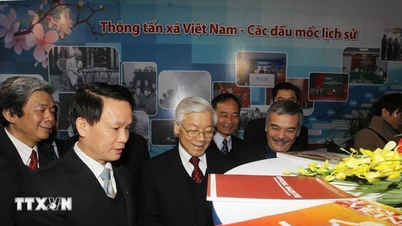
The Vietnam News Agency (VNA), established in 1945, is the official voice of the revolution, broadcasting President Ho Chi Minh's Declaration of Independence in three languages: Vietnamese, French, and English.
Reporters from the Vietnam News Agency (VNA) worked directly on the front lines, and many of them sacrificed their lives in the line of duty.
Mr. Moonesinghe stated that since its establishment, VNA has affirmed its global stature, maintaining accuracy and objectivity in reporting on domestic and international affairs. At the same time, the agency has continuously innovated, applying modern technologies such as multilingual platforms, AI, and engaging storytelling methods. VNA is a model for modern journalism: responsible, honest, and effectively adaptable to the technological age.
In addition, Mr. Moonesinghe pointed out that President Ho Chi Minh's journalistic philosophy was profoundly expressed through the saying: "Nothing is more precious than independence and freedom," and the emphasis that journalists must be honest, responsible, and ethical.
Newspaper readers are a revolutionary tool for arousing patriotism and promoting social progress. That idea remains the guiding principle for editorial standards and professional ethics in Vietnamese newsrooms today.
This ideology continues to guide Vietnamese media with core values such as: serving the people, honesty, and national unity. Principles such as truth and integrity, clear and understandable language, political awareness and professional ethics, and a close approach to the people remain the foundation of journalistic ethics in Vietnam, especially in the process of digital transformation and global integration.
In other words, President Ho Chi Minh's journalistic philosophy remains the ethical guiding principle for Vietnamese journalism in the new era.
(VNA/Vietnam+)
Source: https://www.vietnamplus.vn/bao-chi-thuc-tinh-long-yeu-nuoc-and-y-chi-doc-lap-dan-toc-post1045384.vnp


![[Image] National Assembly discusses the implementation of the socio-economic development plan.](https://vphoto.vietnam.vn/thumb/1200x675/vietnam/resource/IMAGE/2026/04/20/1776696707422_ndo_br_img-20260420-185419-jpg.webp)

![[Photo] General Secretary and President To Lam meets with National Assembly delegates from ethnic minorities.](https://vphoto.vietnam.vn/thumb/1200x675/vietnam/resource/IMAGE/2026/04/20/1776696701056_a1-bnd-8331-3342-jpg.webp)



















































































Comment (0)