

Lai Len Temple – an ancient temple in Phu Duc village (Kim Duc commune, Viet Tri city) – is considered the first "grand theater" of Vietnam during the Van Lang period. It is also the birthplace of Xoan singing, associated with the legend of King Hung searching for land to build a citadel, and is the original site related to the origin of the representative intangible cultural heritage of humanity – the ritual singing of worship, Phu Tho Xoan singing...

A corner showcasing Xoan singing art at Lai Len Temple.
In the hearts of the people of the ancestral land, Lai Len Temple is a sacred place preserving the essence and value of ancient Xoan folk songs, a space for performing Xoan singing during festivals, especially the Hung Kings' Commemoration Day. At the same time, the temple is also a space for students from schools in and outside the province to visit during experiential and career guidance activities.
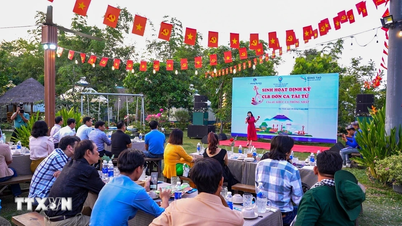
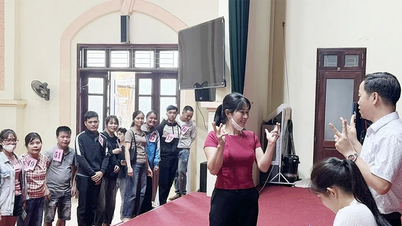
Recently, the Lai Len Temple welcomed a group of over 100 students from the Tourism and Travel Service Management program (2021-2025 cohort) of the Ho Chi Minh City University of Foreign Languages - Information Technology for a visit and experience. Here, in the solemn atmosphere of the sacred space, the students immersed themselves in the traditional Xoan singing art. Not only did they listen to ancient Xoan melodies, but they also participated in performances with the artisans, gaining a deeper understanding of the history and significance of this art form. The exchange helped many students feel the connection between the past and the present, and appreciate the value of traditional culture even more.
Student Nguyen Thi Ha Linh, a member of the tour group, shared: "Here, we had the opportunity to visit the Xoan Singing Art Heritage Exhibition House with many documents, images, artifacts, maps, and scientific documentaries... We also listened to presentations and experienced the art of Xoan singing, its history, and its existence in Phu Tho. Through this, my friends and I felt the beauty and charm of Xoan singing when we enjoyed the performances and interacted with many artisans, living in the Xoan performance space in the most authentic and vivid way... For me, this is an impressive and unforgettable experience that will enrich my journey to becoming a tour guide."
At Lai Len Temple, visitors can not only listen to and immerse themselves in the melodious Xoan folk songs, but also admire photographs and artifacts related to Xoan singing at the Xoan Art Heritage Exhibition House. This is an important highlight that helps locals and tourists gain a complete understanding of this unique art form.

Students from the Ho Chi Minh City University of Foreign Languages and Information Technology were excited to experience performing Xoan singing with local artisans.
Through the exhibits showcasing ancient Xoan singing troupes in Viet Tri city, including Thet Village Temple, Kim Dai, An Thai, Lau Thuong, and Lai Len Temple, visitors gain a comprehensive overview of the space where Xoan singing art is preserved. Within this space and performance art are also ancient Xoan songs. These songs were originally written in Chinese characters by scholars, and later translated into the Vietnamese Quốc ngữ script for easier learning.
The ancient Xoan songs are mainly preserved and passed down by the troupe leaders. Generally, these versions have similar content, but each troupe differs in song arrangement and lyrics. Through more than a dozen exhibited photographs, visitors can also learn about the art of Xoan singing performance, including its customs, sequence, performance techniques, and the rituals and traditions of singing in harmony with the spirits.
Besides the performance art, musical instruments and costumes used in Xoan singing are also displayed at the Lai Len Temple, attracting the attention of tourists with simple instruments: a small drum made of jackfruit wood covered with leather on both sides, a pair of bamboo clappers, a wine flask, a four-panel dress combined with a silk blouse, a square scarf, a headscarf... all arranged scientifically.
Xoan singing has transcended the cultural boundaries of Phu Tho province to reach the Vietnamese people and the world, retaining its vitality through millennia. This success is largely due to the significant contributions of folk artists. In the Xoan singing exhibition space, images of the Xoan singing troupe leaders – members of families with long-standing Xoan singing traditions, some families having held the position for three or four generations through a father-to-son succession – are prominently displayed...
Immersing oneself in the art of Xoan singing has left a deep impression on every visitor who comes to Lai Len Temple. From there, Phu Tho Xoan singing continues to spread throughout the community, demonstrating its enduring vitality over time.
Hong Nhung
Source: https://baophutho.vn/bao-tang-nghe-thuat-hat-xoan-216637.htm
![[Photo] General Secretary and President To Lam meets with National Assembly delegates from ethnic minorities.](https://vphoto.vietnam.vn/thumb/1200x675/vietnam/resource/IMAGE/2026/04/20/1776696701056_a1-bnd-8331-3342-jpg.webp)




![[Image] National Assembly discusses the implementation of the socio-economic development plan.](https://vphoto.vietnam.vn/thumb/1200x675/vietnam/resource/IMAGE/2026/04/20/1776696707422_ndo_br_img-20260420-185419-jpg.webp)























































Comment (0)