

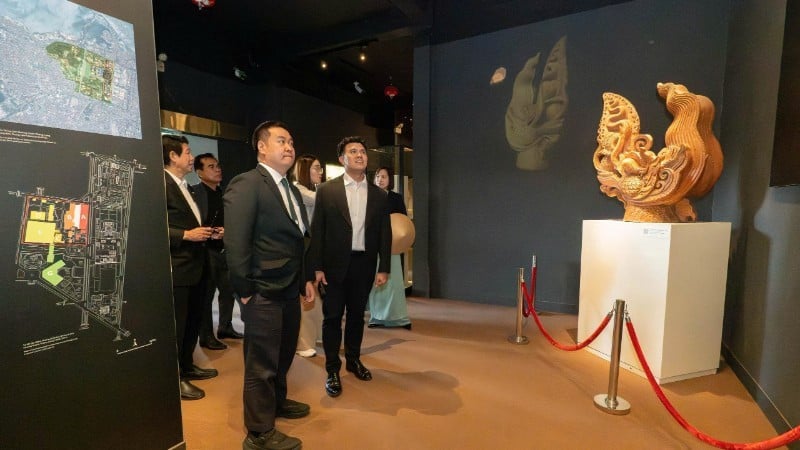
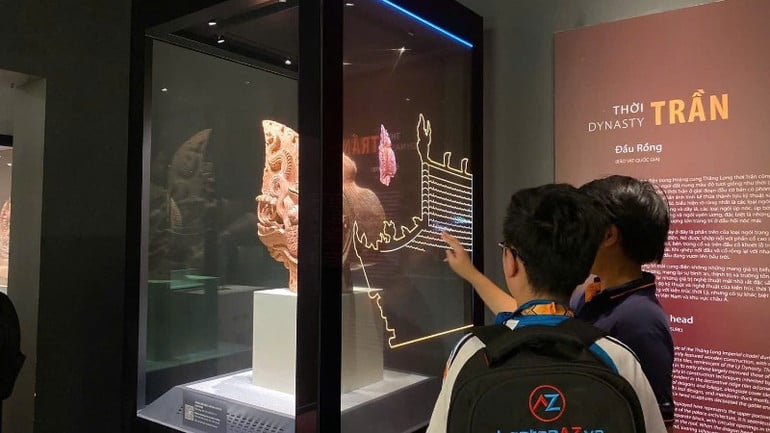
The delegates were deeply impressed with the projection technology at the Thang Long Imperial Citadel exhibition space.
That momentum is becoming increasingly evident as the 2024 Law on Cultural Heritage opens up a new legal framework for the digitization, interoperability, and exploitation of heritage data in the electronic environment.
Enhancing the national heritage data platform.
At the national archives system, the digitization process was implemented early and systematically, forming an important foundation for operating valuable archival resources in the digital environment.
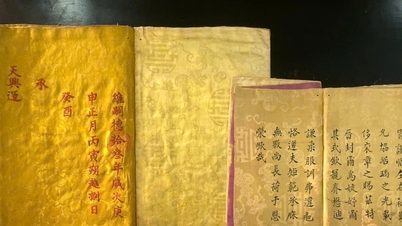
According to Dang Thanh Tung, Director of the State Archives and Records Department, the unit is managing "an extremely vast and valuable volume of national archival documents, including more than 30km of shelving, among which are 2 national treasures recognized by the Prime Minister and 3 world documentary heritage sites inscribed by UNESCO." This source of documents fully reflects the historical, cultural, diplomatic , and socio-economic development of the country through many periods.
For many years, the Department proactively implemented digitalization efforts even before the legal framework was fully developed. The development of technical processes, standardization of operations, and infrastructure formation were carried out step by step, providing the entire sector with a solid foundation for large-scale digitalization today.
Currently, digitalization efforts are focused on four key areas: developing digitalization and data standards, perfecting the national data archiving architecture framework with interoperability, strengthening digital data preservation and backup storage to ensure sustainability, expanding the platform for accessing documents to serve society, and facilitating convenient access to documents for citizens, researchers, and cultural and educational institutions.
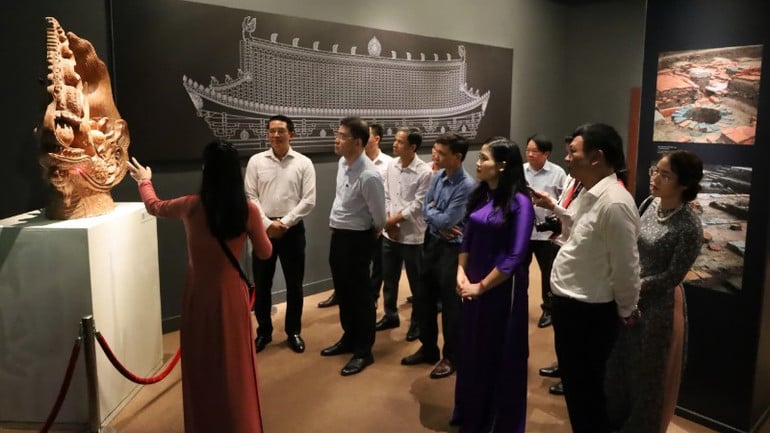
Delegates visit the ancient artifacts of Thang Long Imperial Citadel.
Emphasizing the three pillars of "data standards - authenticity assurance - inter-sectoral connectivity," Director Dang Thanh Tung stated that unifying data descriptions and quality standards facilitates information retrieval, sharing, and integration. These requirements have been concretized in the specialized circulars issued by the Ministry of Interior regarding digital documents. The authenticity of digital documents is ensured through sophisticated operational and technical processes, serving both legal value and long-term exploitation needs.
In addition, the Department is promoting the development of common connectivity standards so that national archived data can be linked with heritage databases, museums, and digital exhibition platforms, creating a broader and more transparent space for accessing documentation.
In the stage of applying modern technology, the State Archives and Records Department continues to strengthen coordination with cultural agencies nationwide. "The application of new technologies such as 3D, VR, or artificial intelligence in preserving and promoting the value of documents requires very close inter-agency coordination," said Director Dang Thanh Tung.
With that in mind, the Department has identified three key areas of action: developing a secure and synchronized connectivity platform; building specialized training programs in digital technology, information security, and data governance; and researching and issuing digitalization process standards that are appropriate to practical realities.
A key highlight is the focus on mobilizing resources for digitalization. Director Dang Thanh Tung stated that the Department is leveraging the tradition of cooperation between the two sectors to encourage technology companies, research institutes, and social partners to participate; while also promoting the socialization of a portion of the funding in accordance with legal regulations. This approach helps expand financial and technical potential, creating conditions for the development of high-quality digital products.
In the coming period, the National Archives Center will closely coordinate with cultural agencies to jointly propose the 3D digitization of a collection of documents and artifacts to be combined with the creation of an online exhibition space, ensuring both informational depth and visual appeal. The combination of archival data and modern simulation technology will help disseminate the value of archival materials in an engaging way, suitable for the public's habits of accessing heritage in the digital age.
From archaeological evidence to digital experiences
As a World Cultural Heritage site, Thang Long Imperial Citadel possesses a particularly important collection of documents, artifacts, and relics, requiring modern preservation methods and a more diverse approach.
According to Nguyen Thanh Quang, Director of the Thang Long-Hanoi Heritage Conservation Center, digital transformation is identified as a key task for the Center in the current period. Solutions are being implemented synchronously, meeting the requirements of management and research while enhancing the experience of domestic and international tourists.
First, all archaeological records, research documents, and technical drawings are being systematically standardized and digitized. With such a large volume of material, the digitization process is being carried out according to standards that ensure accuracy, interoperability, and long-term usability.
In addition, the Center is promoting the digitization of relics and artifacts using 3D technology and high-resolution digital images, creating a rich image database to serve scientific research, modern exhibitions, and support the reconstruction and dramatization of ancient court rituals in a more authentic and engaging way.
More importantly, the Center is building an integrated database as the digital infrastructure for all heritage management activities. Once completed, this system will become a centralized data repository serving in-depth research, conservation efforts, and educational and communication programs. It will also serve as a platform for information sharing between research, exhibition, and guidance departments, and support the long-term management of archaeological sites and artifacts within the heritage area.
Exhibition activities are implemented in diverse environments, both in-person and online. Besides physical exhibits, the Center organizes numerous online exhibitions, 3D spaces, 360-degree tours, and virtual tours, enabling the public to access heritage regardless of their geographical location.
New technological applications are being utilized at various levels: simulating the space of the Kính Thiên Palace, recreating solemn ceremonies such as the Royal Court Ceremony or the Imperial Examination during the Lê Dynasty; introducing the system of relics and artifacts using 3D mapping (3D light projection); and providing 3D tours of the Thăng Long Imperial Palace exhibition area and the 18 Hoàng Diệu archaeological site with intuitive images and comprehensive information links.
The guided tours have been significantly standardized and modernized. Audio guides, tour guides, documentary films, and automated audio guides via mobile phones enable visitors to actively explore and interact with the information. Viewers can search for information, view reconstructed models, or interact on large screens in the exhibition area.
The websites hoangthanhthanglong.vn and thanhcoloa.vn continue to serve as open archives, publishing archival records, research results, publications, and forms of heritage education.
Mr. Nguyen Thanh Quang emphasized that digitalization contributes to preserving, protecting, and promoting heritage values in a more vibrant and accessible way, creating a widespread impact in the community, especially among young people. The center is orienting the development of a digital experience ecosystem using 3D, 360-degree, VR, and AR technologies; expanding online tours; providing digital explanations using QR codes (information lookup codes); and continuing to implement interpretive technology applications at revolutionary relics within the heritage area, such as the D67 House and Tunnel.
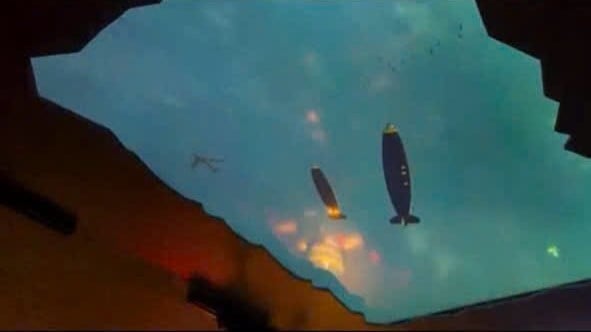
Interpretation at revolutionary historical sites within the Thang Long Imperial Citadel exhibition area.
In the coming period, 3D mapping technology will be studied and used to tell the historical story through the feudal dynasties. With a combination of images, sound, artistic effects, and the setting of the imperial court, these projection programs will help visitors access history through a captivating visual experience, while bringing Thang Long Imperial Citadel closer to the community, transcending the limitations of traditional exhibition spaces.
Heritage data synchronization strategy
To meet the demands of modern management, the Law on Cultural Heritage, passed by the National Assembly on November 23, 2024, has opened up an important legal framework to promote digital transformation in the field of heritage. Associate Professor, Dr. Le Thi Thu Hien, Director of the Department of Cultural Heritage, stated that the Law affirms the role of digital technology in protecting and promoting heritage values, while clearly defining the responsibilities of management agencies, organizations, and individuals in the digitization process.
The law also fully addresses rights related to digital heritage data, including intellectual property rights and rights to protect digitized products, creating a legal basis to promote the sharing, interoperability, and effective exploitation of cultural heritage resources in the electronic environment, in accordance with the Intellectual Property Law, the Electronic Transactions Law, the Cybersecurity Law, and other legal regulations.
Currently, the draft Decree guiding the implementation of the Law on Cultural Heritage includes a separate chapter of 10 articles, specifically regulating the development of science, technology, innovation, and digital transformation in the field of cultural heritage. The key contents of this chapter include technical standards, data management processes, requirements for operating the database system, and implementation steps.
According to Director Le Thi Thu Hien, this is an important foundation for building a national database on cultural heritage, operating uniformly from the central to local levels and meeting the requirements of national data interoperability in the process of building a digital government, digital economy, and digital society.
Along with perfecting the legal framework, the digitization of heritage sites is being implemented by the sector according to the principles of "green, sufficient, clean, vibrant, unified, and shared." These principles ensure that digitized data is of high quality, capable of being updated and reused over the long term, while also supporting inventory, impact assessment, and heritage record management.
Once completed, the national database will become an open search space, making heritage widely accessible, facilitating education, research, promotion, and long-term preservation. It will also serve as a foundation for developing the cultural industry through electronic exhibitions, digital maps, tour applications, and heritage education products, contributing to the exploitation of cultural heritage for socio-economic development.
Director Le Thi Thu Hien stated that promoting heritage values in the digital environment requires a combination of technology and human factors, especially respecting the role of the community, the creators and custodians of heritage. Therefore, protecting intellectual property rights and the rights of artisans and communities in the digital environment is considered a crucial requirement to ensure the sustainability of the digitization process, avoiding misuse or commercialization that is inconsistent with cultural identity.
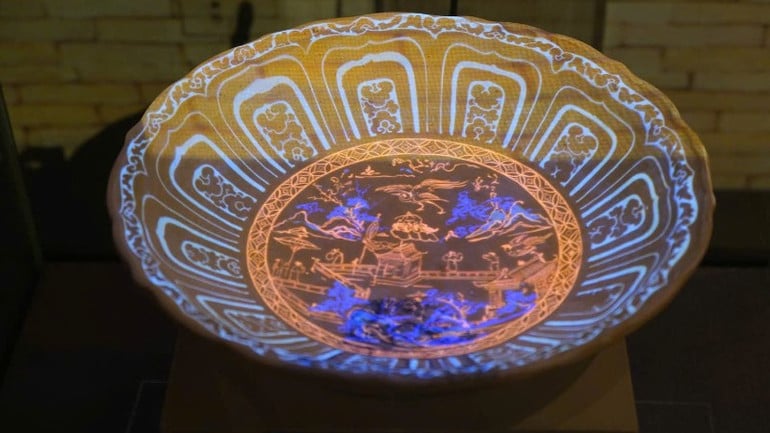
The idyllic scene of the ancient royal palace is recreated through 3D mapping technology at the Royal Treasures exhibition room of the Thang Long Imperial Citadel historical site.
Simultaneously, the Department of Cultural Heritage is strengthening cooperation between museums, historical sites, and creative businesses to deploy modern applications such as virtual reality (VR), augmented reality (AR), artificial intelligence (AI), 3D light projection, and 3D digital spaces to innovate the approach to heritage. These technologies help traditional arts, especially folk performing arts, appear more attractively on digital platforms and create appeal for domestic and international tourists. At the same time, the tourism industry and localities are encouraged to coordinate the development of cultural tourism products linked to digital experiences, from online tours and electronic exhibitions to interactive activities and creative experiences.
According to Director Le Thi Thu Hien, digital transformation contributes to improving the effectiveness of state management, protecting and promoting the value of cultural heritage, and simultaneously promoting sustainable development. The application of technology to heritage expands opportunities for creating livelihoods for communities and enhances cultural experiences for residents and tourists in the digital age.
Therefore, the digitization of heritage is opening up new approaches, helping to sustainably preserve and widely disseminate cultural values. When data infrastructure and legal frameworks are synchronized, heritage will continue to demonstrate its value in modern life.
HOAI THU
Source: https://nhandan.vn/bao-ton-di-san-trong-khong-gian-so-post926403.html
![[Photo] General Secretary and President To Lam meets with National Assembly delegates from ethnic minorities.](https://vphoto.vietnam.vn/thumb/1200x675/vietnam/resource/IMAGE/2026/04/20/1776696701056_a1-bnd-8331-3342-jpg.webp)




![[Image] National Assembly discusses the implementation of the socio-economic development plan.](https://vphoto.vietnam.vn/thumb/1200x675/vietnam/resource/IMAGE/2026/04/20/1776696707422_ndo_br_img-20260420-185419-jpg.webp)

















![[Photo] General Secretary and President To Lam meets with National Assembly delegates from ethnic minorities.](https://vphoto.vietnam.vn/thumb/402x226/vietnam/resource/IMAGE/2026/04/20/1776696701056_a1-bnd-8331-3342-jpg.webp)
![[Image] National Assembly discusses the implementation of the socio-economic development plan.](https://vphoto.vietnam.vn/thumb/402x226/vietnam/resource/IMAGE/2026/04/20/1776696707422_ndo_br_img-20260420-185419-jpg.webp)




















































Comment (0)