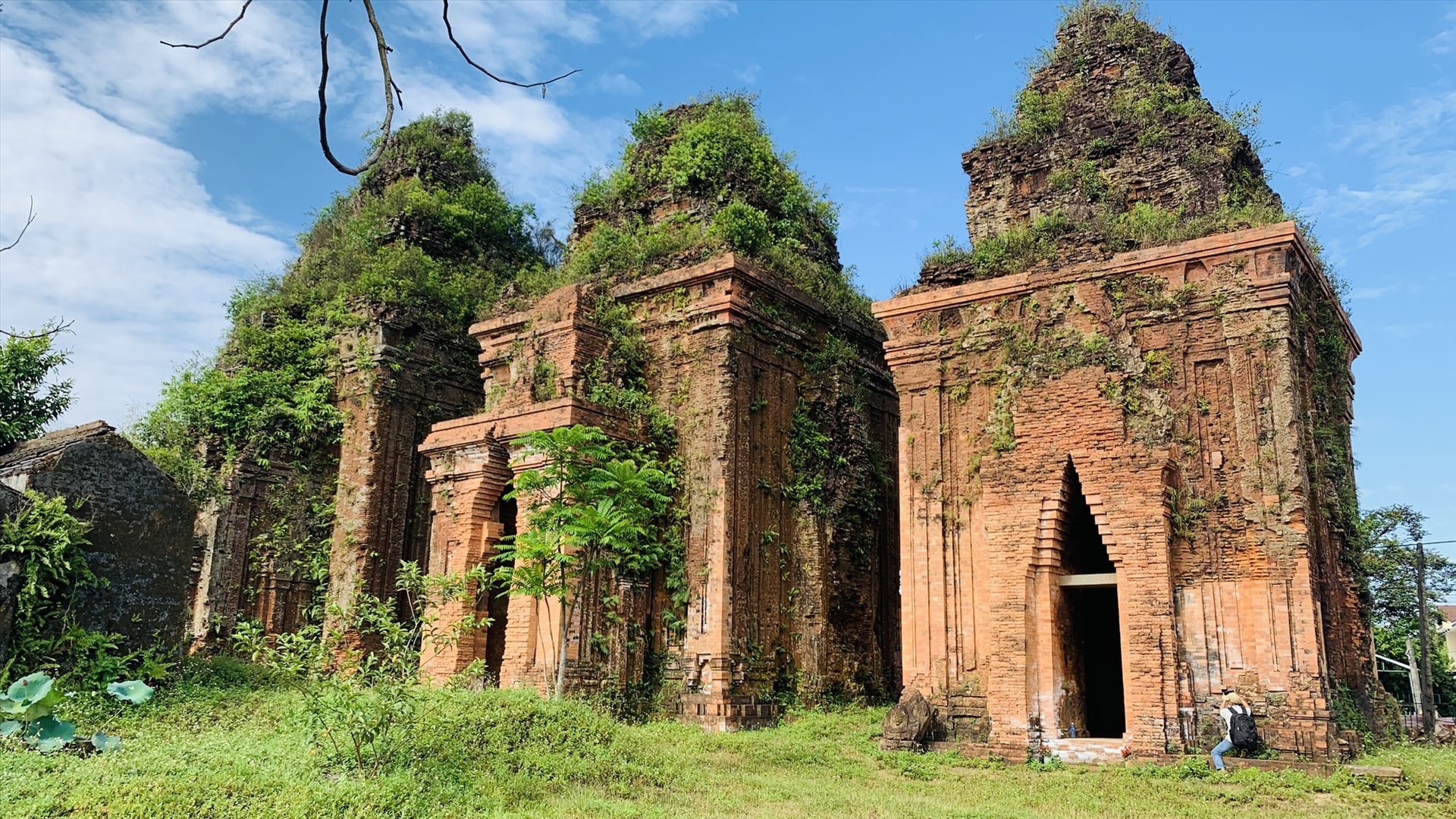
However, these millennia-old structures are facing serious damage from salinization – a silent, physicochemical corrosion process that destroys the material structure from within.
Practical lessons from the Khuong My Tower incident.
This article is the culmination of the dedication and practical experience of those directly involved in the restoration of ancient temples and towers. Since 1980, we have had the opportunity to meet and work alongside Polish architect Kazimierz Kwiatkowski on restoration projects at the My Son temple complex (Quang Nam province) as well as many other temple complexes throughout Central Vietnam. Years of direct involvement on the construction sites have provided us with profound insights into the challenges, past mistakes, and the necessity of a scientific conservation methodology.
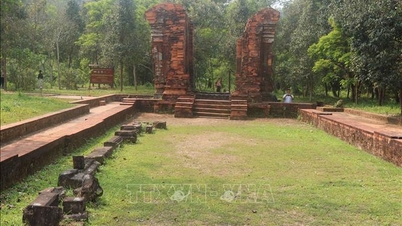
The Khuong My tower complex (Quang Nam province) is a cautionary case study. Just a few months after the restoration project was completed, the newly restored bricks quickly showed signs of severe damage: the surface was covered with moss, crumbling, and peeling badly. And today, the Nam Khuong My tower, currently under restoration, is also showing signs of salt contamination.
The root cause lies not in the quality of the new materials, but in a failure in the diagnostic process. The old masonry had accumulated enormous amounts of salt over centuries but was not desalinated before intervention. When combined with moisture from groundwater and rainwater, the new, porous bricks acted like a "wick," drawing salt solution from the original material. As the water evaporated, the salt crystals crystallized, creating immense physical pressure that shattered the new brick structure from the inside.
Salt contamination has been a chronic problem affecting brick structures near the coast in South Central Vietnam… Even groups of towers further from the sea, such as E7, HA, and G in the My Son World Heritage site, have been damaged by salt. The costly lesson learned from the conservation efforts at Khuong My towers confirms that desalination is a crucial and indispensable step before any restoration work.



The material "paradox" of ancient Cham bricks
To find a suitable solution, it is necessary to understand the unique characteristics of ancient Cham bricks. Made from local clay combined with organic additives such as cow dung, rice husks, straw, or charcoal powder, Cham bricks are fired at moderate temperatures ranging from 800°C to below 1,000°C. This process creates a product with very high porosity, ranging from 18% to 25%.
Historically, this microporous structure allowed the wall to "breathe," facilitating rapid moisture evaporation and limiting salt buildup. However, in the current context, this very advantage has become a fatal weakness. The high porosity turns the brick into a giant "sponge," easily absorbing and retaining moisture and salt from groundwater and sea spray. The incompatibility between modern restored bricks (often too dense) and old (porous) bricks disrupts the natural movement of moisture, leading to rapid deterioration at the interface between the old and new masonry.
Sustainable intervention and conservation roadmap
The degradation of the site is a result of the convergence of material properties, harsh climate, and diverse salt sources. Central Vietnam, with its high humidity and distinct wet-dry seasons, has created ideal conditions for the continuous cycle of salt dissolution and recrystallization.
Therefore, the strategy for preserving Cham towers needs to shift to a "diagnosis first, intervention later" model with an integrated roadmap comprising three phases:
- Mandatory survey and diagnosis: This forms the basis for building a complete "medical record" for the monument. The process includes analyzing material characteristics, mapping the distribution of salt and moisture at different depths, and accurately determining the source of moisture from groundwater or the atmosphere.
- Integrated desalination technology: Simultaneously combining various methods is necessary to optimize effectiveness. First, a powder compress is applied to safely remove most of the salt from the surface layer; then, a direct current is applied to extract salt ions deep within the masonry, combined with pH buffering systems to ensure absolute safety for the original materials.


- Long-term preventative conservation: Desalination is only a symptomatic treatment. To ensure sustainability, moisture control measures such as underground drainage systems and improved surface drainage should be implemented. Simultaneously, research should be conducted on the application of new generation breathable waterproofing agents or traditional materials like resin oil to protect the surface while maintaining the breathability of Cham bricks.
Preserving the heritage of Cham towers is not just a technical challenge, but also a long-term commitment. A shift from a "repair when damaged" mindset to a "proactive management and care" model, including regular cleaning of the brick walls, is essential. Combining decades of practical knowledge with modern science is the only way for these masterpieces to endure for future generations.
Source: https://baodanang.vn/bao-ton-thap-cham-truc-thach-thuc-muoi-hoa-3339594.html

![[Photo] Opening Ceremony of the 13th National Congress of the Ho Chi Minh Communist Youth Union](https://vphoto.vietnam.vn/thumb/1200x675/vietnam/resource/IMAGE/2026/06/24/1782286753905_ndo_br_1-8510-jpg.webp)

![[Photo] General Secretary and President To Lam attends the Central Public Security Party Committee Conference](https://vphoto.vietnam.vn/thumb/1200x675/vietnam/resource/IMAGE/2026/06/24/1782302063612_a1-bnd-9302-9166-jpg.webp)
![[Photo] The 13th National Congress of the Youth Union conducts personnel work.](https://vphoto.vietnam.vn/thumb/1200x675/vietnam/resource/IMAGE/2026/06/24/1782299943080_ndo_br_1-6868-jpg.webp)