Museum of Memory
In the northernmost region of Vietnam, each ethnic group possesses a unique sound to tell the story of their origins and preserve community memories through generations. For the Hmong people, that sound is the Hmong flute. Legend has it that, from the pain of losing their parents, six sons wept incessantly for days and nights until they lost their voices. In their exhaustion, they used their flutes to continue playing mournful music for their deceased parents. Moved by their filial devotion, the gods appeared in a dream, instructing them to combine the six flutes into a single instrument, symbolizing the unity and solidarity of the six brothers.
 |
| Ms. Vi Thi Suu, from My Lam ward, teaches the art of playing the Sanh drum to the younger generation, contributing to the preservation and transmission of the Cao Lan cultural heritage. |
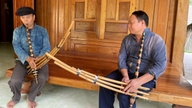
From that legend, the Hmong flute was born, becoming a unique cultural "language" intimately connected to the life cycle of the Hmong people. Artisan Sung Nhia Su, from Doan Ket village, Sa Phin commune, shared: "The Hmong people hear the sound of the flute from the cradle, make friends at the market, and even close their eyes in death to the sound of the flute guiding them." It is these unique, sacred values and enduring vitality that have elevated the Hmong flute art to the status of a National Intangible Cultural Heritage.
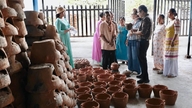
In a different shade of cultural tapestry, the Cao Lan people, through generations, have preserved the Sành drum – a unique musical instrument embodying the essence of Mother Earth. Unlike ordinary wooden drums, the Sành drum is meticulously crafted from a single block of fired clay, narrowed in the middle, and played with a curved bamboo mallet or by hand, creating a deep, majestic sound. This difference is what gives this instrument its unique appeal, becoming a distinctive cultural mark of the Cao Lan people among the treasure trove of Vietnamese folk music . Ms. Vi Thi Suu, from My Lam ward, said: “The Sành drum was originally the dwelling place of the spirits, holding a special position that constitutes the sacred space of rituals praying for a good harvest and rain. The drum's sound does not stand alone but guides the Sình songs, harmonizing with gongs, cymbals, and traditional dances, vividly recreating the working life and beliefs of the community.”
While the Hmong mouth organ is majestic and the earthenware drum is solemn, the Tay people's Tinh lute possesses a simple yet profound beauty. This rustic instrument, with its soundbox made from half a dried gourd, its slender wooden neck, and its supple silk strings, produces a clear, melodious sound like a mountain stream, and a warm, comforting sound like a fireplace in a stilt house on a winter night. However, the Tinh lute truly reaches its peak when accompanied by Then singing. If Then tells the story of origins, aspirations for life, and love for one's homeland, then the sound of the Tinh lute is the emotional thread guiding that story. The harmonious blend of lyrics and music creates a unique performance space, contributing to the recognition of "Then Practices of the Tay, Nung, and Thai People in Vietnam," including Tuyen Quang , as a UNESCO Representative Intangible Cultural Heritage of Humanity.
According to Comrade Nguyen Trung Ngoc, Director of the Department of Culture, Sports and Tourism: Mong flutes, earthenware drums, Tinh lutes, and many other traditional musical instruments, although different in sound and shape, all share a common mission: to preserve the history, beliefs, folk knowledge, and cultural essence of each ethnic group.

Blending into contemporary life
When the community keeps the flame alive, the younger generation follows in their footsteps, and technology becomes an extension of culture, traditional musical instruments are no longer just present in memories or festivals, but are increasingly integrating into contemporary life while still retaining their national essence.
 |
| The art of the Hmong flute – a national intangible cultural heritage, embodying the cultural identity of the Hmong people. |
In many villages, numerous artisans quietly preserve the cultural heritage. Artisan Thò Chứ Dia (Khâu Vai commune) has been dedicated to the khèn (a type of bamboo flute) for nearly half a century. Facing the risk of young people increasingly abandoning this traditional instrument, he opened free classes, directly instructing hundreds of students. From children who didn't know how to play the khèn, many have now become key figures in the arts. Meanwhile, in Phú Lương commune, artisan Sầm Văn Đạo not only teaches and practices Cao Lan folk art, but he is also one of the few artisans currently possessing the technique of crafting ancient Sành drums. Nearly 50 drums he has created have become a bridge spreading the cultural essence of Cao Lan, bringing the sounds of this heritage to the public both domestically and internationally through cultural activities, tourism, and international exchanges.
Building upon the foundation painstakingly laid by previous generations, today's youth are writing a new chapter for traditional Vietnamese musical instruments. Growing up surrounded by the sound of the Hmong flute in the Dong Van Stone Plateau, Ly Mi Cuong, a student at the Vietnam National Academy of Music, has brought traditional music to the international stage by winning first prize in the Young Music Talent Search competition at the Zhejiang Academy of Music (China) and first prize in the Traditional Musical Instruments category at the 2024 China-Singapore International Music Competition. Not stopping there, Cuong has also formed a contemporary folk band, blending the Hmong flute with electronic and modern music, creating fresh and appealing melodies for young people while still preserving the essence and cultural identity of the ethnic group.
In a different direction, artist Xuan Huu from Bac Quang commune has chosen the digital space to spread traditional cultural values. Having dedicated over 15 years to teaching Then singing and Tinh playing, he has built the "Xuan Huu Dan Tinh" channels on YouTube and TikTok, attracting over 70,000 followers. Through simple videos capturing the sound of the Tinh instrument, Then lyrics, and the scenery of the mountains and forests, the heritage is told in a more accessible, vivid, and engaging way for young audiences.
If the digital space expands the reach of heritage, then schools are the place to nurture the next generation. In the 2025-2026 school year, the province will have 1,053 schools with 81.56% of its students belonging to ethnic minorities. Building on this rich cultural foundation, the Education sector has promoted the "Schools Connected with Heritage" model, incorporating folk songs, folk dances, and folk music into teaching and extracurricular activities; and inviting artisans to directly teach performance skills, helping students understand and be more proud of their ethnic culture.
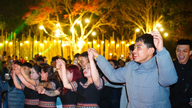


From villages to schools, from stages to digital spaces, traditional musical instruments are becoming increasingly prevalent in contemporary life. Events like the Mong Flute Festival in Dong Van or experiential tourism products associated with Then, Tinh lute, and Sanh drums are gradually transforming heritage into resources for economic and tourism development. When nurtured within community life, these ancient sounds not only preserve cultural memories but also create new values. This is also how ethnic identity continues to spread, sustainably building vitality to endure through time.
Thu Phuong
Source: https://baotuyenquang.com.vn/van-hoa/tin-tuc/202606/thanh-am-giu-hon-dan-toc-656680a/
![[Photo] Opening Ceremony of the 13th National Congress of the Ho Chi Minh Communist Youth Union](https://vphoto.vietnam.vn/thumb/1200x675/vietnam/resource/IMAGE/2026/06/24/1782286753905_ndo_br_1-8510-jpg.webp)

![[Photo] The 13th National Congress of the Youth Union conducts personnel work.](https://vphoto.vietnam.vn/thumb/1200x675/vietnam/resource/IMAGE/2026/06/24/1782299943080_ndo_br_1-6868-jpg.webp)
![[Photo] General Secretary and President To Lam attends the Central Public Security Party Committee Conference](https://vphoto.vietnam.vn/thumb/1200x675/vietnam/resource/IMAGE/2026/06/24/1782302063612_a1-bnd-9302-9166-jpg.webp)







![[Video] Weather forecast for tonight and tomorrow, June 25, 2026: Hot and intensely hot weather will continue throughout the country.](https://vphoto.vietnam.vn/thumb/402x226/vietnam/resource/IMAGE/2026/06/24/1782306248499_dem-24-png.webp)