The conservative CDU/CSU party in Germany is currently leading, but finding a coalition to form a government will be a challenge.
German voters will go to the polls on February 23rd to elect a new parliament . This election is almost certain to bring about a change in the country's leadership, as the conservative CDU/CSU (Christian Democratic Union/Christian Social Union) led by Friedrich Merz is currently holding a large lead.
Conservatives hold the advantage.
Polls conducted over the past few months have yielded similar results across the four major political parties. A YouGov survey on February 17th showed the CDU/CSU maintaining their lead with 27% support, far ahead of the second-place far-right AfD (Alternative for Germany) party led by Alice Weidel, which received 20%. The SPD (Social Democratic Party) of current German Chancellor Olaf Scholz and the Green Party of Robert Habeck followed with 17% and 12% respectively.
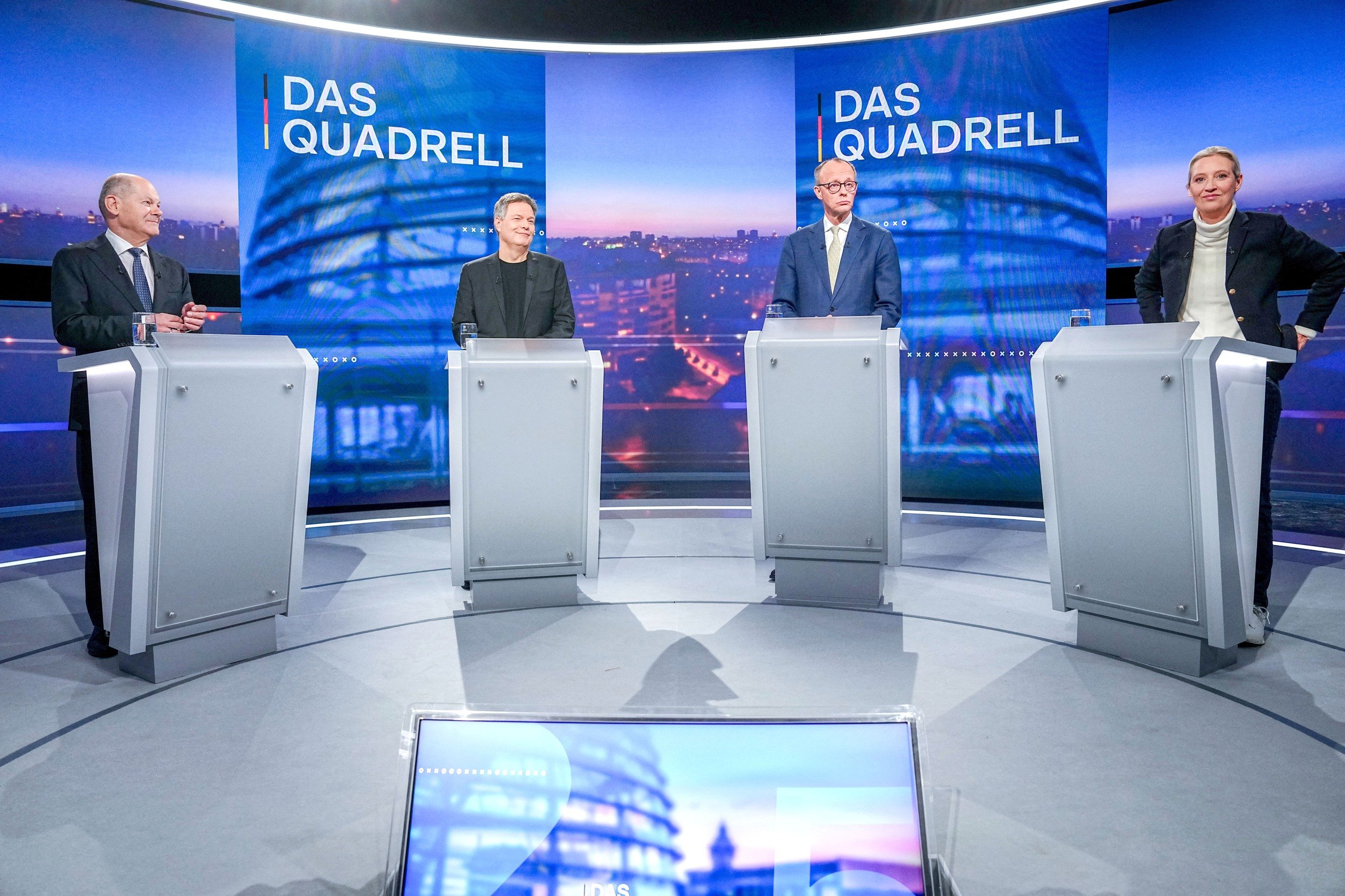
The four candidates who debated on February 16th: (From left to right) Scholz (SPD), Habeck (Green Party), Merz (CDU/CSU), and Weidel (AfD).



Despite currently leading, Merz's coalition still needs to be mindful of the number of seats it wins out of the 630 seats in parliament. The more seats the CDU/CSU wins, the less likely they are to have to form coalitions with multiple parties to secure a majority in parliament.
"I want to ensure strategically that we have at least two options, and only one, which could be the SPD or the Greens," Merz said during the German chancellor debate on February 16, according to Politico. He also ruled out the possibility of a coalition with the far-right AfD. If forced to cooperate with more than one party, Merz's side could face difficulties in governing, due to the potential for differing viewpoints between the parties.
National polls also show a clear rise of the far right, with the AfD projected to come in second with 22% support, more than double its 2021 election results. At the bottom, smaller parties, including the FDP (Free Democratic Party), the Left Party, and the BSW, will need to secure 5% of the vote to gain a seat in the German parliament. The results of these smaller parties could also impact the overall picture if they secure enough seats to form a coalition with the leading party to create a majority government.
Important issues
The economy and immigration are two major issues highlighted by political parties as they seek support. According to Reuters, Germany, Europe's largest economy, experienced its second consecutive recession last year. High energy prices have significantly impacted the economy, the lives of households, and businesses in Germany. Among the four leading parties in the race – the CDU/CSU, the SPD, and the Green Party – they agree on expanding renewable energy to reduce costs but differ on spending positions. The CDU and AfD have proposed considering a return to nuclear power, an idea opposed by the other two major parties. Meanwhile, the AfD disagrees with subsidizing renewable energy projects.
The immigration situation has recently heated up with serious attacks in Germany involving suspected foreign nationals. This has increased public concerns about security, and political parties have taken a tougher stance on immigration. On this issue, the AfD has taken a hardline position, calling for border closures and the removal of refugee quotas. Some senior members of the AfD even want to deport millions of people of foreign origin, including those who already have German citizenship.
Meanwhile, Friedrich Merz's decision to vote on two anti-immigration bills supported by the AfD sparked outrage. Opponents argued that Merz had broken a taboo by breaching the "firewall"—a political stance established after World War II that prohibited German political parties from openly supporting or cooperating with far-right parties. The SPD also advocated for tighter border controls and the recruitment of skilled foreign workers. Conversely, the Green Party maintained an open asylum policy and increased integration.



How are German parliamentary elections conducted?
Approximately 59 million German voters aged 18 and over are eligible to vote on February 23rd. Each person will have two votes. The first vote will be cast for a candidate in one of the 299 constituencies, and the second vote will be cast for a political party. The remaining parliamentary seats will be divided among the parties proportionally based on the second vote.
Each party needs at least 5% of the vote to gain entry into the German parliament. If they don't meet this requirement, a party can still win seats in parliament if at least three of their candidates win in 299 constituencies. This year also marks the fourth time Germany has held early elections since World War II.
Source: https://thanhnien.vn/bau-cu-duc-den-giai-doan-nuoc-rut-185250219222227765.htm




![[Image] National conference summarizing one year of operation of the overall organizational model of the political system, the three-tiered government model.](https://vphoto.vietnam.vn/thumb/1200x675/vietnam/resource/IMAGE/2026/07/01/1782882811691_ndo_br_1-jpg.webp)