

Unlike him, whose daughter is so filial, he doesn't even need to look after his grandchildren. He shook his head, "It's not that I don't need to look after them. I miss my granddaughter dearly. Every time she and her mother come home, I bury my face in her soft, silky hair and inhale deeply. But with my daughter, I have to be indifferent."
My daughter boasted about getting two projects at once, and that she'd be working with incredibly talented people. Hearing that made me realize so much. She's incredibly busy but so enthusiastic, she doesn't seem tired at all. Then she lowered her voice, saying she doesn't get home until nine or ten o'clock every day, and then stays up until one or two in the morning. Cá Kèo, neglected by her mother, is left alone, eating whatever she can find. Just now she was crying and throwing a tantrum, saying her mother wouldn't take her to art class. If her grandfather lived with them, she'd have someone to take her to and from school, and she could take piano and art lessons as she wished. Not to mention, she'd get to eat her grandfather's hot, delicious home-cooked meals instead of seeing the maid more often than her mother.
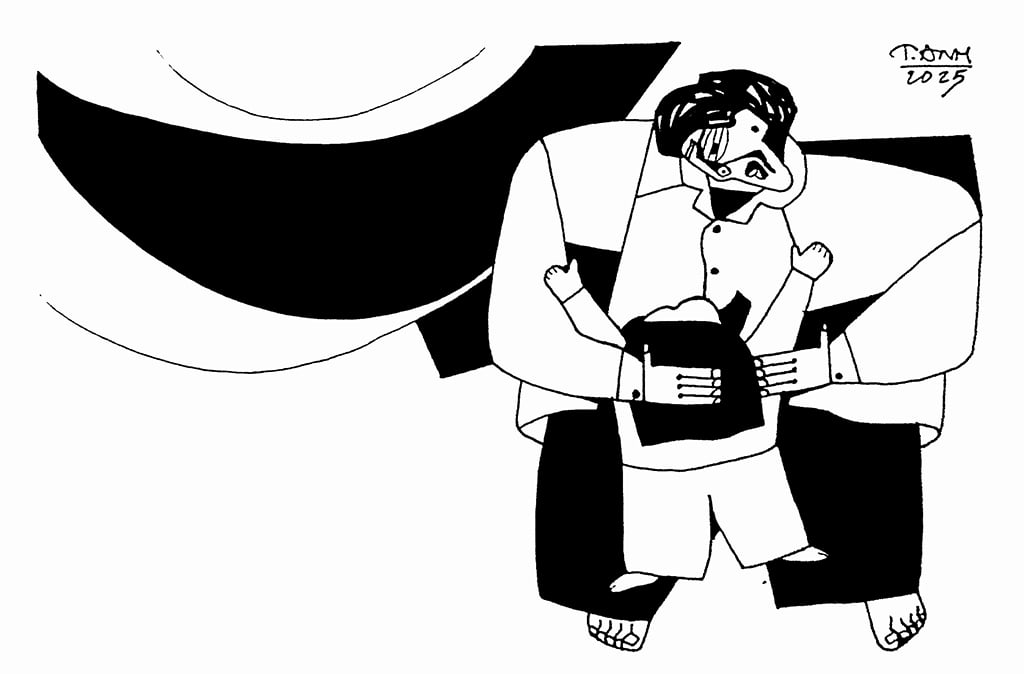
Hearing his daughter's complaints, he truly felt sorry for her and his granddaughter. From a young age, his daughter had understood their family's poverty, so she always tried twice or three times harder than others. Back home, she did the same planting and harvesting, but their fields were always cleaner, the water was drawn earlier, and the soil dried up later than others. His daughter never rested, so when she went to the city to study, she worked two or three extra jobs, earning enough money for tuition and even sending it back to him to repair the fence to prevent buffaloes and cows from damaging the garden. Now that she was doing what she loved, she was like a fish in water, completely absorbed and oblivious to everything else. It was only natural that he would entrust her with the chores.
- Dad, the catfish, is still running back and forth, isn't he?
His daughter paused for a moment but quickly broke into a smile.
- Dad, think about it, if I'm not home, would he dare stay home alone with the maid? We should bring Cá Kèo back; he'll let the dog into the house and then leave. He'll only dare come in if you come over.
He wanted to tell Cá Kèo's father to come home, but couldn't bring himself to say it. He knew his son's nature; once he became stubborn, even a reinforced concrete building couldn't hold him back.
He wanted to give them space to reconcile, but given his daughter's personality, he feared the prospective son-in-law might never make it.
They met during a cultural exchange between their two schools in their student years. The boy, who could both play the guitar and sing, had an artistic demeanor and a glib tongue, somehow took a liking to the daughter of the logistics officer. The girl tried everything to avoid him because she knew he was a notorious womanizer and untrustworthy. Apparently, the rejection upset him and hurt his male pride. He continued to pursue her until they both started working.
After graduating, he became more serious, less boastful, and achieved some success at work. Plus, because they were always together, the girls got used to his presence.
He sighed, and then the little girl, Cá Kèo, arrived.
- I'm sorry for embarrassing you and bringing shame to the village, Dad. But if I didn't have feelings for him, I wouldn't have done that.
That day, his daughter told him this when the boy's parents came to visit, asking for their daughter and son to live together. His daughter also had feelings for the boy, so he happily agreed. He thought there would be a wedding afterward, his daughter would wear a wedding dress, and he and his in-laws would joyfully await their grandchild.
Who knew that after that meeting there would be no wedding? People had gone to all the trouble of coming all the way here, chatting happily and sharing a meal together. He was already thinking about how soon his daughter would have to find someone to clean up the garden, repair the yard, go around the neighborhood asking for help, and ask people to set up the tent and decorations. In his mind, he remembered where to print wedding invitations, rent tables and chairs, cutlery, sound and lighting equipment, and the catering—the women in the neighborhood would take care of that. A village wedding doesn't involve catering like in restaurants; it's all about mobilizing the available resources. It's rare to have a wedding like that in the village, and he'd helped out all over the village before. Now that he was asking for their help, people were overjoyed; it would be lively and bustling for days. He would do all the preparations to send his daughter off to her husband's home; she only needed to make the guest list and try on her wedding dress. He also had to rent a formal suit. It's a once-in-a-lifetime event.
Who knew that just as her in-laws were about to leave, her daughter had something to say? She thanked them for visiting, apologized for inconveniencing them, but said there would be no wedding. She said she didn't feel ready to be a wife or daughter-in-law, and that her child would still be their grandchild.
No matter how much he pressed her, she only gave brief answers about raising the child alone, even crying and saying the child was causing her father more suffering. Hearing his daughter cry, he knew she was deeply hurt and resentful. She had said she also had feelings for the boy, and was just one step away from taking the next step. He knew there must be a reason, and he didn't blame her; he just wanted to share her burden. Yet, she remained silent even with him. The boy's parents kept apologizing, saying it was all their son's fault, and that they would listen to whatever decision their daughter made. Whether she married him or not, they would still consider her their daughter-in-law and welcome her into their home.
The daughter remained calm after everything, giving birth to Cá Kèo alone. She didn't object when Cá Kèo's father came, and she agreed when Cá Kèo's paternal grandparents came to take their grandchild home to play. Occasionally, she and her child would go to Cá Kèo's paternal grandparents' house for meals, but that was all.
On numerous occasions, her grandparents on her father's side pleaded with her to let her father come and live with her and her mother so that Cá Kèo could have both parents. Her daughter just smiled lightly:
Not everyone in the world has both parents. And not everyone born into a complete family becomes a good person.
She spoke as if she were talking to herself. Her mother died when she was three. Her grandfather raised her on rice porridge and vegetables. She grew up under the pitying gaze of the villagers, amidst whispers that one day, when her father remarried and had a new sibling, she would be left out. People thought children didn't know pain, so they teased and played cruel jokes on her. The girl retaliated fiercely, and many called her disrespectful. She glared back:
- If you want to avoid causing trouble, turn your mouth towards your own house and speak, don't direct your words at your neighbors!
Many times he had to apologize on his daughter's behalf, but he was also proud that she knew how to protect herself. He didn't wish for her to become someone important in the future; he only hoped she would be healthy and safe.
The prospective son-in-law called to ask to see him, but he didn't know what he intended to say. From a father's perspective, no father could be polite to a man who was causing his daughter and grandchildren so much suffering. Every time he thought about his daughter, who went through nine months alone, figuring out what to eat and what to avoid, going to the hospital alone, watching her baby grow clearer on the ultrasound scans. His daughter suffered from morning sickness, vomiting and then eating again without needing anyone to coax or encourage her. She bought and prepared her own milk, bought and washed the baby's clothes and diapers herself, keeping them ready in a plastic basket. Even on nights when she had painful cramps that brought tears to her eyes, she massaged herself. He was a man, and there weren't many things he could do to help his daughter. Seeing her strong and comforting him, his heart ached. Where was that man during all that? His daughter didn't blame him, but he couldn't be so forgiving. What good were his parents, who were reasonable people? For the past few years, he's been helping his daughter take care of Cá Kèo, and he has no one else. So what? Is that enough? Cá Kèo was cared for solely by his daughter, through countless bouts of vomiting, fevers, diarrhea, nights in the hospital, and the teeth that have grown in. The first time she crawled, her first smile, her first babbling, her first steps, her first spoonful of porridge… did anyone see or know about it?
The prospective son-in-law said it was all his fault. When his parents visited, he decided to get married. He had pursued her for so long, and now that he had achieved something, he felt proud to show it off to his friends. But when he went to his father's house with his parents, he realized that this outcome wasn't because he had been accepted, but because of the child. He felt like he was the loser in this game. A young man always surrounded by beautiful girls, now he had to surrender to a girl who wasn't as pretty as the others, and not necessarily as talented either. So, during their argument, he couldn't help but mock her, saying that his father was very clever, having caught him amidst a sea of flowers and even forcing him to willingly enter the grave of marriage. This trap was incredibly perfect, surely aided in part by the girl's father, his father.
- When I said those words, I knew I was wrong. She fell silent, coldly, her lips pressed together. She just looked at me, not angry, not furious, she gave a cold smile and said, "Then, this grave doesn't welcome you!"
The boy scratched his head.
- I know you raised her alone, Dad. To her, you were everything—her world, her brother, her friend, her home, her pride. I was wrong, Dad. She was right to say I was untrustworthy. For years, I've done everything, tried everything, but she still hasn't forgiven me, even after hearing that I'm about to get married.
He quickly waved his hand:
- How could I possibly have the presence of mind to look at anyone else? I asked my friends to spread the rumor to see how she would react. The result was that she was completely indifferent, like she was just listening to a conversation on the bus.
He sat silently, looking at his prospective son-in-law. The man was pitiable, but also partly to blame. He wanted to speak up for him, so that his daughter and granddaughter could have a complete and warm home. Unfortunately, the young man had touched his daughter's sensitive spot.
After thinking it over for a night, he called his nephew to come and stay, conveniently looking after the fields and gardens. Everyone congratulated him, saying he would now enjoy a peaceful life, waiting for his daughter to repay his kindness. He smiled, saying his daughter had already repaid him long ago; he didn't need to wait.
He'll be leaving at the beginning of the month. His daughter considers him her sky, so now the sky must do something to protect her. The sky feels pain too. He'll be by her side like when she was little, taking Cá Kèo to school morning and evening. Whatever Cá Kèo wants to learn—music, singing, drawing—he'll indulge her. The two of them will take care of themselves so Cá Kèo's mother can have free time to do what she likes. Maybe in the evenings he'll cook a few dishes, call her prospective son-in-law to pick Cá Kèo up, and keep him for dinner. For so many years, mother and daughter have lived well. As his daughter, she's always had to stretch herself to fit into a dress that's too big for her. If only there was someone she could lean on, someone to share things with, someone to nag, someone to cry with, someone to laugh with, someone to be happy with.
That's all he could do; the rest depends on how the two of them handle it.
Source: https://thanhnien.vn/bau-troi-cung-biet-dau-truyen-ngan-cua-nguyen-thi-thanh-binh-185250222170308.htm


![OCOP during Tet season: [Part 3] Ultra-thin rice paper takes off.](/_next/image?url=https%3A%2F%2Fvphoto.vietnam.vn%2Fthumb%2F402x226%2Fvietnam%2Fresource%2FIMAGE%2F2026%2F01%2F28%2F1769562783429_004-194121_651-081010.jpeg&w=3840&q=75)


Comment (0)