

In Europe – the region with the most developed football – the highest level of youth football only goes up to U21. The reason is clear: players aged 22-23 are already mature enough to play for the first team of their club and national team. For many European football academies, if a player reaches 22-23 years old and is still not able to play in the first team, it is considered a failure in their training.
In the Americas, Africa, and Oceania, the U23 tournament is held only once every four years, with the sole objective of selecting a team for the Olympics. Only Asia maintains a U23 tournament with a two-year cycle, and only those tournaments linked to the Olympics truly have professional significance.
Therefore, U23 football tournaments outside the Olympic cycle often have low quality and limited competitiveness. Many teams even use their U20-U21 age groups to gain experience. Japan won the 2026 AFC U23 Championship with a U21 squad.
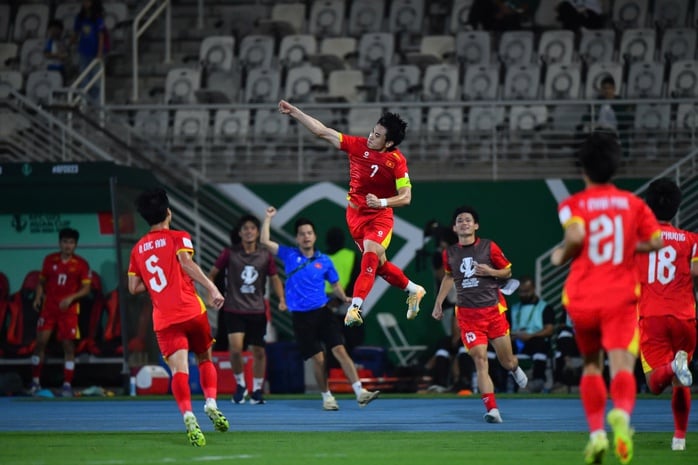
Vietnam U23's impressive performance at the AFC U23 Asian Championship is just the beginning. Photo: AFC
The 2026 AFC U23 Championship also leaves much to ponder; Saudi Arabia is hosting it in small stadiums, and there's no proper awards ceremony... Several details quite clearly reflect the tournament's standing within the Asian football system.
Vietnamese football often achieves high results in U23 tournaments that alternate with the Olympics, such as runner-up in 2018 or third place in 2026. In reality, in U23 tournaments that are linked to Olympic qualification – when teams field their strongest squads – Vietnam has not achieved high results. Specifically, they were eliminated early and finished last in their groups in 2016 and 2020; in 2024, they finished second in their group, reaching the quarterfinals and losing 0-1 to Iraq.
Even the Olympics are considered not the benchmark for top-level football. Brazil has won the World Cup four times but only won an Olympic gold medal in 2016, on home soil; Argentina won the World Cup in 1978 and 1986 but only won an Olympic gold medal in 2004. Youth achievements are not a measure of a nation's football strength, although they reflect development in the right direction and, to some extent, sustainability.
Therefore, we need to be realistic about the goals of Vietnam's football development plan. Viewing the victory at the U23 Asian Championship as proof of progress might not be entirely accurate, as this achievement is merely an advantage in a competition where some teams don't prioritize technical skill. What's truly important is whether the progress of the Vietnamese U23 team, following their achievements at the SEA Games 33 and the U23 Asian Championship, will help create a strong successor generation for the national team in the near future, aiming for the 2027 Asian qualifiers and the 2030 World Cup!
Source: https://nld.com.vn/be-phong-tu-giai-u23-chau-luc-196260125211249433.htm























































































Comment (0)