Amidst the modern pace of life creeping into even the smallest villages in the highlands, the sound of the Nung ethnic people's lin xin instrument still resonates like a persistent underground stream.
At the age of seventy, artisan Vang Van Seng (Coc Cooc village, Pa Vay Su commune, Tuyen Quang province) still tirelessly "keeps the flame alive" and teaches the traditional sounds of his ancestors, so that the "sacred spirit" of the forest does not fade away with time.
The soul in the life of the Nung people
Early in the morning in Coc Cooc village, as dew drops still clung to the petals of wild peach blossoms, the tranquil atmosphere of the Pa Vay Su highlands was awakened by melodious, heartfelt sounds. These sounds were not loud or ostentatious, but powerful enough to penetrate the thick mist, stirring the heart like the gentle murmur of a stream flowing from the heart of the rocks. It was the sound of the lin xin instrument emanating from the small house of the artist Vang Van Seng.
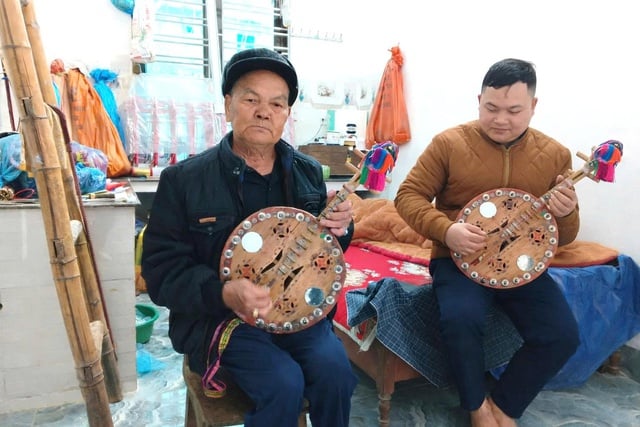
Artisan Vang Van Seng (left) teaches the younger generation how to play the lin xin instrument.
PHOTO: DO TU
At over 70 years old, Mr. Séng's hands, though calloused from the harsh weather and farming, become surprisingly soft and graceful when they touch the strings of the instrument. He recounts that he developed a passion for this instrument in his childhood. On cold winter nights before electricity, by the crackling fire, young Séng was captivated by the music of his father and the elders in the village.
"Back then, the sound of the guitar echoing in the night was like the sound of a stream flowing through the vast mountains and forests. Before I knew it, that melody had seeped into my very being," Mr. Séng recalled nostalgically.
Driven by his passion, he taught himself, painstakingly figuring out how to play the strings and keep the rhythm. His fingers, bleeding from the steel strings, became calloused over time, eventually making him the most skilled player of the "lìn xìn" instrument in the region, the one who "sets the rhythm" for the village's major festivals.
The lin xin instrument has a relatively simple structure but embodies the sophistication of traditional craftsmanship. The instrument resembles the nguyet lute, with a wooden body approximately 70 cm long. The soundbox is round and flat, decorated with gleaming aluminum or silver pieces. Notably, the headstock is often embellished with the distinctive brocade fabrics of the Nung people.
The strings of the lin xin, traditionally made of horsehair, are now replaced with nylon or thin steel strings to enhance the resonance of the sound. For the Nung people of Pa Vay Su, the lin xin is not simply a musical instrument; it is the "voice of the heart" in every nuance of human emotion. In festivals, weddings, and housewarming celebrations, the lively sound of the lin xin urges on the steps, harmonizing with the luon songs praising the Party, President Ho Chi Minh, and the renewed homeland.
During romantic nights, the music becomes deeply moving, serving as a bridge connecting lovers. In funerals, however, the music is somber, bidding farewell to the deceased as they return to their ancestors.
Artisan Chang Thi Ve, a knowledgeable local folk culture expert, shared: "The lin xin instrument is the soul of community rituals. It connects people together across generations."
The aspiration to continue the legacy in the digital age.
Although the sound of the instrument still resonates every day, a hint of melancholy lingers in the eyes of the old craftsman. Modern life, with its smartphones, portable speakers, and electronic entertainment, is infiltrating every corner of the village. Young people today are engrossed in upbeat music online, and many no longer know the name or appearance of the instrument their ancestors used.
"The young people have all gone away to study or work. Those who stay at home only like listening to music on their phones. I'm very worried that if I pass away without anyone to carry on the tradition, the sound of the linhin instrument will just follow me to the grave," Mr. Séng said.
Concerned about the risk of this art form disappearing, artisan Váng Vần Séng transformed his porch into a special classroom. Every evening after school, children gather around him to learn to play the instrument. He patiently holds each child's hand, adjusts their posture, and guides them on how to tune the strings and keep the rhythm.
"Teaching the children isn't just about teaching techniques, but also about teaching them why their ancestors cherished this instrument so much. Learning to play the instrument is also about learning how to behave, and learning to love their village," Mr. Séng confided.
Beyond performing and teaching, Mr. Séng is also a self-taught "engineer." From rudimentary materials like scraps of wood, water pipes, or old milk cans, his skillful hands transform them into instruments with unique tones. Each instrument he creates is another "bridge" connecting the past to the future.
Speaking with reporters, Mr. Duong Van Phu, Head of the Culture Department of Pa Vay Su commune, affirmed that artisan Vang Van Seng is one of the most valuable "living human treasures" of the locality.
"Mr. Séng plays a very special role in preserving intangible cultural heritage, creating a foundation for building a mass arts movement associated with community tourism development in the future," Mr. Phú observed.
During national unity festivals or spring festivals, the image of Mr. Séng, dressed in traditional indigo attire, embracing his lin xin instrument and playing melodiously amidst the villagers, has become a symbol of the vitality of Nùng culture. His music not only enriches spiritual life but also serves as a gentle yet profound reminder of the ethnic group's origins.
Leaving Pà Vầy Sủ as the sun rose higher, with the sound of the lìn xìn instrument still echoing in my ears, I believe that, with dedicated "keepers of the flame" like artisan Váng Vần Séng, the sounds of the vast forest will continue to resonate, enduring and powerful, just like the vitality of the people in the border region of Tuyên Quang.
Source: https://thanhnien.vn/nguoi-giu-hon-thieng-noi-dai-ngan-185260402210802538.htm



























































































Comment (0)