

The Jrai people in the Ayun Pa and Krong Pa regions also live in longhouses like the Ede people, but the staircases are usually not as elaborately decorated as those of the Ede and M'Nong people in Dak Lak .
In front of the longhouse, the Jrai people mainly use a single round or flat staircase, but it's narrower, giving people a precarious feeling when going up and down. Those unfamiliar with it must be cautious with each step. Wealthier families pay more attention to decorating the top of the main staircase with two breasts and a crescent moon, symbolizing prosperity and the role of the woman—the head of the household.
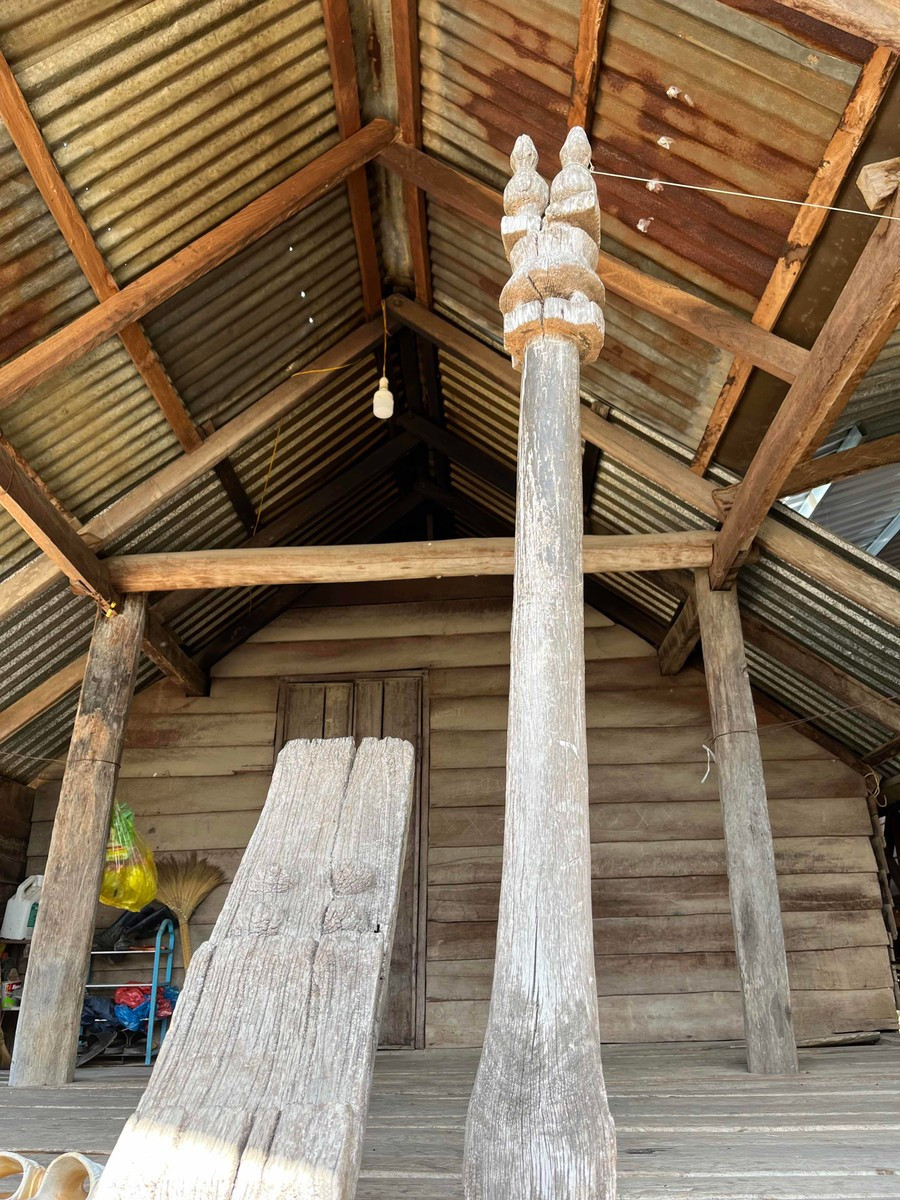
Cultural researchers suggest that the breast sculptures on the staircases of some indigenous ethnic groups in the Central Highlands represent fertility and reflect the matriarchal system still existing within the community. The crescent moon at the top of the staircase also carries a feminine meaning, signifying the honoring of women's role in society.
For the Ede and M'Nong people, the more sturdy and ancient the longhouse, the wider and more spacious the front floor, and the more often it is designed with two staircases; one main staircase (larger, flat-style) with a slightly curved top like the bow of a boat, traditionally carved and decorated, and a smaller secondary staircase often carved with star and turtle motifs.
The steps leading up and down are made in odd numbers—a lucky number according to the beliefs of the indigenous people—just enough to allow a foot to slide sideways. For longhouses with many inhabitants, an additional staircase is often added at the back door for convenience.
Previously, some believed that Ede houses had a "male staircase" and a "female staircase" structure. However, in reality, village elders say that their tradition does not include such a classification. In the past, out of hospitality, Ede houses had two staircases, one intended for family members and the other for guests.
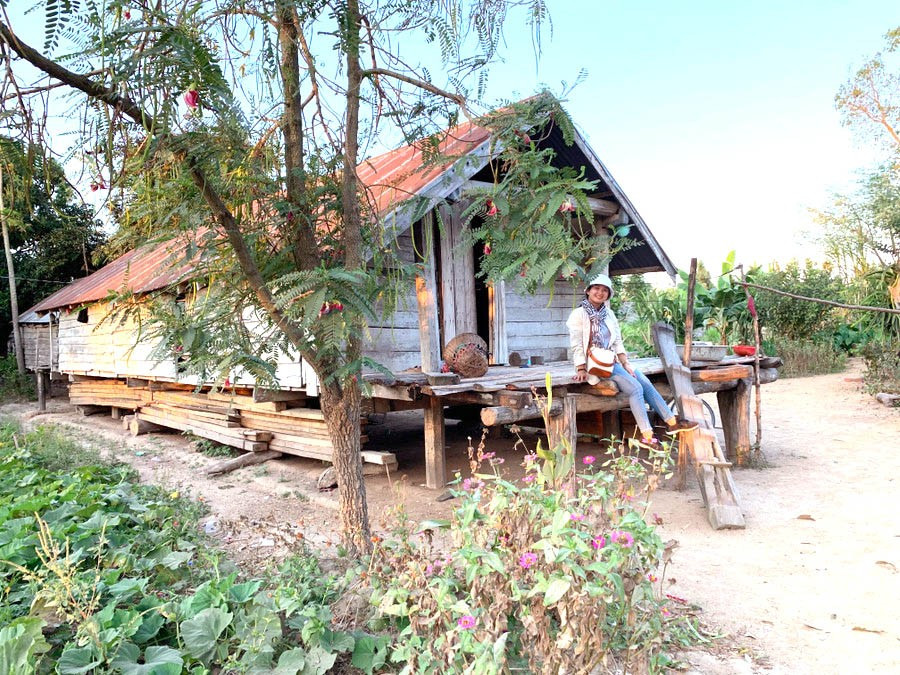
For ethnic minorities in the Central Highlands, the staircase of a stilt house is just as important as the main pillars and rafters of the house. Therefore, they must choose good quality wood from the forest, such as teak or mahogany, that is durable, resistant to termites, and sturdy enough to last as long as the house.
Before going to find wood for a staircase, the Jrai, Ede, and M'Nong people perform a ritual to worship the forest spirit, asking permission to bring the wood back to build the staircase. The simplest offerings are a chicken and a jar of wine. Wealthier people offer a pig, wine, and invite skilled artisans to carve, refine, and sculpt the staircase to match their longhouse, a process that takes at least a few days. These are flat, wide staircases, considered an aesthetic element that enhances the overall architectural beauty of the house.
Today, when I return to the Jrai villages in Ayun Pa, Ia Pa, and Krong Pa, many families build houses with unusual architecture, pointed roofs, and elaborate decorations similar to Thai houses. The staircases are also not designed traditionally with solid blocks of wood, but rather as stepped staircases like those in multi-story houses of the Kinh people.
Many people have told me that they also want to maintain the traditional longhouse architecture of their ancestors, but wood is becoming increasingly scarce, especially good quality wood. To have a beautiful staircase suitable for a traditional longhouse, they have to order it from traders months in advance. Therefore, for convenience and ease of access, many families are building modern staircases with handrails.
Preserving the traditional architectural foundations of the villages, including the long stilt houses and distinctive staircases, seems to be facing obstacles and gradually disappearing. The conditions for completing a traditional house of ethnic minorities are becoming increasingly difficult, so most are building single-story houses using modern materials.
Source: https://baogialai.com.vn/ben-chiec-cau-thang-nha-dai-post320781.html
![[Photo] President Luong Cuong receives Speaker of the Jordanian House of Representatives Mazen Turki El Qadi](/_next/image?url=https%3A%2F%2Fvphoto.vietnam.vn%2Fthumb%2F1200x675%2Fvietnam%2Fresource%2FIMAGE%2F2026%2F02%2F03%2F1770112220330_ndo_br_1-3704-jpg.webp&w=3840&q=75)


Comment (0)