


From locally grown rice grains, the skillful hands of village artisans have created the traditional rice vermicelli with a delicious, chewy, and rich flavor that few other places can match. Currently, Thang Long Long rice vermicelli is sold in many localities inside and outside the province, and is highly appreciated by customers for its quality.

The only ingredient used to make Thang Long rice vermicelli is plain rice, usually Khang Dan 18 or Kim Cuong 98 varieties… no other additives are used. Photo: Hoa Mai/TTXVN
As one of the households with over 20 years of experience in the trade, Mr. Le Ba Phiệt's family (Tan Giao village, Thang Binh commune) produces an average of about 20 tons of vermicelli per year. During the Tet holiday season, the family produces about 200 kg of vermicelli per day, earning 500,000 - 600,000 VND per day.
Despite working day and night, the vermicelli sells out as soon as it's made. Currently, with only about half a month left until Lunar New Year, orders are piling up, but fearing they won't be able to keep up, the family isn't accepting any more orders.
Mr. Le Ba Phiệt (Tan Giao village, Thang Binh commune) said: "To produce translucent, fragrant vermicelli noodles, all stages such as selecting rice, soaking, grinding flour, spinning, and drying are done carefully, meticulously, and cleanly by our family. Currently, Thang Long rice vermicelli has a brand name and a place in the market, so we are very excited. This will be a motivation for the people of the craft village to continue building, preserving, and developing this traditional craft."

Mr. Le Ba Phiệt (Tan Giao village, Thang Binh commune) said that to produce translucent, fragrant vermicelli noodles, all steps such as selecting rice, soaking, grinding flour, spinning, and drying are done carefully, meticulously, and cleanly by his family. Photo: Hoa Mai/TTXVN
According to the artisans here, the only ingredient used to make rice vermicelli is plain rice flour, usually Khang Dan 18 or Kim Cuong 98 rice, and no other additives are used, ensuring food safety. Making vermicelli involves many steps and a continuous production process, so the workers are always busy. First, the rice is soaked for 2-4 hours, depending on the season (longer soaking is needed in winter), then ground into a watery paste, filtered, fermented, and dried. After drying, the paste is extruded into vermicelli strands. These strands are then fermented for about 5-7 hours, rinsed with cold water, and further dried on bamboo racks under the sun before being packaged as finished products.
Along with gradually improving production techniques to enhance economic efficiency and create jobs for workers, the issue of ensuring food safety and hygiene is also a concern for the local government and households involved in the Thang Long rice vermicelli production industry. Previously, vermicelli in the village was made entirely by hand, resulting in low production. Now, thanks to bold investments in machinery for grinding flour, shaping strands, and drying vermicelli, productivity has increased significantly, and many families in the Thang Long vermicelli village have earned considerable income and become wealthy. Furthermore, from small-scale household production, in recent years, many vermicelli producers in Thang Binh commune have joined together for concentrated production, gradually improving quality and design, and building their own brands.
Ms. Nguyen Thi Hang, owner of the Thai Hang production facility (Tan Giao village, Thang Binh commune), said that she usually wakes up at 4 a.m. to soak rice, grind flour, and make vermicelli. In the afternoon, she is busy weighing and packaging products to deliver to traders. For three months leading up to Tet (Lunar New Year), households in the craft village have almost no days off, but this provides them with a significant additional income to prepare for the holiday.

Ms. Nguyen Thi Hang, owner of Thai Hang production facility (Tan Giao village, Thang Binh commune), said that in the three months leading up to Tet (Lunar New Year), households in the craft village have almost no days off, but in return, they earn a significant additional income to prepare for Tet for their families. Photo: Hoa Mai/TTXVN
Mr. Truong Huu Hoa, Director of Thang Long Rice Vermicelli Production Service Cooperative (Thang Binh commune, Thanh Hoa province), said: The Thang Long Rice Vermicelli Production Service Cooperative has gradually standardized the production process, improved packaging designs, and especially focused on input materials, considering this a decisive factor in the quality of Thang Long rice vermicelli. Currently, nearly 60 households in the commune are engaged in the profession, of which 28 households participate in the Thang Long Rice Vermicelli Production Service Cooperative.

Drying vermicelli noodles. Photo: Hoa Mai/TTXVN
To further expand and develop the craft village, the Thang Long Rice Vermicelli Production and Service Cooperative will focus even more on promoting and introducing its products to customers both domestically and internationally.
According to the leaders of Thang Binh commune People's Committee, the rice vermicelli making industry has created jobs for about 300 workers in the commune. Each year, households produce more than 800 tons of vermicelli, worth approximately 16 billion VND, with each household earning an average income of 8-10 million VND per month from vermicelli production. During Tet (Lunar New Year), due to high market demand, wholesalers from various places come here to collect goods and place orders with rice vermicelli producers as early as October of the lunar calendar to ensure they have stock for sale during the Tet holiday.

The most laborious step in making vermicelli is drying, as this process is highly dependent on the weather. However, Thang Long rice vermicelli enjoys a stable market and fetches a good price. Photo: Hoa Mai/TTXVN
In particular, since being recognized as a 4-star OCOP product at the provincial level (in 2024), the Thang Long rice vermicelli brand has been further affirmed in the market, supplying many provinces and cities nationwide. Amidst the bustling work pace of the days leading up to Tet (Lunar New Year), these pristine white, fragrant, and chewy rice vermicelli strands not only encapsulate the flavors of Tet in the countryside but also convey the hopes for a prosperous and abundant new year for the people of Thang Long rice vermicelli village.

Vermicelli noodles are transported directly from the farm by traders for distribution. Photo: Hoa Mai/TTXVN

Packaging vermicelli at Thang Long Rice Vermicelli Production Service Cooperative (Thang Binh commune, Thanh Hoa province). Photo: Hoa Mai/TTXVN
*Similarly, the atmosphere at the traditional spring roll wrapper (bánh ram) making village in Ha Tinh is more bustling than ever. In Binh Hung residential area, Thanh Sen ward (Ha Tinh), people are concentrating maximum manpower and machinery to supply millions of bundles of wrappers to the market, meeting the needs of people nationwide and for export.

Villagers in Binh Hung craft village, Thanh Sen ward (Ha Tinh province) take advantage of the sunny weather to dry rice paper. Photo: Hoang Nga/TTXVN.
Binh Hung residential area, Thanh Sen ward (formerly Binh village, Thach Hung commune) is considered the "cradle" of Ha Tinh's traditional rice cake making craft, with the Tet atmosphere permeating every alleyway. Binh Hung residential area was recognized and a plan for preserving and developing this traditional craft village was issued in 2021. From the initial small-scale production by individual households, the craft has now spread to neighboring areas, becoming the main source of income for many families.
Leading us on a tour of the production workshop, Ms. Tran Thi Thuy (Binh Hung residential area), a household with decades of experience in the trade, shared that although making banh ram (a type of Vietnamese rice cake) is hard work, it provides a very stable income, especially in the context of the increasing demand for clean food with clear origins.
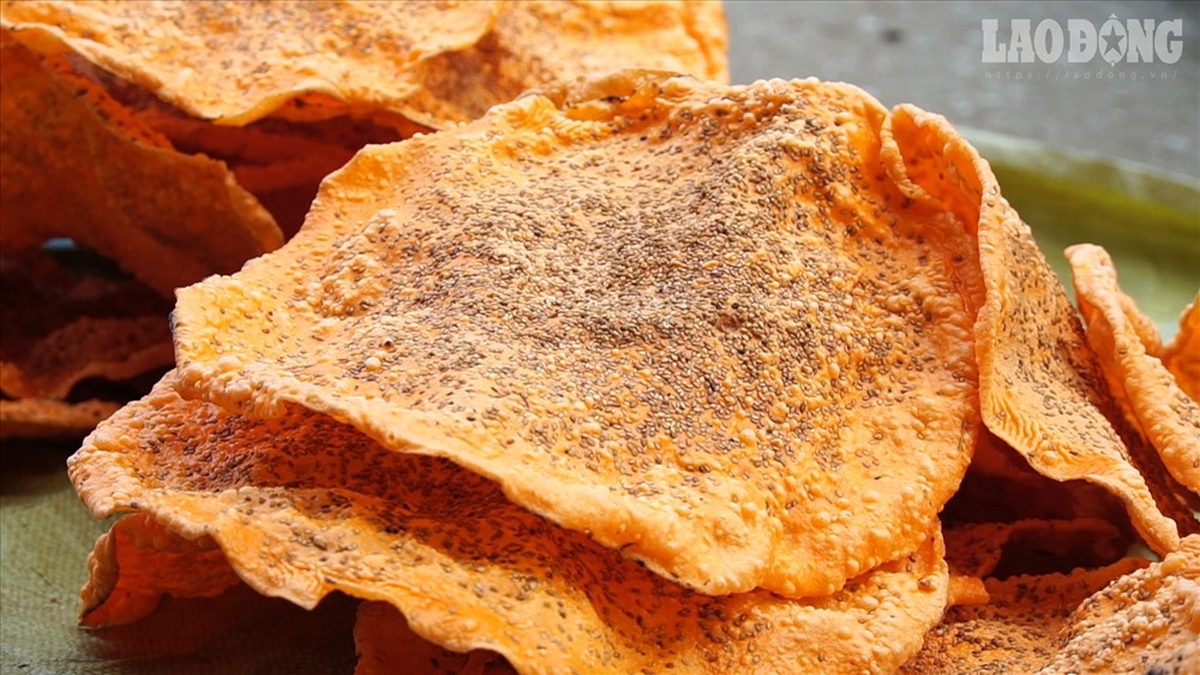
The appeal of Ha Tinh's banh ram (rice flour cakes) lies in the secret of its ingredient blend. The rice used must be a type of traditional, locally grown rice with just the right dryness. The secret to its attractive light yellow color and characteristic chewiness is the mixing of molasses in a specific ratio with the rice flour. The drying process also requires meticulous care; the cakes must not be dried under harsh sunlight as this will make them brittle and break, nor should they be exposed to drizzle as this will cause mold. The dry, sunny days of the Central Vietnamese winter are considered the "golden time" for the cakes to achieve the ideal dryness, maintaining their chewiness when wrapped and their crispiness when fried.

Stacks of rice paper rolls are being packaged, ready for delivery to customers. Photo: Hoang Nga/TTXVN
In recent years, instead of completely manual rice paper making as before, many households have invested in automatic rice paper making machines, increasing productivity by 3-4 times and ensuring uniform thickness to meet the strict standards of supermarket chains. In addition, many households have also invested in machinery for processes such as drying and cutting the rice paper to ensure the quality meets customer requirements.
According to a report from the local government of Thanh Sen ward, the craft of making banh ram (a type of Vietnamese rice cake) not only contributes to preserving the cultural identity of the traditional craft village but also creates regular jobs for more than 200 local workers. This is a significant number in stabilizing social welfare and helping people have a stable source of income right in their hometown.
Currently, over 120 households in Thanh Sen ward are closely involved in the production of banh ram (a type of Vietnamese rice cake). The total revenue from this profession is estimated to bring the ward more than 31 billion VND per year. Making banh ram has become an important livelihood, helping many families not only escape poverty but also become wealthy, purchase modern equipment, and provide their children with a successful education.
To enhance its brand image, Ha Tinh province has promoted the One Commune One Product (OCOP) program in recent years. Many rice paper production facilities in Thanh Sen ward have achieved OCOP 3-star and 4-star certifications. This opens up great opportunities for the product to reach a wider market. Currently, Ha Tinh rice paper is present in demanding markets such as Japan, South Korea, and some European countries through official export channels and personal import.
Mr. Tran Van Thanh, Director of Nhat Thanh Rice Paper Production Company Limited in Tran Phu Ward, said that the international market demand for Ha Tinh rice paper is very high due to the durability of the rice paper during long-distance transportation and its unique, unmistakable flavor. However, the biggest challenge currently is ensuring consistency in quality and meeting the strict food safety and hygiene standards of other countries. The company has been building a closed production process, from selecting clean rice to vacuum packaging and affixing traceability labels.
Besides the advantages, the craft village is also facing some difficulties such as the shrinking area of land for drying rice cakes due to urbanization and unpredictable weather changes. To overcome this, the Ha Tinh provincial government is encouraging households to invest in modern electric drying systems, helping them to proactively produce in all weather conditions, especially during the drizzly season leading up to Tet.
Meanwhile, these days, Tet flower growers in Dak Lak province are busy tending to their flowers, preparing to supply the market in many provinces and cities. According to the growers, this year, due to the complicated natural disasters, the supply is somewhat scarcer compared to previous years. Therefore, the market for Tet flowers is stable, and they expect to bring good income to the flower growers.

Picking chrysanthemum buds at Khanh Xuan Flower Village, Dak Lak province, provides additional income for local workers. Photo: Tuan Anh/TTXVN
Observations at Khanh Xuan Flower Village – the chrysanthemum capital in Thanh Nhat ward, Dak Lak province – show that these days, flower growers are closely monitoring the developments of the Tet holiday season, strengthening appropriate flower care measures to ensure the quality of Tet flowers, and preparing to supply the market.
With over 10 years of experience growing crystal chrysanthemums in Khanh Xuan Flower Village, Mr. Nguyen Le Vu said that this year his family planted more than 1,000 pots of crystal chrysanthemums. Currently, they are in the peak period of care to ensure the flowers bloom beautifully and at the right time for the Lunar New Year of the Horse. This year, the weather in many flower-growing areas has not been favorable, so the price of flowers on the market is higher than in previous years. Traders from many southern provinces and cities have also come to the Flower Village to place orders and will arrive around the 20th of December (lunar calendar) to transport the flowers for sale, serving people's Tet flower shopping.
Excited by the slightly higher flower prices this year and the high demand from traders, Ms. Nguyen Thi Hong Hanh from Khanh Xuan Flower Village happily shared: "For the Tet flower season, my family planted 700 pots of crystal chrysanthemums. This year, the weather has been rainy and cold for a long time, so flower growers have adjusted their care, especially regarding watering, bud removal timing, and pest and disease control... in order to create the most beautiful pots of flowers to meet the Tet holiday needs of the people."
“Currently, traders have placed deposits for the entire chrysanthemum garden at prices ranging from 300,000 VND to 1.5 million VND per pot, depending on the size and quality of the flowers. This selling price is about 100,000 to 200,000 VND higher per pot compared to last year. At this time, flower growers need to be meticulous and ensure proper care techniques, especially in the period leading up to the Lunar New Year, to prepare for delivering flowers to traders,” shared Ms. Nguyen Thi Hong Hanh.

Pots of chrysanthemums are being prepared for sale to people celebrating Tet (Lunar New Year). Photo: Tuan Anh/TTXVN
In Binh Kien Flower Village, Dak Lak province, despite suffering heavy losses after successive natural disasters, the villagers are still busily tending to their flowers and ornamental plants to ensure they are ready for the Lunar New Year market.
Ms. Nguyen Thi Lien, from Binh Kien Ward Flower Village, said that Typhoon No. 13 and the historic floods in November 2025 caused severe damage to the flower-growing area of Binh Kien Ward, with most of the previously invested crops being destroyed. After the natural disasters, the farmers had to invest time and money in replanting and race against time to meet the planting season and hope to earn income during the Tet flower season. Currently, flower growers in Binh Kien Ward are making efforts to care for the flowers to ensure product quality. At the same time, they are linking with consumption markets to "sell" their goods in the period leading up to Tet.
According to Ms. Huynh Thi Nho from Binh Kien ward, flower growers are entering the most crucial stage of cultivation in their gardens. In particular, they are mobilizing additional workers to remove buds and prune branches to adjust the flowering time to coincide with the Lunar New Year. Despite increased investment and labor costs following the recent natural disasters, flower growers are still striving to cultivate the Tet flower crop to restore their livelihoods after the disasters.
Mr. Luong Thao Nguyen, Vice Chairman of the People's Committee of Binh Kien Ward, Dak Lak Province, said that the ward has over 50 hectares of land cultivated with various types of flowers. Currently, about 50% of the produce from gardens less affected by natural disasters has been reserved by traders. For the remaining areas, farmers are still maintaining care and monitoring market developments to ensure supply. The local government has proactively developed plans to connect with markets and support consumption to minimize risks for people after a year of severe natural disasters. In particular, the locality is actively coordinating with relevant units to find stable outlets, helping farmers feel secure during the final stages of the Tet flower season.
To create a joyful and exciting atmosphere and stimulate the Tet flower market, the People's Committee of Dak Lak province has also assigned the People's Committees of Buon Ma Thuot and Tuy Hoa wards to organize the Spring Flower Festival of the Year of the Horse 2026, from February 11th to February 16th, 2026 (24th to 29th of the 12th lunar month), at the March 10th Square (Buon Ma Thuot ward) and Ho Son Lake Park (Tuy Hoa ward).
Source: https://baotintuc.vn/kinh-te/cac-lang-nghe-ron-rang-vao-vu-tet-20260203132140364.htm
![[Photo] National Assembly Chairman Tran Thanh Man visits and works with the National Assembly Committees and the State Audit Office.](https://vphoto.vietnam.vn/thumb/1200x675/vietnam/resource/IMAGE/2026/02/23/1771848141941_ndo_br_bnd-6798-jpg.webp)



































































Comment (0)