

Recently, we published an article in Thanh Nien Newspaper about the discovery of a sun chariot in the Dong Son culture. Now, we have discovered another artifact that we believe is closely related to the aforementioned sun chariot. It is a bronze ornament from the collection of Mr. Ut Ruong in Ho Chi Minh City. He said it was retrieved from a riverbed in Thanh Hoa province.
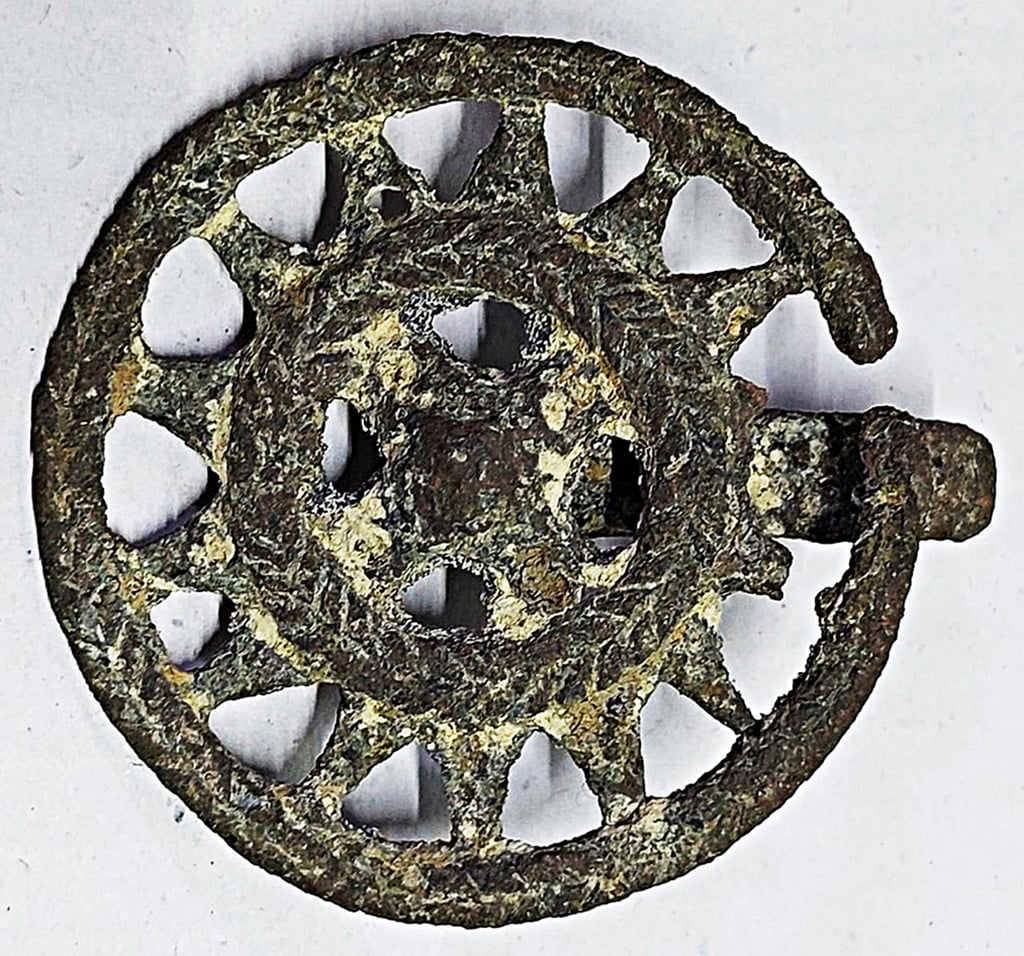
Front view of the sun wheel
The ornament is circular with a hook, 4.3 cm in diameter. At first glance, I immediately recognized it as belonging to the Dong Son culture because the inner rim has many rays resembling the sun on bronze drums from the same period, and especially because the rim is engraved with leaf and branch patterns, one of its distinctive features. However, upon closer examination, besides resembling the sun, it also has a wheel-like shape: In the center is an axle with 4 spokes, followed by a circular rim with 14 rays, one of which is broken, and the outermost rim is also broken in a small section. Notably, on the back there is a horizontal bar originating from the center of the axle, extending over the outer rim for a short distance, with a hook at the end pointing inwards.
Based on the above description, it appears that this piece of jewelry is similar to other belt buckles from the same period that have been discovered by archaeologists, especially the sun-shaped belt buckle currently housed at the Barbier-Mueller Museum (Switzerland).
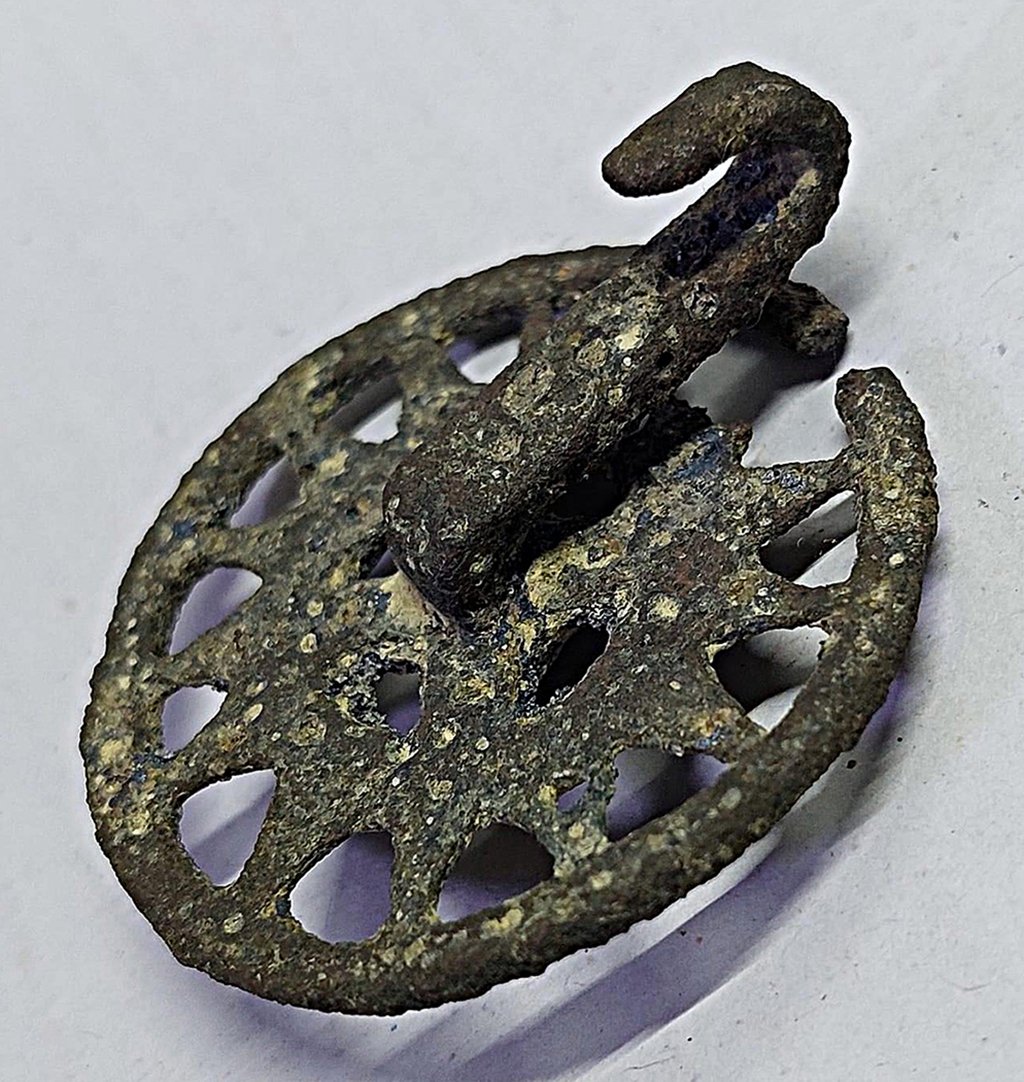
The back of the sun wheel
However, a comparison reveals structural differences, such as the hooks facing outwards and having ends to attach to belt loops, and notably, the absence of a horizontal bar; the hooks are seamlessly integrated with the buckle. Despite these differences, it's clear that this piece of jewelry is attached to or hung on something.
Although its function has not yet been determined, the interesting aspect here is that this piece of jewelry is depicted with features that resemble both the sun and the wheel.
Regarding the sun, the ornaments have rays similar to the sun depicted on bronze drums of the same period. Regarding the wheel, according to the Dictionary of World Cultural Symbols (pp. 59, 60): It is a symbol of the sun in most cultures… Many beliefs, formulas, and customs associate the wheel with the structure of sun myths. The symbolic meaning of the wheel arises both from its radiating arrangement and from its movement. The radiating rays of the wheel make it appear as a symbol of the sun.
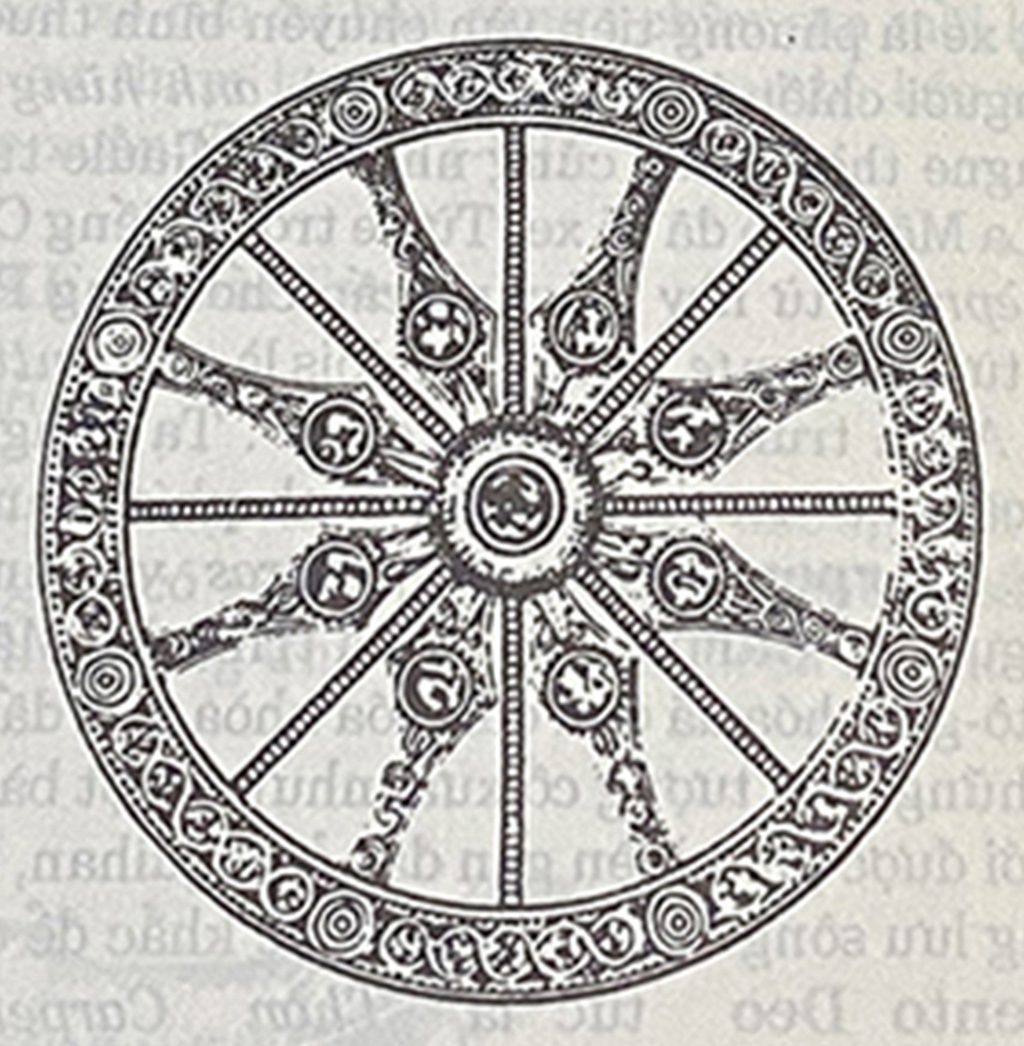
The sun wheel at the sun temple in India.
Dictionary of World Cultural Symbols, p. 1019
In Indian scriptures and paintings, the wheel typically has 12 spokes, the number of the zodiac, the number of the solar cycle. The simplest wheel has 4 spokes: representing the four directions of space. A wheel with 6 spokes brings us back to the symbol of the sun. The most common wheel always has 8 spokes: representing the eight directions of space…
Overall, the characteristics of this ornament, combined with the dictionary entries mentioned above, allow us to conclude that it is a sun wheel. With this discovery, we will have a basis to explain why the image of the sun on all Dong Son bronze drums is always depicted tightly within a circle, without leaving any space to represent the sky.
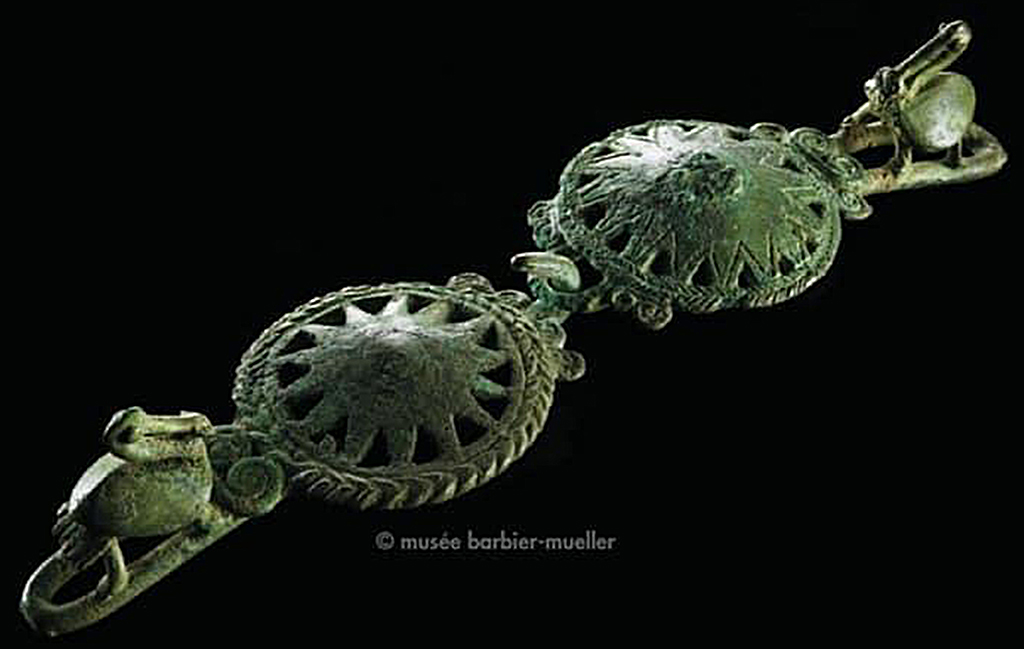
Dong Son belt buckle at the Barbier-Mueller Museum
Next is the chrysanthemum motif on a bronze axe, also surrounded by a circle. Perhaps it represents both the sun and the wheel, and the chrysanthemum is similar. In addition, we must also mention the leaf and branch patterns that the Dong Son artisans incorporated into this ornament.
This indicates a close connection between the sun and a sacred plant revered by contemporary society. Thus, the discovery of the sun wheel and the sun chariot reveals that the sun worship beliefs of the Dong Son culture were rich, but also encompassed both endogenous and exogenous elements.
Source: https://thanhnien.vn/giai-ma-van-hoa-dong-son-bi-an-co-xe-mat-troi-185240630224150095.htm

![[Photo] General Secretary To Lam attends the inauguration ceremony of Si Pa Phin multi-level boarding school.](/_next/image?url=https%3A%2F%2Fvphoto.vietnam.vn%2Fthumb%2F1200x675%2Fvietnam%2Fresource%2FIMAGE%2F2026%2F01%2F31%2F1769840655651_ndo_br_z7486540481209-f37c7e00a962aec2a061c64b7db569ef-jpg.webp&w=3840&q=75)


![OCOP during Tet season: [Part 3] Ultra-thin rice paper takes off.](/_next/image?url=https%3A%2F%2Fvphoto.vietnam.vn%2Fthumb%2F402x226%2Fvietnam%2Fresource%2FIMAGE%2F2026%2F01%2F28%2F1769562783429_004-194121_651-081010.jpeg&w=3840&q=75)


![OCOP during Tet season: [Part 2] Hoa Thanh incense village glows red.](/_next/image?url=https%3A%2F%2Fvphoto.vietnam.vn%2Fthumb%2F402x226%2Fvietnam%2Fresource%2FIMAGE%2F2026%2F01%2F27%2F1769480573807_505139049_683408031333867_2820052735775418136_n-180643_808-092229.jpeg&w=3840&q=75)


Comment (0)