1.
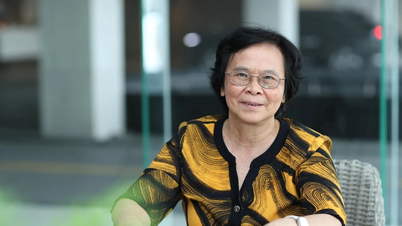
Poet Tran Dang Khoa met me in a rather simple room on the 5th floor of the Vietnam Writers Association (9 Nguyen Dinh Chieu Street, Hanoi ). Although he retired and received his pension on May 1st last year, Tran Dang Khoa has still held the position of Vice President for over a year because he has to wait until the congress to return the remaining funds. He has also returned the Vice President's office to the agency and now shares a room with the editors of the Writers & Life magazine, where he once served as Editor-in-Chief. Sadly, this magazine has ceased operations for almost a year and a half awaiting restructuring.

Poet Tran Dang Khoa. Photo: Tung Dinh.
The situation that Tran Dang Khoa described to me is quite similar to what happened more than ten years ago, when he resigned from his position as Deputy Secretary of the Party Committee of the Voice of Vietnam Radio , even though according to the regulations of the Party Committee of the Central Agencies Bloc at that time he still had 18 months to reach retirement age. He was then given a room, a car, and the status of a regular employee, and was transferred to work at the Vietnam Writers Association.
Returning to this morning, at nearly 70 years old, Tran Dang Khoa is still enthusiastic and full of energy. He said: "The issue of the sea and islands that you have raised is very good. This is a major theme in literature. It's a theme of universal significance. Many great works, classics of the world, have written about this theme: 'The Old Man and the Sea,' 'Robinson Crusoe,' 'Twenty Thousand Leagues Under the Sea,' 'The Captain and the Lieutenant,' 'Treasure Island,' 'Titanic,' and many more. So many. We are in an era of progress, an era of integration. This year's Poetry Day of the Vietnam Writers Association is also 'Before the Great Sea.' He himself has written a lot about the sea and islands. From his youth, when he was a naval soldier, until now, the sea and islands have always been present in his mind."
“The sea and islands are an endless subject, but writing about them well is not easy,” the former child prodigy of poetry said leisurely. Even the simplest thing, taking a picture of the sea and islands, is difficult, because everywhere looks the same. Although the poet Huu Thinh has a very good line, “The sea has islands, the sea avoids repeating itself,” even with islands, the sea and islands are all the same. They still repeat themselves. It’s that difficult. Taking our time, I asked him about his mini-novel, “Sunken Island,” a book that set a unique record. First published in 2000, it’s now exactly 26 years old, and by 2025 it has already been reprinted more than 50 times.

Tran Dang Khoa and memories of the sea and islands. Photo: Tung Dinh.
Tran Dang Khoa said that although it's called a novel, it's actually a true story that he didn't invent or fabricate. The story takes place on the submerged island. In reality, it's Thuyen Chai Island, currently just an underwater coral reef, still submerged about 3 meters below sea level. Soldiers set up tents on the sea to guard it. But he didn't just write about the submerged island; he also wrote about the above-water islands. The soldiers on the submerged island called it the Truong Sa Capital. The Truong Sa Capital is a very small island. It's so small that it's hard for people to imagine. So much so that a poet later exclaimed: "The island is so small, you can finish it in one sentence." Tran Dang Khoa visited an island so small that he finished it before he could even "say a word." It was just a small, salty patch of sand, about the size of a rice drying tray, just enough space to set up a makeshift tent.
Tran Dang Khoa recounted: "General Giap Van Cuong, Commander of the Navy, also came here and spent a night on this island during a sea patrol. 'Is it tough, guys?' the Commander asked a young soldier with bright red hair like boiled shrimp, tanned skin, and a sturdy build like a block of iron tempered in fire. The young soldier chuckled: 'Reporting to you, sir, it's alright!'"
Everything is scarce here," the Commander said sadly. "But whatever you need most, whatever is most urgent, just tell me directly. The Command will do everything possible to help you."
"So, Dad, let me tell you the truth!" "Yes, I have to tell the truth!" the commander smiled. "Surely I'm not old enough to brave the storms to come here with you guys, only to end up listening to your lies? But you can't criticize me for being romantic... You rascal! I'm even more romantic than you!"
The young soldier looked at the Commander's white hair and smiled innocently: "Well then, I suggest this to you, Father! Next time you come to the island, please bring a few girls with you for us..." The young soldier suddenly felt flustered by the Commander's astonished gaze. "But I asked you first, so you have to forgive me and not criticize me for being romantic! You want to hear singing? You want to see a cultural troupe, right? No, no!" the soldier stammered. "I wouldn't dare ask for anything extravagant! A cultural troupe seems too far-fetched! I only want you to bring a few girls to help with the chores! They don't have to sing, cook, or do anything else. We'll take care of everything. We just ask that they wear white cotton shirts and black silk trousers, strolling around the island so we can admire them and 'adjust' our eyesight. Because, as you can see, our eyes are already worn out!" The Commander laughed heartily. The young soldier laughed too. Trần Đăng Khoa had never heard such a strange conversation before.
Later, just as the young soldier had wished, the girls came to visit the island one after another. Not the supply crew, but the beautiful, well-groomed female entertainers. Each one looked lovely, fragrant, and resplendent like a mermaid. They sang, danced, and sewed for the soldiers. Many soldiers, even with brand-new clothes, secretly tore them apart and asked the girls to mend them. From then on, every time the Commander visited the island, the soldiers were treated to lavish feasts.

But that's a story for later. That afternoon, as he once confided privately to Tran Dang Khoa, he said he was deeply troubled by having to do the most difficult thing in his life as a general: cutting off soldiers' leave. Back then, some soldiers stayed on the island for four years, even nearly ten years at a time, unlike later when soldiers only stayed on the island for two years, and the island lacked everything. The commander said: "I don't want to torment you. But this is our homeland, our flesh and blood. What value are these handfuls of sand? But we're not just protecting these handfuls of sand and a few barren rocks, we're protecting the sea. Losing the island means losing the sea, and the sea surrounds us from North to South. All our enemies come from the sea. The French entered us through seaports, the Americans also came through seaports. We are close to mountains and rivers, yet the O Ma Nhi invaders also entered us through the Bach Dang estuary. So we must protect the islands and the sea. No matter how difficult it is, we must protect them. Even if we die, we must protect them."
As for your leave, we wouldn't mind at all. But the Command Headquarters is too poor. The whole country is poor too. Sending one of you on leave costs the Command Headquarters 20 tons of fuel for the entire ship's journey there and back. And that fuel has to be bought from abroad, and it's very expensive.
![[Photo] Exploring Ke Ga Lighthouse during low tide](https://vphoto.vietnam.vn/thumb/192x108/vietnam/resource/IMAGE/2026/06/22/1782111552078_anh-man-hinh-2026-06-22-luc-13-58-49.png)


Sitting beside the Commander on the scorching hot sand, even though the sun had long since set, the young soldier from Nghe An truly regarded the Commander as a close comrade. He shook the Commander's knee: "Father, what do you think of our Kingdom?" The Commander's gaze swept across the empty stretch of sand, then to the makeshift tent flapping in the wind, like an untamed horse, rearing up as if wanting to break free from its iron chains and gallop away with the wild wind. Beautiful, orderly. True military discipline.
"Just holding on like this here is already very good," the Commander's voice suddenly became melancholic. "Of course it's hard work! You've all suffered so much! I know! But unfortunately, this is our homeland, the ancestral land of our forefathers, so even if it's just rocks, pebbles, wind, and sand like this, we must protect it, not giving up an inch, not letting go a millimeter, even if it means sacrificing our lives and blood..."
"Yes, I understand! I understand, Father!" The commander embraced the sun-scorched, wind-burned shoulders of the young soldier from Nghe An. His eyes suddenly welled up with tears. The young soldier also clasped the commander's rough, calloused hand tightly: "Don't worry, Father! We're used to being here! We can endure any hardship! No enemy can steal our island. Rest assured! But it's true, Father. It's very hard and arduous. Sometimes, when I'm too tired, I even think, maybe we should just hide the island for now!"
The commander was surprised: "Hiding the island? What strange thing are you saying? How would you hide it?" The young soldier cheerfully replied: "Just let me borrow your shovel for now, Father." And early the next morning, when the commander returned to the island by boat, he found the young man shirtless, splashing around with the commander's shovel. But instead of scooping sand and dumping it into the sea, he was using the shovel handle to gently pry up coral rocks submerged several meters underwater, then painstakingly carrying them up and piling them around the base of the island to keep the sand from blowing away. "What are you doing? Hiding the island?" the commander asked. "Sir, I'm expanding... the territory!" the soldier chuckled, his face glistening with water. "Actually, I'm just 'dropping anchor' so the country won't drift away!"

Poet Tran Dang Khoa speaks with the Agriculture and Environment Newspaper. Photo: Tung Dinh.
2.
At this morning's tea party at the Vietnam Writers Association, besides myself and Tran Dang Khoa, there was also Mr. Nguyen Chu Nhac, a literary friend and also a close friend of the former child prodigy of poetry. According to Mr. Nhac, Tran Dang Khoa's writings about the sea and islands are a special case in contemporary Vietnamese literature.
Nguyen Chu Nhac believes that Tran Dang Khoa's greatest advantage lies in the fact that the poet writes not only from imagination or empathy, but also from the profound real-life experiences of a naval soldier who had visited Truong Sa many times since the early years after the country's reunification.
In Nguyen Chu Nhac's opinion, Tran Dang Khoa is one of the most outstanding contemporary writers when it comes to the sea, in both poetry and prose.
His writings possess a rare authenticity because behind each word lies the accumulated life experience gained over years of connection with the sea, islands, and soldiers. This is what gives his works their weight, allowing readers to feel the very breath of life in these harsh, windswept places.
In particular, when discussing the work "Sunken Island," Nguyen Chu Nhac offered many words of praise. According to him, despite its relatively short length, the book contains an astonishing amount of linguistic and intellectual power. Tran Dang Khoa's inherent poetic quality makes the descriptions of the seascape, the emotions, and the portrayal of people very poignant and evocative. This critic envisioned "Sunken Island" as a multi-act drama, in which each chapter is a performance with distinct characters and situations, yet closely linked together. One of the points that impressed him was how Tran Dang Khoa used humor to reflect reality. Amidst the difficulties, shortages, and dangers on the remote island, the writer did not fall into melodrama but chose a witty, sometimes playful, tone.

Tran Dang Khoa is an outstanding writer on the sea and islands. Photo: Tung Dinh.
Nguyen Chu Nhac specifically mentions the image of the "pig," which is actually a dog, as a clown character in folk Cheo theater, contributing to the vibrancy and connection of the work's storylines. However, according to Nguyen Chu Nhac, the enduring value of *Sunken Island* lies not only in its storytelling art. He argues that while Tran Dang Khoa's poetry about the sea has made a widespread impression on the public, his prose in *Sunken Island* carries a special intellectual weight. The writer does not merely praise soldiers or the beauty of the sea and islands, but also delves into issues concerning the human condition.
Nguyen Chu Nhac was particularly moved by the passages describing the sacrifices of naval soldiers. These deaths were not depicted in the usual tragic manner, but rather with all the anguish, sorrow, and haunting intensity. These details create a lingering emotional impact long after the reader closes the book. According to him, this is a sign of a work with profound humanistic depth and enduring vitality.
In Nguyen Chu Nhac's eyes, Tran Dang Khoa seems to be not only a renowned poet but also a leading prose writer on the theme of the sea and islands. From the experiences of a naval soldier to the linguistic talent of a poet, he transformed the hardships, losses, and beauty of Vietnam's sea and islands into rich, artistic prose imbued with humanistic spirit, leaving a profound mark on readers.

Writer Nguyen Chu Nhac. Photo: Tung Dinh.



3.
Returning to the topic of the sea and islands, Tran Dang Khoa reflected: The sea is fierce but always fresh and holds many mysteries waiting for us to discover and explore. The sea is an endless subject for literature and art, but in reality, Vietnamese literature and art have not yet produced many works worthy of the theme of the sea and islands. Simply put, this subject matter is an inexhaustible treasure, but we have not yet exploited its most valuable aspects. Perhaps the Agriculture and Environment Newspaper should organize a national writing competition on the theme of the sea and islands?
Then he explained that the value of the sea, first and foremost, is its age-old source of livelihood for a nation with "three mountains and four seas." The sea provides us with everything from shrimp and fish to every grain of salt in every corner of our homes. Along with its source of livelihood, the sea and islands are also an integral part of the country, forming the maritime borders and inseparable national sovereignty.

Tran Dang Khoa is famous for his works about the sea and islands, such as the novel *Sunken Island* and the poem *Love Poem of a Seaman*. Photo: Tung Dinh.
And romantic. That romantic quality of the sea remains endless to this day. Out there, far out at sea, are still the island soldiers guarding the sea and sky, amidst the vast expanse of waves, while our compatriots still go there every day to earn a living, contributing to the preservation of our nation's territorial waters.
The sky above may no longer hold you/No longer hold the sea. Just me and the grass/Even so, I will still remember/The sea on one side and you on the other...
Tran Dang Khoa enthusiastically recited a few lines from the poem "Love Poem of a Seaman," which he himself composed in 1981.
Source: https://nongnghiepmoitruong.vn/bien-dao-voi-tran-dang-khoa-d815273.html

![[Image] National conference summarizing one year of operation of the overall organizational model of the political system, the three-tiered government model.](https://vphoto.vietnam.vn/thumb/1200x675/vietnam/resource/IMAGE/2026/07/01/1782882811691_ndo_br_1-jpg.webp)







![[Video] Weather forecast for tonight and tomorrow, July 2nd, 2026: Tropical depression likely to strengthen into a storm; many areas will continue to experience thunderstorms.](https://vphoto.vietnam.vn/thumb/402x226/vietnam/resource/IMAGE/2026/07/01/1782911026600_thumb-dem-png.webp)