

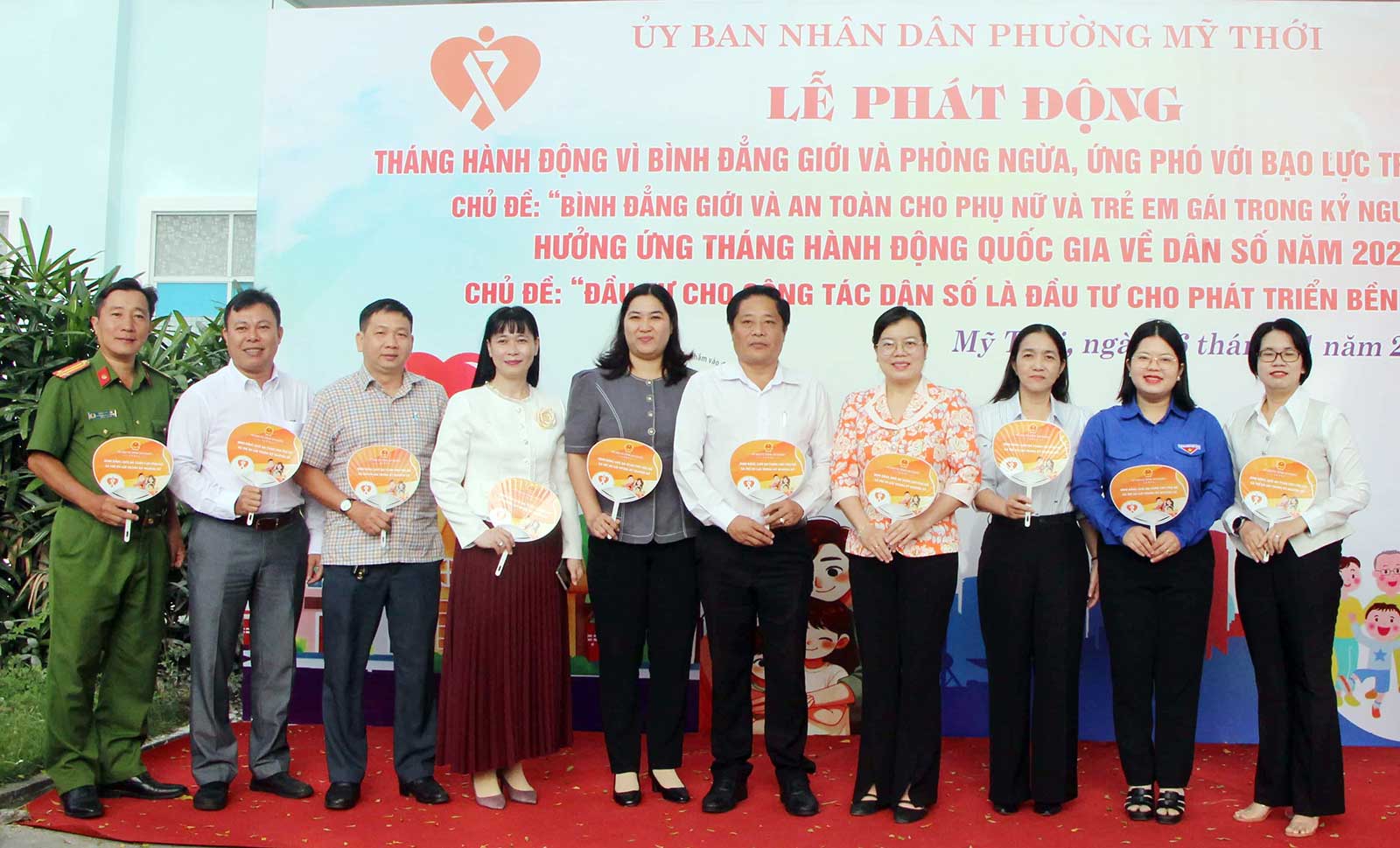
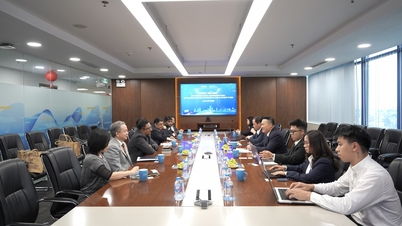
The People's Committee of My Thoi Ward organized a ceremony to launch the Month of Action for Gender Equality and Prevention and Response to Gender-Based Violence. Photo: Hanh Chau
The seven key tasks and solutions of the gender equality communication program have been implemented quite effectively by all levels, sectors, and localities in recent times. These include strengthening the provision of information, propaganda, and dissemination of laws, policies, and the results of gender equality work at the central and provincial levels to all levels of government, agencies, organizations, businesses, and the people; organizing appropriate information and propaganda activities for target groups on a regular basis and during peak periods each year; actively combating misinformation and misconceptions about gender equality; speaking out to eliminate gender stereotypes, with a focus on communicating with ethnic minority groups, poor women, women of working age, and other vulnerable groups.
Along with innovation in form and media, promoting the application of technology and digital platforms, and diversifying types and products in communication work on gender equality; organizing information and propaganda activities suitable for target groups on a regular basis and on International Women's Day (March 8), International Day of Happiness (March 20), Vietnamese Family Day (June 28), the Month of Action on Preventing and Combating Domestic Violence, and the Month of Action for Gender Equality (November 15 to December 15 annually). In addition, organizing intensive communication campaigns at all levels during the Month of Action for Gender Equality and Prevention and Combating Gender-Based Violence.
According to Le Thi Ngoc Dung, Vice President of the Provincial Women's Union, women's unions at all levels in the province are actively promoting gender equality and addressing pressing issues for women and children; developing appropriate and effective communication content. Through these efforts, the unions at all levels raise awareness, change behaviors, eliminate gender stereotypes; and affirm the equal roles, rights, and responsibilities of women and men in the family and society…
The Department of Justice organizes conferences annually to disseminate laws on gender equality to officials of women's unions at all levels and grassroots mediators. The cultural sector effectively carries out propaganda work on gender equality and the prevention and control of domestic violence through diverse forms and rich content, such as visual displays, banners, and leaflets. Mass media agencies create special pages and sections promoting the advancement of women, with content aimed at raising awareness, changing behavior, and combating gender stereotypes and gender-based violence.
According to Deputy Director of the Department of Internal Affairs Truong Long Ho, in the field of gender equality, communication is identified as the most important task and solution to raise awareness, change behavior, contribute to eliminating gender stereotypes, and move towards achieving genuine gender equality. Communication and propaganda work on gender equality is widely implemented through various forms such as seminars, forums, community communication, competitions, and thematic activities…
Currently, the proportion of female cadres participating in Party committees, People's Councils, and People's Committees at all levels, as well as female cadres holding leadership and management positions in agencies and units, is increasing. Many localities are focusing on planning, training, and fostering female cadres, ensuring the principle of equality in recruitment and appointment. The prevention and control of domestic violence and abuse against women and children is receiving attention from all levels, sectors, and local authorities.
Today, with digital technology permeating every aspect of life, we need to recognize that gender equality is not just a traditional issue but also a new challenge in the digital environment. Women and girls are facing many new forms of violence such as online bullying, cyberbullying, and high-tech fraud. These risks require comprehensive solutions, from digital skills education and awareness raising to building a safe and friendly online environment. In reality, domestic violence and violence against women and children still occur; many cases go undetected; victims are hesitant and lack information; and the community sometimes still considers these to be private family matters.
According to Duong Anh Dung, Vice Chairman of the People's Committee of My Thoi Ward: “To effectively implement gender equality, the People's Committee of the ward continues to coordinate with departments, agencies, mass organizations, and residential groups to organize communication activities, digital skills training, legal counseling, support for victims of gender-based violence, and build safe community models. At the same time, we are implementing population activities such as pre-marital counseling, reproductive health care, prevention of child marriage, and improving the quality of the population.”
The People's Committee of My Thoi Ward has established a community advisory group on gender equality and prevention and response to gender-based violence with 27 members. "The group's nhiệm vụ is to provide free support and advice on gender equality, prevention and response to gender-based violence; and legal assistance in cases of abuse against women and children, and victims of domestic violence and gender-based violence," said Vuong Mai Trinh, Deputy Secretary of the Party Committee and Chairwoman of the People's Committee of My Thoi Ward.
Source: https://baoangiang.com.vn/binh-dang-bat-dau-tu-nha-a470163.html















![[Infographics] An Giang is ready for the national festival.](https://vphoto.vietnam.vn/thumb/402x226/vietnam/resource/IMAGE/2026/03/10/1773148917917_infographics-an-gi_345_1773147797.jpeg)













































Comment (0)