

On Tuesday (October 8), the Russian military said in a statement that a Caesar self-propelled artillery piece was spotted at a firing position in a forest in the Sumy region of Ukraine.
In this attack, the Russian military used Inokhodets medium- and long-range drones. The combination of Inokhodets drones with Kh-BPLA laser-guided missiles has proven effective in combat deployment on the battlefield.
The video, shared by the Russian military, shows a powerful explosion, seemingly a secondary blast caused by hitting an ammunition depot.
The Caesar self-propelled howitzer was developed jointly by the French arms manufacturer Nexter Systems and the German defense group Krauss-Maffei Wegmann. The Caesar is compatible with all NATO 155mm artillery rounds and has a firing rate of 6 rounds per minute. The system can also fire bursts of 3 rounds in 18 seconds thanks to its semi-automatic loading system. A notable feature of the Caesar self-propelled howitzer is its wheeled truck chassis, a design that gives it high mobility and ease of maintenance.
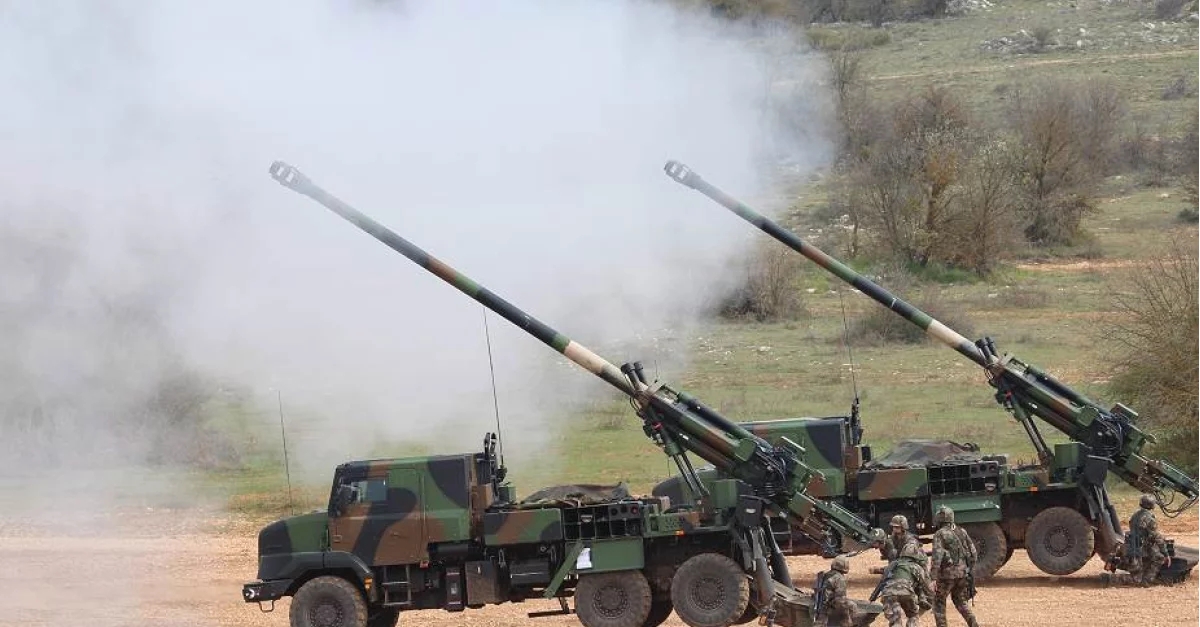
Caesar self-propelled artillery (Photo: Army Recognition)
During the Russian offensive on the Kursk region, Kyiv's forces actively used Western-supplied artillery, including French-made Caesar self-propelled howitzers. Many systems operating in Russian territory and the Sumy region of Ukraine were destroyed by counter-artillery fire, as well as drone and missile attacks.
The ongoing border battle in Kursk has seen the unexpected return of Russian medium- and long-range drones to the battlefield. Both Kyiv and Moscow have actively used drones since the early days of the conflict. However, long- and medium-range drones have rarely achieved significant success in combat due to the effective operation of air defense systems, electronic warfare systems, and early warning systems.
However, in the Kursk region, this protection has disappeared. Ukrainian forces launched attacks without adequate defenses, allowing medium- and long-range drones to move freely over the battlefield.
In recent weeks, Russian drones have also been highly effective in Sumy (a region bordering Russia) and deep within Ukraine's rear.
A Caesar self-propelled artillery piece of the Ukrainian Armed Forces was destroyed by Russian fire. (Source: Russian Ministry of Defense )
Fierce battles are also taking place on the Donbass front. In the strategic city of Chasov Yar, Russian troops have achieved victories.
According to SF, after a series of street attacks, Russian troops broke through Ukrainian defenses and advanced into the Zhovtnevy district. The Ukrainian Armed Forces suffered heavy losses and were forced to retreat west of Vatytina Street. This expanded the area under Russian control on the southern bank of the Seversky Donets-Donbass canal. This will give Russian troops an advantage in subsequent attacks.
Earlier, Russian forces had gained complete control of the Kanal district on the north bank of the canal. In the eastern part of the city, Ukrainian forces continued to resist. However, in the Oktyabrsky district, Ukrainian armed forces were forced to retreat as Russia launched successive attacks. Controlling the Oktyabrsky district allowed Russian forces to seize further high ground in the city.
Chasov Yar is a strategically important city because it sits atop high ground. Controlling this city means controlling the high ground, thereby controlling the firepower of a large area from a distance.
The Hai (According to Army Recognition, RT, SF)
Source: https://www.nguoiduatin.vn/bo-doi-inokhodets-ten-lua-kh-bpla-doi-dau-phao-tu-hanh-caesar-204241009202233675.htm
































































































Comment (0)