|
A police officer inspects a fraudulent housing complex in Kampot province, Cambodia, in February. Photo: Reuters . |
On June 3rd, during a trial in Singapore , details of the transnational fraud ring based in Cambodia were revealed when defendant De Villar Rizalyn Panganiban, 35, a Filipino national, was brought to trial for allegedly participating in a criminal network specializing in scams involving impersonating government officials.
According to the indictment, the group tricked victims into believing their bank accounts or credit cards had been compromised, then persuaded them to transfer money to accounts that were actually under the control of the fraudsters.
De Villar was among 12 people indicted last September after Singaporean police, in cooperation with Cambodian national police, dismantled the ring in a cross-border operation.
At the time, Singapore police said the organization was suspected of being involved in at least 330 reported fraud cases, causing losses of more than S$40 million (approximately US$31 million ).
Three-tiered scam scenario
According to documents agreed upon by both the prosecution and the defense, in March 2025, De Villar was introduced to a job in Cambodia by a woman. She believed she would be working as an office employee for an online gambling company with a salary of $1,500 per month.
Court records do not specify where De Villar was when he accepted the job offer.
On March 29, 2025, she arrived in Phnom Penh and was taken to a call center operated by the network.
Prosecutors Suhas Malhotra and Yeo Kee Hwan said that on his very first day in Cambodia, De Villar was trained to be a call center operator and given a script to memorize.
According to the prosecution, she memorized the content so well that months later, during an interrogation in September 2025, she was able to transcribe the entire script verbatim.
Prosecutors argued that De Villar participated in the operation voluntarily, and was not a victim of human trafficking or a victim of fraudulent recruitment. The prosecution then summoned the investigating officer in charge of the case to testify.
Investigators stated that, according to De Villar's testimony, she was also provided with a list of questions the victim might ask during the phone conversation.
According to the case file, the ring operated through three levels of call center agents, referred to as line one, line two, and line three.
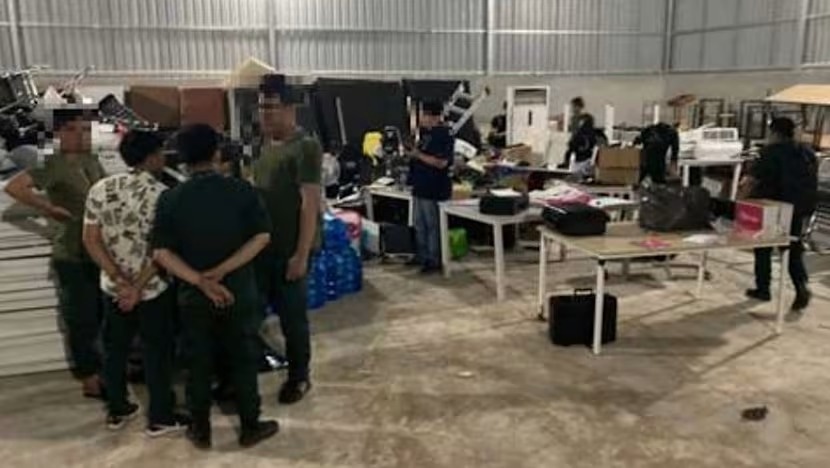 |
A crackdown operation was conducted in Cambodia. Photo: Singapore Police Force. |
On the first line of defense, the perpetrators impersonated Singaporean bank employees, making random calls to numerous people.
They inform the victim that their credit card or bank account has been compromised and encourage them to report the incident to the Monetary Authority of Singapore (MAS).
The victim was then transferred to a second-tier facility, where the perpetrators continued to impersonate MAS officials and claimed they would assist in filing a complaint with the police.
If the victim still trusts them, they will be transferred to the third level. There, the perpetrators pose as Singaporean law enforcement officers.



This group continued to exploit the victims' fears, demanding that they transfer all their money into a "secure account" for investigation purposes. In reality, these accounts were all controlled by the ring.
On March 30, 2025, De Villar was added to a Telegram group used internally to monitor call transfers between routes, known as “passed bills”.
According to her testimony, the amount of money extorted from victims each day ranged from 20,000 to 60,000 SGD (15,600-46,800 USD ).
Suspecting it was a scam center, but still stayed.
According to the prosecution, De Villar was given a choice between two compensation options: a base salary of $1,500 plus a 3% commission, or an 8% commission with no base salary.
She was informed that this commission came from "money obtained from clients." However, De Villar testified that she did not ask what the phrase "obtained" meant in this context.
During training, a coach commented that she had a fairly clear Filipino accent and asked her to adjust her pronunciation to a Singaporean English style. De Villar also participated in role-playing sessions to practice handling situations involving victims.
She was also taken to a first-line operations center, where many people were making calls.
According to the testimony, De Villar's suspicions grew as she noticed many employees pretending to type on computers using broken or disconnected keyboards, some even disassembled into smaller parts for individual use.
By April 2, 2025, De Villar began to believe that her workplace was actually a scam center. She discussed this with a friend who had come to Cambodia from the Philippines.
However, according to the prosecutor, both decided to stay because they wanted to "make a lot of money." This is taken from one of De Villar's statements.
She also admitted that it would be difficult for her to earn a comparable income in the Philippines.
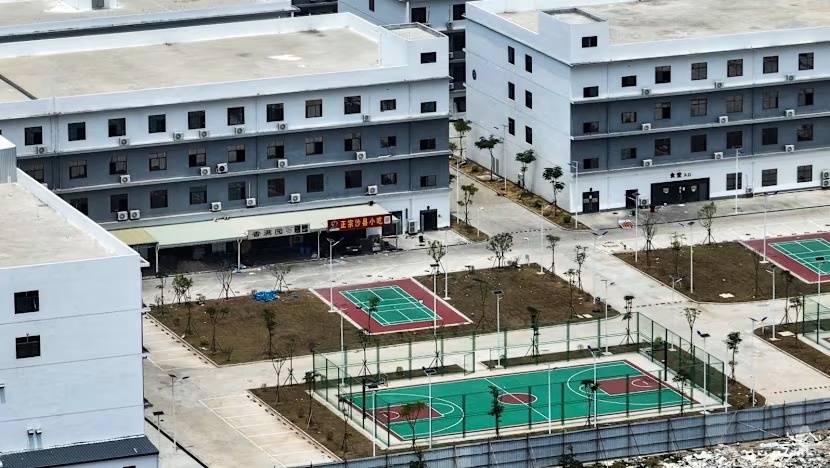 |
Inside a large building complex that was evacuated following a Cambodian crackdown on fraud in Chrey Thum, including a basketball court, restaurants, and surveillance cameras. Photo: CNA. |
Continue working at the scam center in Laos.
On April 7, 2025, De Villar took a test to become a first-line employee and then chose a commission-only income plan.
She stayed at the call center in Cambodia from March 29 to April 24, 2025, where accommodation and meals were provided.
The prosecution emphasized that throughout this time, De Villar retained his personal phone, had internet access, and was fully capable of leaving the premises at any time.
In her testimony, she stated that she had "complete freedom" while living there and "was not subjected to any restrictions or curfews."
Prosecutors cited testimony indicating that De Villar frequently went out to eat. She even received payment for manicures at a beauty salon from a member of the group who earned $7,000 in commission.
On April 24, 2025, De Villar left Cambodia for Vientiane (Laos) to work at another scam center and stayed there until early June.



According to the allegations, in Laos, she continued to make fraudulent calls and send scam emails as directed by the center's operations team.
"This is evidence that De Villar participated in the organization's activities voluntarily. She was not a detainee seeking to escape, but willing to go to another country to continue working at another fraudulent center as suggested by the organization," the prosecution argued.
Before leaving Cambodia, De Villar reportedly received $1,000 and S$300.
The trial will continue on June 4th, when the defense will present its arguments.
If convicted of participating in organized crime, De Villar could face a maximum sentence of five years in prison, a fine of up to 100,000 SGD ( US$78,000 ), or both.
Meanwhile, the charge of fraud carries a potential sentence of up to 10 years in prison and an additional fine under Singaporean law.
Source: https://znews.vn/boc-tran-kich-ban-lua-dao-3-tang-tu-campuchia-post1656908.html