

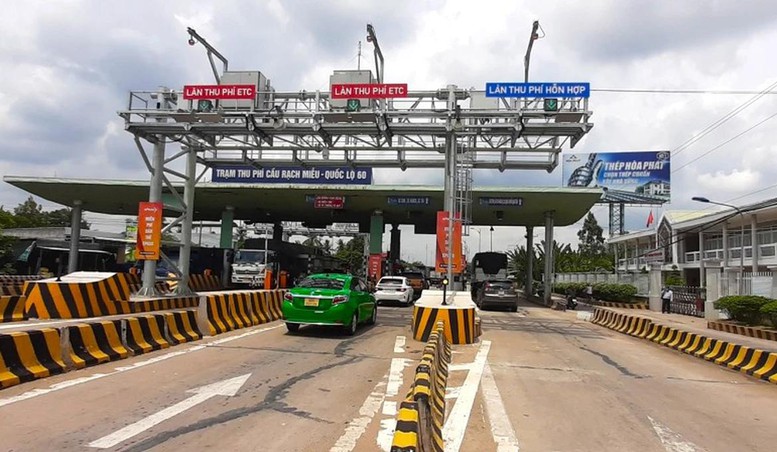
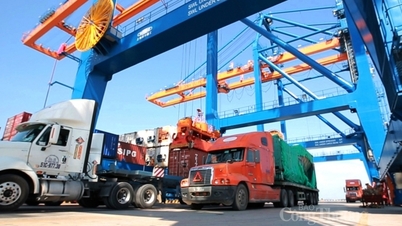
Toll station of the Rach Mieu Bridge BOT project - Photo: Construction Newspaper
According to information from the Vietnam Road Administration ( Ministry of Construction ), after more than 17 years of toll collection since its commissioning, the Rach Mieu Bridge BOT project on National Highway 60 connecting Tien Giang (now Dong Thap province) and Ben Tre (now Vinh Long province) is expected to officially cease toll collection at the end of September 2026.
10-year fee reduction
The agency stated: After fully updating the inspection and audit findings and adjusting the financial plan, the project has essentially fulfilled its obligations to repay capital and profits to the investor. This is an important basis for the state management agency to proceed with stopping toll collection.
The Rach Mieu Bridge is one of the first BOT (Build-Operate-Transfer) projects in the field of road transport in Vietnam. Phase 1 of the project was put into operation on April 2, 2009, with a toll collection period of 13 years and 5 months as stipulated in Appendix 16/PLHĐ.BOT-BGTVT signed in 2016, including 10 years and 5 months for capital recovery and 3 years for generating profit for the investor.
In fact, the toll collection process went more smoothly than expected. Revenue from the project increased significantly due to the increased traffic volume, while many cost factors were adjusted downward following inspection and audit findings. As a result, the actual payback period was significantly shortened.
During the project implementation, specific contract conditions changed, including: a 8% reduction in the final settlement value; a 58% increase in management and maintenance costs compared to the original contract; a 24% increase in actual toll revenue from 2009-2016 compared to the original contract's toll revenue; a 119% increase in revenue from 2017-2019 compared to the original contract and a 28% increase compared to Contract Appendix 16; and a project support budget exceeding VND 151 billion.
According to the Vietnam Road Administration, the toll collection period for phase 1 has been reduced by 10 years compared to the original contract, equivalent to 50% of the project's toll collection period. This is a reduction of 3 years compared to the 2016 contract addendum, equivalent to 30% of the project's toll collection period.
Investor returns have been fully calculated.
Regarding the profit-generating plan for investors, the Vietnam Road Administration stated that after 11 negotiation sessions with investors and project enterprises, the profit allocated to investors was redefined based on the principle of "expected profit" converted to actual time.
According to the BOT contract signed in 2003 and the 2016 contract addendum, the investor is entitled to 3 years of toll collection to generate profit after the payback period ends. Based on the Road Department's method of calculating expected profit after updating actual financial factors and removing inappropriate costs, the toll collection period for generating profit is only 2 years, 4 months, and 2 days, from November 18, 2016 to March 22, 2019, corresponding to a profit of over 338 billion VND, a reduction of 7 months and 29 days compared to the profit generation period stipulated in the contract.
The profit-generating toll collection period based on expected profit targets has also been applied to the following projects: The construction project of National Highway 2, Noi Bai - Vinh Yen section, successfully negotiated a reduction from 3.5 years of profit-generating toll collection to 3 years and 3 months, and toll collection has been stopped; the construction project of National Highway 51 has temporarily suspended toll collection, with the adjusted profit-generating toll collection period being 10 months; the BOT project for the Thanh Hoa City bypass has temporarily suspended toll collection, with the adjusted profit-generating toll collection period being 1 year and 5 months.
Another factor directly impacting the toll collection period is the update of over 151 billion VND in state budget support for the project in the initial phase. This capital was included in the actual cash flow balance, reducing the amount of capital that the investor must recover through the toll station.
One of the key factors shortening the toll collection period was the removal of the 4.8%/year "capital preservation fee." The State Audit Office, in Document No. 336/KTNN-TH of 2017, determined that this expense lacked legal basis and recommended its removal from the financial plan. According to the audit's calculations, simply removing this fee reduced the project's toll collection period by approximately 1 year and 11 months.
"After updating the project's financial plan according to the above contents, the toll collection period for capital recovery is expected to end at the end of September 2026. If the financial indicators do not change as projected in the calculated financial plan, the Vietnam Road Administration will stop collecting tolls at the end of September 2026," the Vietnam Road Administration stated.
The Rach Mieu bridge project on National Highway 60, approved by the Ministry of Transport (now the Ministry of Construction) in 2016, involved two phases of investment adjustments under a BOT (Build-Operate-Transfer) contract.
Phase 1: Investment in the construction of Rach Mieu Bridge under a BOT (Build-Operate-Transfer) contract with a total investment of nearly 1,200 billion VND. Phase 2: Investment in upgrading, expanding, and constructing four sections of National Highway 60 connecting Rach Mieu Bridge to Co Chien Bridge in Ben Tre province under a BOT contract with a total investment of over 1,700 billion VND.
According to the BOT contract, both phases of the project will be recouped through toll collection at the Rach Mieu bridge toll station.
Phan Trang
Source: https://baochinhphu.vn/bot-cau-rach-mieu-hoan-von-som-dung-thu-phi-tu-thang-9-2026-102260522152224301.htm












































































![[INFOGRAPHICS] 25 targets and groups of targets that Can Tho City strives for by 2030](https://vphoto.vietnam.vn/thumb/402x226/vietnam/resource/IMAGE/2026/05/25/1779688983034_1779688951.webp)















Comment (0)