

Receiving digital technology transfer
E-commerce and cashless payment applications and platforms for B2B and B2C models are well-developed in Vietnam and have been significantly improved during the COVID-19 pandemic. Digital platforms for small and medium-sized enterprises (SMEs) are also developing rapidly. These product classes are well-suited for developing countries at reasonable prices. However, many Vietnamese businesses lack sufficient understanding and skills in international business. This limitation, viewed positively, presents opportunities for collaboration between international partners and domestic technology companies in less selective markets such as Africa, Asia, and even niche markets in developed countries.
Regarding opportunities for research and development (R&D) collaboration with Vietnamese startups, I believe that the potential of Vietnamese technology startups in areas such as Blockchain applications, Machine Learning, and AI (artificial intelligence) has been and is being encouraged by the Government , and they will have opportunities to seek international investment. The major challenge is that startups lack experience and understanding of market access for their research products, so they still need to strive hard to achieve results.

Technology staff working atFPT Software's high-tech campus in Ho Chi Minh City High-Tech Park. Photo: HOANG TRIEU
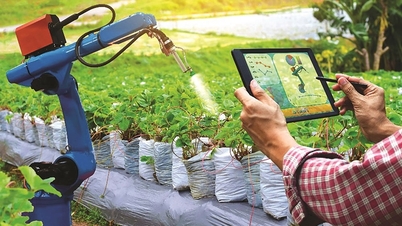
Vietnam is implementing a national digital transformation program. The manufacturing and wood processing sectors, seafood products, high-tech agriculture, and food processing are experiencing strong growth. The energy and renewable energy sectors are gradually developing, replacing fossil fuels. Digital solutions and factory automation are emerging. Digitalization challenges are being addressed in the cultivation, preservation, and processing of agricultural products. Optimization of energy operations and logistics are also crucial. We will continue to need to connect trade and deploy applications on digital platforms. This remains a significant need for Vietnamese technology and digital technology companies to invest, collaborate with partners, and apply these solutions to serve socio-economic development.
I remember when the software industry set a target of achieving $500 million in software exports, many people thought it was unrealistic. Through hard work and perseverance, domestic software companies have ventured into outsourcing for the Japanese, American, and Canadian markets, and before we knew it, we had reached the $500 million mark. Today, in terms of software outsourcing, FPT Software (the unit specializing in providing IT services in foreign markets of the FPT Group) alone has reached $1 billion per year. Other strong players like TMA, KMS, and Harvey Nash also contribute to Vietnam remaining a destination for software outsourcing with high added-value services.
Confidently venturing out into the open sea.
If I were to highlight a significant milestone for Vietnamese small and medium-sized IT companies in 2023 on the international stage, I would use the phrase "confidently venturing into the global market with their own products." This is exemplified by HQSoft, whose distribution and retail solutions have been chosen by major corporations like Johnson & Johnson and Philips to implement their management systems in the Philippines, Indonesia, and Malaysia for many years, and continue to expand. Having overcome challenges in the Vietnamese market, HQSoft confidently opened offices in Thailand and several other countries in the region to begin its global expansion. Another example is iLotusLand, a young start-up offering an environmental monitoring and management solution based on the Internet of Things (IoT), which is gaining trust and adoption in various provinces and cities. Not only Vietnamese customers, but also customers in Mongolia and Brazil choose the company for its accuracy, ease of operation, and reasonable pricing.

FPT Corporation at the Ho Chi Minh City High-Tech Park. Photo: HOANG TRIEU
These include a young enterprise from Ho Chi Minh City University of Technology collaborating with Viettel's 5G Lab to produce peripherals and applications for managing the internal transportation fleet of a US airport using near-collision avoidance technology. These are businesses that grew from the business incubators of the Ho Chi Minh City High-Tech Park. After achieving success in the international market, after 5 to 6 years, they returned to become investors in the high-tech park, producing and developing high-tech applications for unmanned aerial vehicles such as drones and UAVs. Many other small and medium-sized technology companies choose the path of going global with their products, contributing to increased value alongside software outsourcing for export.
It would be remiss not to mention the applications developed in Vietnam that are "exported" back to Vietnamese businesses and foreign-invested companies in Vietnam. Our businesses used to spend millions of dollars equipping each of their enterprises with international ERP solutions. The choice of advanced management solutions revolved around SAP, Oracle, and Microsoft. However, in 2022-2023, during the economic downturn, Vietnamese and international businesses took advantage of the opportunity to upgrade their management systems. Vietnamese solution companies, mastering enterprise management technology and combining it with newer, more flexible software development technologies, secured orders and a solid foothold. Gia Minh Company (GMC), with its comprehensive ExpertERP solution on a mobile platform, has been used by Starprint Group (Thailand), S&K Vina (Korea), Unilever Vietnam, as well as manufacturing clients in the packaging, wood, and printing sectors as an alternative to international products. In 2024, the company has committed to deploying its solutions to overseas clients.
Another bright spot in the picture of technological mastery that cannot be overlooked is the role of businesses in the logistics sector. Logistics costs in developed countries account for approximately 12%-14% of GDP. In Vietnam, according to reports from the Vietnam Logistics Association, this rate is nearly 22% of GDP. Applying technology to logistics will bring significant results for socio-economic development. This includes better management and coordination of cargo release at seaports, optimized port and terminal scheduling systems, and connectivity with international logistics systems, while also ensuring improved customs clearance for both import and export goods.
Previously, all seaports had to purchase foreign solutions at a cost of 3-5 million USD per port. CEH Company has mastered the technology with its VTOS port management solution and VSL ecosystem, winning against international competitors to equip the port systems of Gemadept, Hai Phong Port, Saigon Port, etc., saving the state budget millions of USD. Simultaneously, the company began forming an ecosystem with domestic companies to gradually solve the problem of optimizing warehousing systems. TKE Company's warehouse management solution is currently trusted by nearly 300 domestic and international warehousing businesses. CEH's port management platform has also been explored and adopted by port customers in the region. With these outstanding results, CEH was selected as a typical digital transformation enterprise to present at the 2023 National Digital Transformation Program summary conference.
2024 has arrived, bringing both opportunities and challenges. Besides maintaining the achievements of the past year, we are seizing the opportunity to become a chip-producing nation, with initial collaborations with the Netherlands – a country that manufactures chip production machinery – collaborative visits from Nvidia, and the potential for expansion from Intel, while our workforce in this field is almost non-existent. But as the saying goes: Perseverance and determination will pay off!
Source: https://nld.com.vn/buc-tranh-cong-nghe-so-viet-nam-196240205135614681.htm





![[Photo] Prime Minister Pham Minh Chinh receives the Chinese Ambassador to Vietnam](https://vphoto.vietnam.vn/thumb/1200x675/vietnam/resource/IMAGE/2026/04/05/1775397481797_ndo_br_dsc-5512-jpg.webp)






















































































Comment (0)