

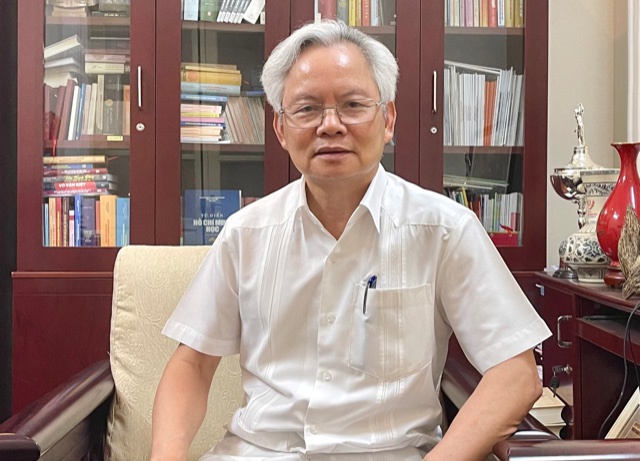
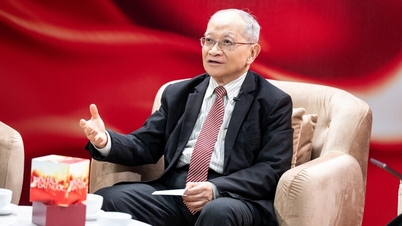
“The Politburo 's Regulation No. 144-QD/TW dated May 9, 2024, on “the revolutionary ethical standards of cadres and Party members in the new period” was issued both to demonstrate the necessity in the process of carrying out the urgent task of building and rectifying the Party, and also to stem from the practical need to persistently build a culture of integrity, free from corruption and negative practices… which is very urgent in the current period,” Professor Dr. Ta Ngoc Tan (Permanent Vice Chairman of the Central Theoretical Council) emphasized in an exchange with the Economic & Urban Newspaper.
Regulations are necessary.
Building the Party on ethical foundations and fostering a culture of integrity is being implemented with many decisive solutions from the Central Committee to Party committees at all levels. Based on your research, how do you assess this issue and the results achieved in the past?
Professor Ta Ngoc Tan : First of all, when talking about building the Party in terms of ethics, and more specifically, building a culture of integrity, we must recognize that this is an issue stemming from the very nature of a revolutionary Party. The Communist Party is the vanguard of the working class, and at the same time represents the interests of all classes and the entire Vietnamese nation. When the Party is the vanguard, its members must become trustworthy and worthy in terms of ethics and integrity, striving for the interests of the people and making the happiness of the people the ultimate goal in their activities. Because, ultimately, the strength of the Party is the strength of the people's trust; if the people trust the Party, cadres and Party members must be exemplary in ethics and integrity.
In fact, the issue of ethics and integrity of cadres and Party members is not a new topic of discussion. From the very founding of the Communist Party of Vietnam , President Ho Chi Minh had already addressed what constitutes a Party member. In his book "The Revolutionary Path," he clearly stated that Party members must be exemplary individuals, possessing talent and wholeheartedly striving for the revolutionary cause. In September 1949, President Ho Chi Minh visited and inscribed on the first page of the Golden Book of the Central Nguyen Ai Quoc School (now the Ho Chi Minh National Political Academy) the following teaching: "Learn to work, to be a good person, to be a good cadre. Learn to serve the organization, the class, the people, the Fatherland, and humanity. To achieve this goal, one must be thrifty, honest, upright, selfless, and impartial." This means that he pointed out that cadres and Party members who want to lead and guide the people in carrying out the political tasks of the revolution must be thrifty, honest, upright, selfless, and impartial. This was also clearly explained by Uncle Ho in many works, typically in the book "Revising Working Methods" (1947), which discussed in detail issues related to leadership, management, the character and conduct of cadres and Party members, the urgent requirements of the Party, the education of cadres and Party members, and issues related to the relationship between the Party and the people...
On the occasion of the Party's 39th anniversary, February 3, 1969, President Ho Chi Minh wrote the work "Raising Revolutionary Morality, Eradicating Individualism." According to him, only after eradicating individualism can revolutionary morality be raised. When cadres fall into individualism, they cannot gain the people's trust and cannot lead the people.
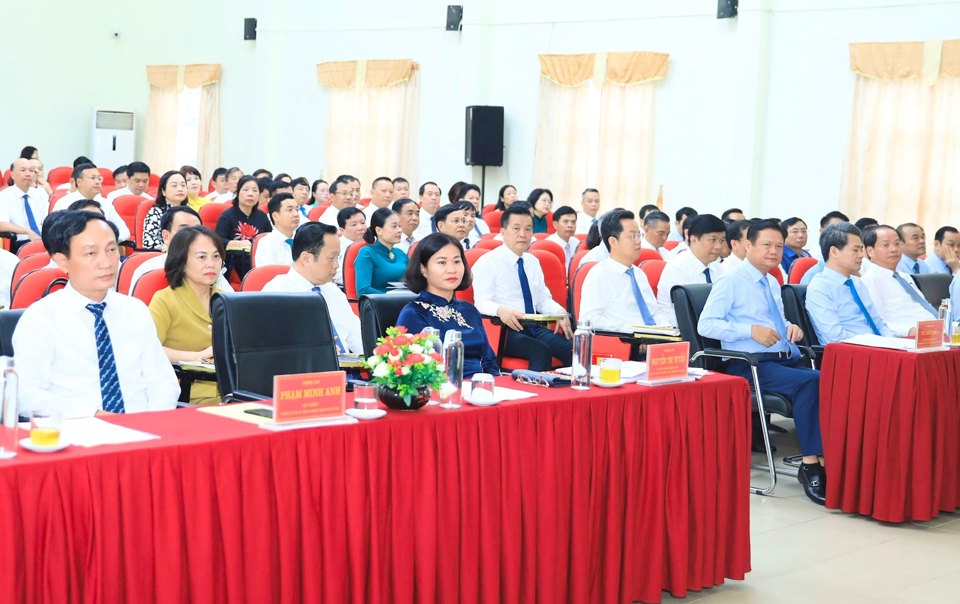
In that spirit, for the past 94 years, our Party has consistently upheld and implemented the viewpoint that "morality is the foundation" of cadres and Party members. Numerous documents and resolutions have concretized this viewpoint, implementing it in Party building in general and personnel work in particular. Especially, the Party continues to focus on dealing with cadres and Party members who have degenerated in ideology and morality, clearly demonstrated in the anti-corruption and anti-negative practices efforts over the past period, which have been conducted systematically, correctly, and cautiously, without any forbidden areas or exceptions, regardless of who is involved.
Those who are corrupt and degenerate, regardless of who they are, including current Politburo members, regardless of whether their wrongdoings occurred long ago, regardless of their profession or educational background… anyone who goes against their oath to the Party, against the interests of the people and the nation, who only seeks to enrich themselves and their interest groups, who causes losses of state funds, and who violates the law… will be dealt with according to the principle of "no forbidden zones, no exceptions." This demonstrates the Party's decisive action to strengthen the people's trust in the Party and create strength for the Party.
So, with the issuance and implementation of Regulation No. 144-QD/TW of the Politburo dated May 9, 2024, on "the standards of revolutionary ethics for cadres and Party members in the new era," is this a new breakthrough in building the Party on ethics and creating a culture of integrity, sir?
Professor Ta Ngoc Tan : In my opinion, the promulgation of Regulation 144-QD/TW first and foremost reflects a constant requirement in building and rectifying the Party, so that cadres and Party members can cultivate, train, and improve their ethics and conduct, enhance their awareness, and build a culture of integrity. At the same time, it is also an urgent requirement stemming from reality. Because each stage of the revolution has different practical conditions and requirements, including changes in the social value system. Currently, we are building a socialist-oriented market economy. While wealth is a positive factor in improving people's lives and bringing greater potential to the country, it also contains challenges and creates opportunities and conditions for people to accumulate personal wealth in various ways.
Under these circumstances, the risk of corruption and waste arises. In several recent Party Congresses, the Party has acknowledged that corruption and waste have become more complex. This has led to a series of officials falling into ideological, political, moral, and lifestyle degradation. This further highlights the urgent need for additional solutions to ensure the ethical standards of officials and Party members, in order to maintain and strengthen the people's trust in the Party.
As I said, the promulgation of Regulation 144-QD/TW reflects the necessity of the urgent task of building and rectifying the Party, while also continuing previous regulations related to the ethics, conduct, and lifestyle of cadres and Party members. It's not just now that our Party has set standards and regulations on revolutionary ethics for cadres and Party members; this issue has been addressed, clearly defined, and required of Party cadres and members from a very early stage, in many documents.
We are currently entering new stages of national development, posing new demands. Building upon the content of existing regulations and conclusions, the Party is for the first time issuing a specialized regulation on the ethical standards of cadres and Party members in the new era. As the name suggests, this is the "Regulation on Revolutionary Ethical Standards of Cadres and Party Members in the New Era," so the content of the articles in the Regulation both inherits and refines existing principles, while also supplementing and developing them to suit the requirements and demands of reality.
The content of the regulations is very clear, both inheriting Ho Chi Minh's thought on revolutionary ethics and the Party's previous regulations on Party building and rectification in general and on Party personnel work in particular; but also stemming from the urgent needs of practice. In my opinion, this is a very important regulation to strengthen the building of a team of cadres and Party members who truly become role models in lifestyle, ethics, and conduct in their work and in their relations with the people.

Comprehensive and persistent implementation
As many have pointed out, the most fundamental and important factor is the awareness, responsibility, and self-discipline of each cadre and Party member in self-cultivation and training. In reality, there have been many examples of self-cultivation demonstrating the spirit of "the more polished a gem becomes," building trust among the people. So, in your opinion, what issues need to be considered in the implementation of Regulation 144-QĐ/TW to ensure its effectiveness?
Professor Ta Ngoc Tan : To effectively implement the Party's regulations in general, especially those concerning the ethical standards of cadres and Party members such as Regulation 144-QĐ/TW, systematic, comprehensive, and persistent solutions should be implemented. These should include educational measures, as well as strict disciplinary and deterrent measures. In particular, measures should be taken to prevent and deter negative behaviors, creating conditions where cadres and Party members cannot, dare not, do not want, and do not need to engage in wrongdoing, negative behavior, corruption, or wastefulness.
In my opinion, first and foremost, each Party committee and unit must concretize the five points in the Regulations into specific contents that are appropriate to the characteristics of each field, agency, and unit; relevant to the work, tasks, and relationships of each position, so that each cadre and Party member can reflect on and clearly understand what they need to cultivate and implement. Furthermore, there should be additional mechanisms to strengthen regular inspection, supervision, and evaluation; promptly detect, remind, and deter violations from the moment they begin to appear.
Another crucial solution is the exemplary conduct of the leader, establishing strict discipline within the unit; implementing measures to consult, inspect, and listen to everyone's opinions, promptly identifying emerging problems; and gathering information through both formal and informal monitoring systems. Above all, the leader himself must set a particularly good example, as stated in Article 5 of Regulation 144-QĐ/TW regarding "Exemplary conduct, humility, self-cultivation, and lifelong learning." Alongside this, it is essential to encourage widespread, substantive, and objective participation of the people in monitoring and inspection.
In my opinion, in the long run, education is crucial so that every official and Party member understands that exemplary conduct and integrity are inherent qualities and essential needs of every individual – this is the essence of a cultured way of life. This is very important, and to achieve this, it's not just about education in schools and courses, but must be done regularly through various channels to shape this way of life and thinking.
In addition, solutions are needed to ensure that officials and civil servants receive appropriate and deserving remuneration. Furthermore, the discipline of agencies and units must be strict and clear, preventing cover-ups that could lead to a loss of trust.
The fight against corruption still faces many difficulties and complexities, posing a significant challenge to building a culture of integrity. Therefore, Regulation 144-QĐ/TW is even more important. If every official, Party member, and head of agency or unit understands and consciously implements all five contents of this Regulation, it will be an effective tool to prevent ideological and political decline, moral erosion, embezzlement, corruption, waste, alienation from the masses, and to build a culture of integrity…
Currently, localities are preparing for Party Congresses at all levels, leading up to the 14th National Party Congress. Regulation 144-QĐ/TW is the "guidebook," the basis for Party committees and organizations at all levels to consider, evaluate, and select cadres and Party members to include in the planning and preparation of personnel for Party Congresses at all levels, sir?
Professor Ta Ngoc Tan : Before each Party Congress, along with drafting documents, personnel matters always present very important requirements, issues of survival, and are extremely difficult and complex. Because, no matter how rigorous the process is, it is only one of the factors ensuring the necessary and sufficient requirements. Besides that, there are many other factors, some of which cannot be resolved through administrative measures alone.
Because selecting personnel involves understanding people's hearts, minds, attitudes, and consciousness, it's incredibly difficult to grasp everything perfectly. Not to mention external influences or specific circumstances that can cause people to change their perceptions, attitudes, viewpoints, behaviors, and lifestyles. Therefore, personnel management is extremely complex and challenging, yet it must be carried out meticulously at every stage to minimize the risk of making wrong choices.
In my opinion, as Party congresses at all levels prepare, personnel work has been set with stricter requirements to prevent those who are parochial, factional, opportunistic, power-seeking, corrupt, or involved in negative practices from entering the new Party committees. However, the standards in Regulation 144-QĐ/TW still have very important implications for screening; those with blemishes should be carefully considered and thoroughly reviewed. But to achieve this, we must return to listening to the opinions of the people thoroughly, objectively, and from multiple perspectives to accurately assess cadres.
In fact, the cadre is the image and direct representative of the Party before the people; therefore, serious adherence to ethical standards is of paramount importance. From this, we can select cadres who are virtuous and talented, who meet the people's trust, thereby strengthening the Party's power, enhancing its leadership and governing capacity, and successfully accomplishing the enormous tasks of national construction and development in the new era – the era of national progress.
Thank you very much, sir!
Source: https://kinhtedothi.vn/xay-dung-van-hoa-liem-chinh-buoc-dot-pha-trong-giai-doan-moi.html













































































Comment (0)