

France's shift in geopolitical approach toward NATO, as well as the expansion of the EU, could reshape the future of Europe.
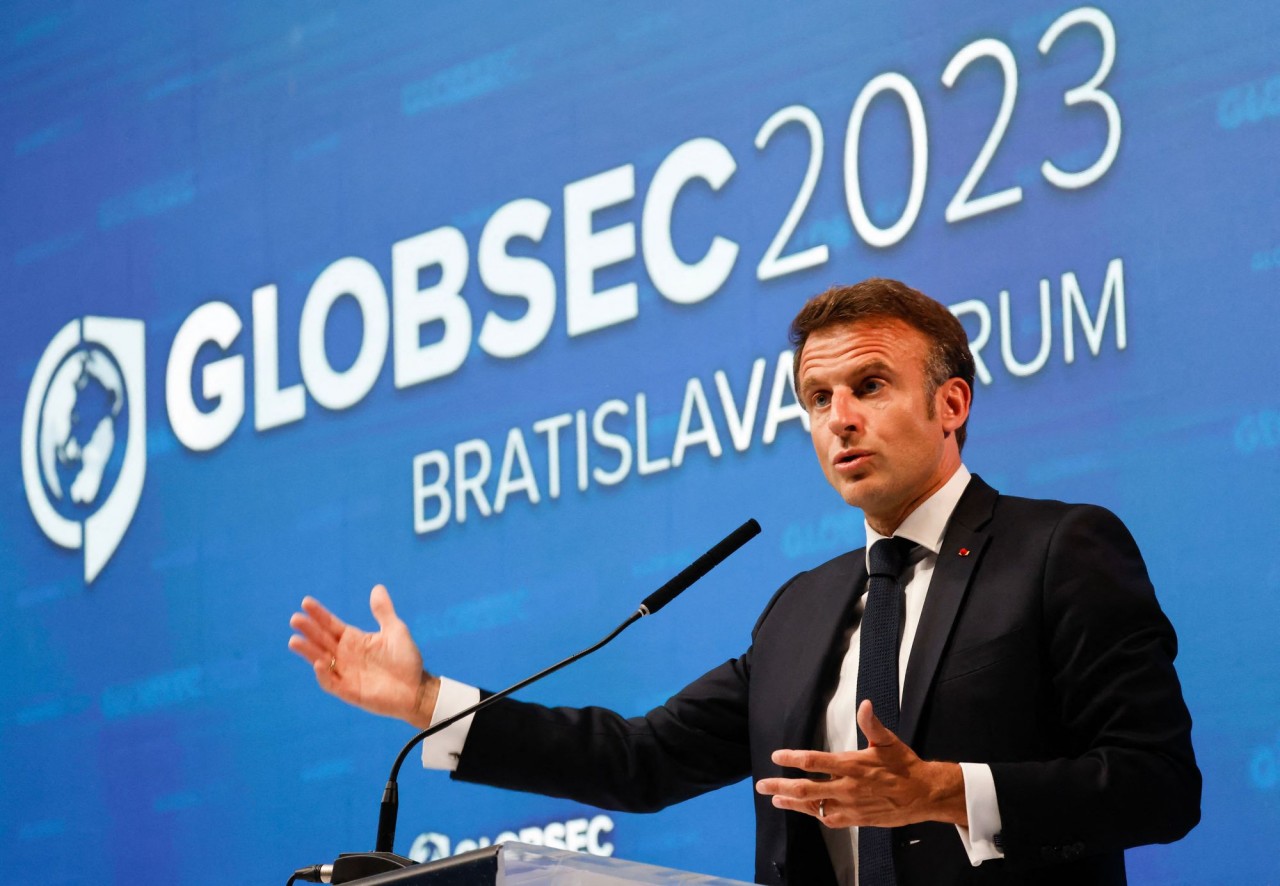 |
| French President Emmanuel Macron speaks at the GlobSec Forum in Bratislava, Slovakia, on May 31. (Source: AFP/Getty Images) |
In February 2022, following the outbreak of the Russia-Ukraine conflict, German Chancellor Olaf Scholz announced "Zeitenwende," or "historic turning point," establishing a €100 billion fund to strengthen defense capabilities. Compared to its previous cautious stance, Berlin's 180-degree shift in defense policy shocked Europe.
At the same time, another, less-noticed "historical turning point" emerged in Paris. However, its impact was no less significant. So what was it?
Two major adjustments
That shift lies in two fundamental aspects currently facing the European Union (EU) and the North Atlantic Treaty Organization (NATO). First, there is Ukraine's NATO membership. Second, it concerns the expansion of the EU's borders eastward and southward. France, a country once skeptical about welcoming new members to either group, now quietly supports both.
On May 31, speaking in Bratislava (Slovakia), French President Emmanuel Macron declared: “We need a roadmap toward membership for Ukraine.” The leader affirmed: “The question for us is not ‘Should we expand?’, but ‘How should we do it?’”
Two months later, on the eve of the NATO summit in Vilnius (Lithuania), the French leader, alongside Britain, Poland, and the Baltic states, debated efforts to expedite the process of admitting Ukraine once the conflict ended.
Paris's shift surprised many allies. Even the United States was taken aback. Former US diplomat Daniel Fried suggested that "President Joe Biden's administration was caught off guard" by this rapid change.
In 2008, it was France and Germany that prevented Ukraine from joining NATO. Just four years ago, Macron himself told The Economist (UK) that NATO was "brain dead." Even in early 2022, the leader only occasionally showed concern for the security of Europe in general and Ukraine in particular.
But now, the eastern flank of the EU has unexpectedly found a new pillar.
France's second shift regarding EU expansion is somewhat more subtle. Discussions will only begin in early October, and a decision on negotiating Ukraine and Moldova's membership will be made in December.
However, in the current context, negotiations are progressing well, even if the process will require complex changes to the rules governing the EU's organizational structure. A Franco-German working group is examining the impact of these adjustments. The European Commission will report back on the expansion in October.
In the past, France has often been wary of EU expansion, viewing it as a threat to its policy of “deepening” the union and building its political project. Conversely, while still within the bloc, London frequently called for expansion and was skeptical that Paris wanted to turn Europe into a region solely for economic cooperation. This is understandable, given that in 2019, France vetoed EU membership talks with Albania and North Macedonia.
However, developments in the Russia-Ukraine conflict have led Emmanuel Macron to reconsider this approach. Last year, Parisian diplomats worked tirelessly to ensure the EU would grant Kyiv the candidacy status. France also overturned its veto, allowing Albania and North Macedonia to begin negotiations with the EU on their membership in the regional union.
| “The question for us is not ‘Should we expand?’, but ‘How should we do it?’” (French President Emmanuel Macron speaking at the Globsec Forum in Bratislava, Slovakia on May 31) |
Doubt to move forward
However, skepticism remains regarding this shift. One European diplomat argued: “It’s just a ‘free lunch’ for Macron to support Ukraine’s NATO membership.” According to this diplomat, France knows that the US will “slow down” the process if things go too far. Therefore, Paris is willing to show support for Kyiv’s NATO membership to strengthen its role amidst rising anti-Moscow sentiment.
Macron's strategic interests with Central and Eastern Europe are also quite clear: the politician hopes to improve his image with the two regions after unsuccessful dialogue with his Russian counterpart Vladimir Putin at the beginning of the conflict.
France's stance on NATO also carries an underlying implication: a strong message to Moscow would strengthen Kyiv's position in future negotiations.
However, there are many reasons to believe that France's dual shift reflects a geopolitical reassessment. Macron, one of the most ardent supporters of Europe, has long been particularly interested in “European sovereignty”: the continent’s ability to shape its future in the fierce great power competition.
This concern is further underscored by the influence of Russia, as well as a United States led by Donald Trump should he win enough votes in the US presidential election next year.
In this context, one official stated that, according to France, Europe “can no longer tolerate a ‘gray area’ between the EU and Russia.” Countries on the periphery of the continent need to become part of the EU or NATO to avoid being vulnerable.
However, will this vision of France become a reality?
Source


![OCOP during Tet season: [Part 3] Ultra-thin rice paper takes off.](/_next/image?url=https%3A%2F%2Fvphoto.vietnam.vn%2Fthumb%2F402x226%2Fvietnam%2Fresource%2FIMAGE%2F2026%2F01%2F28%2F1769562783429_004-194121_651-081010.jpeg&w=3840&q=75)



Comment (0)