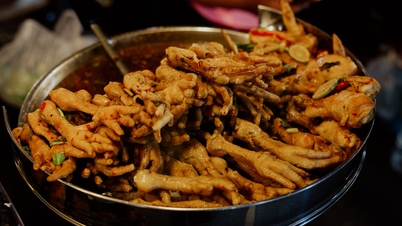
A delicious bowl of stingray stew with banana, boasting many distinctive flavors - Photo: Provided by the author
Not as flashy as high-end seafood dishes, nor elaborate in presentation, braised stingray stands out for its simplicity and rich flavor.
Green bananas – whether seeded bananas, plantains, or royal bananas – blend with stingray to create a unique, slightly astringent, rich, and aromatic flavor. That's the taste of Nam O beach, where mountains and sea meet at the foot of Hai Van Pass.
Nam O, now part of Hai Van ward ( Da Nang city), has long been famous as an ancient fishing village with a lifestyle closely tied to the water.
In Nam O, the hearth is not only for cooking but also for sharing stories of life and the sea. In that setting, braised stingray with green bananas stands out as a familiar dish, accompanying the years and the memories of many generations of fishermen.
To make a truly delicious stingray stew, the locals prioritize ingredient selection. The stingray they usually choose is the yellow stingray – a species that lives in clean coastal sand, with firm, sweet, and naturally crispy flesh.
The fish must be freshly caught, with a supple body, clear eyes, and no strange odor. The cook must not rush, because stingray, if not properly prepared, can easily become fishy.



After cleaning, the fish is thoroughly drained of all clotted blood and the white membrane inside the belly – the part most prone to causing odor. Next, the fish is quickly blanched in boiling water with ginger, rice wine, or vinegar to remove the fishy smell, then rubbed with salt to firm the flesh and reduce sliminess. These seemingly minor steps largely determine the quality of the dish.

Main ingredients for cooking braised stingray with green bananas - Photo: Provided by the author
Accompanying the stingray is a green banana – the element that gives the dish its name, "embracing the banana." The banana must be just ripe, not yet fully ripe, still firm and flavorful. The banana is peeled, cut into pieces, and soaked in salt water to preserve its color and remove the sap. When braised, the banana doesn't become mushy but absorbs the flavor, creating a balance with the crispy, sweet fish meat.
The dish's spices clearly reflect the flavors of Central Vietnam. Fresh galangal and turmeric are pounded into a paste, mixed with shrimp paste, and then strained to extract the liquid.
Onions, garlic, and chili peppers are sautéed until fragrant, then green bananas are added and stir-fried, followed by stingray that has been lightly fried to firm up the edges. All the ingredients blend together in a rich, warm aroma, very characteristic of a seafood kitchen.

Stingrays in Nam O Bay - Photo: Provided by the author
The braising liquid is usually fresh coconut water, with a little vinegar and a little wine added to enhance the flavor and make the fish meat more tender.



The fish is simmered over low heat, allowing enough time for the fish to absorb the flavors without falling apart. When the broth turns a clear yellow from the turmeric and its aroma fills the kitchen, the cook adds finely chopped turmeric leaves, perilla leaves, and coriander before turning off the heat.
Enjoying stingray stewed with green bananas is a delightful culinary experience. The fish meat is slightly crispy and subtly sweet, the bananas are soft and creamy, and the flavors blend perfectly with the pungent taste of galangal, the mild spiciness of chili, and just the right amount of shrimp paste to enhance the taste without overpowering it.
This dish can be served with white rice, fresh vermicelli, or wrapped in rice paper with fresh vegetables; each way of eating offers a different experience, but all are distinctly Da Nang in style.
Source: https://tuoitre.vn/ca-duoi-bien-nam-o-om-chuoi-xanh-20260203172937297.htm




![[Image] National conference summarizing one year of operation of the overall organizational model of the political system, the three-tiered government model.](https://vphoto.vietnam.vn/thumb/1200x675/vietnam/resource/IMAGE/2026/07/01/1782882811691_ndo_br_1-jpg.webp)