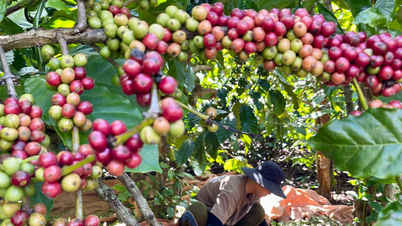
In Lam Dong province, coffee prices in Di Linh, Bao Loc, and Lam Ha are around 100,000 VND/kg; Gia Nghia and Dak R'lap are trading at 100,800 and 100,700 VND/kg respectively.
In Dak Lak province, in the Cu M'gar area, traders are buying coffee at 100,800 VND/kg; while in the Ea H'leo and Buon Ho areas, the price is 100,700 VND/kg.
In the Chu Prong area ( Gia Lai province), coffee is trading at 100,700 VND/kg, while in Pleiku and La Grai it is maintaining at 100,600 VND/kg.
On the international market, the New York exchange faced the most pressure due to favorable weather forecasts in Brazil. At the close of trading on Friday, the price of Arabica for March 2026 delivery adjusted to 332.25 cents/lb (1 lb = 0.4535 kg). The main reason was the forecast of steady rain in the Minas Gerais region next week, easing concerns about drought for the next crop.
Meanwhile, Robusta coffee futures for March 2026 delivery on the London exchange closed at $4,113 per ton. The fact that Robusta coffee prices remain above $4,100 per ton indicates that demand for this caffeine-rich coffee remains very stable, despite technical profit-taking pressure from speculators.
While global Arabica coffee prices hit a 5.5-month low, Vietnamese coffee prices only saw a slight correction and remained above resistance levels. This is supported by the fact that Brazilian exports are declining, with Robusta coffee exports in December 2025 falling by as much as 61%, creating a strong foothold for Vietnamese products.
The fact that prices have remained above 100,000 VND/kg even amidst unfavorable weather news in Brazil is a test of market sentiment. Entering February 2026, with limited Robusta coffee supply from Brazil and stable global demand, the 100,000 VND/kg price level is expected to become the new floor, opening up positive prospects for farmers after the Lunar New Year holiday.
Regarding the Asian rice market, last week, Thai export rice prices recorded an upward trend thanks to positive signals from market demand and domestic factors, as well as developments related to the nomination of a new leader at the US Federal Reserve (Fed). Meanwhile, Indian rice prices remained stable due to the depreciation of the domestic currency, which helped offset higher input costs.
In Thailand, the price of 5% broken rice also rose to between $390 and $400 per ton in the January 29th trading session, the highest level since December 24th, compared to $380 per ton the previous week.
Traders explain that this price increase stems from the high domestic rice prices. Exporters and millers are currently waiting to assess the quality of the upcoming harvest. In addition, exchange rate fluctuations have also contributed slightly to the price hike.



However, traders also noted that overall market demand remains rather subdued, with regular customers only purchasing in small quantities. Regarding supply, expected output is positive due to favorable water conditions.
In India, parboiled rice with 5% broken grains remained unchanged at $351-$356 per ton compared to last week. White rice with 5% broken grains was listed at $348-$353 per ton.
The Indian rupee fell to a record low on January 29, boosting the rebates for exporters from foreign exchange earnings. An exporter in Kolkata said the weak rupee helps them maintain a competitive edge amid a supply-oversupply market, although overall consumer demand remains subdued.
In Bangladesh, domestic rice prices remain high despite secured reserves and imports, putting pressure on consumers. Last week, the government authorized private companies to import 200,000 tons of parboiled rice to prevent price shocks, alongside state-level stockpiling efforts.
In Vietnam, the price of 5% broken rice was offered at 360-367 USD/ton in the trading session on January 29, a slight increase compared to the 360-365 USD/ton range of the previous week.
A trader in Ho Chi Minh City noted that market demand is currently stable, with increasing orders from key partners such as the Philippines and Malaysia. Business circles also noted that the Philippines is expected to purchase approximately 300,000 tons of rice for delivery in February 2026.
However, that signal was not enough to stimulate the domestic rice market. Rice prices in the Mekong Delta remained stable last week. According to the Institute for Agricultural and Environmental Strategy and Policy, in Can Tho, many rice varieties were priced similarly to the previous week: Jasmine rice remained at 8,400 VND/kg; IR 5451 rice at 6,200 VND/kg; ST25 at 9,400 VND/kg; and OM 18 at 6,600 VND/kg.
In Dong Thap, IR 50404 rice remains priced at 7,000 VND/kg; OM 18 rice is priced at 7,200 VND/kg, an increase of 100 VND/kg. Meanwhile, in Vinh Long, OM 5451 rice is priced at 6,700 VND/kg and OM 4900 at 7,200 VND/kg.
In An Giang, the prices of many types of fresh rice remained unchanged compared to last week, such as: OM 18 at 6,300 - 6,500 VND/kg; Dai Thom 8 at 6,300 - 6,500 VND/kg; OM 5451 at 5,800 - 6,200 VND/kg; IR 50404 was still being purchased at 5,500 - 5,600 VND/kg.
In the An Giang retail market, rice prices remain stable: regular rice 12,000 - 13,000 VND/kg; Thai fragrant rice 20,000 - 22,000 VND/kg; Jasmine rice 14,000 - 15,000 VND/kg; white rice 16,000 VND/kg, Nang Hoa rice 21,000 VND/kg, Huong Lai rice 22,000 VND/kg, Taiwanese fragrant rice 20,000 VND/kg, regular Soc rice 17,000 VND/kg, Thai Soc rice 20,000 VND/kg, Japanese rice 22,000 VND/kg.
Regarding the US agricultural market, at the close of trading on January 30th, prices of agricultural commodities including corn, soybeans, and wheat on the Chicago Board of Commodity Exchange (CBOT) all declined due to selling pressure from investors taking profits and the strong recovery of the US dollar after hitting a four-year low earlier in the week.
Specifically, wheat prices fell 3.5 cents to $5.38 per bushel, after just reaching a 9-week high of $5.4475 per bushel. Soybean prices fell 8 cents, closing at $10.6425 per bushel, while corn prices also dropped 2.5 cents to $4.2825 per bushel (1 bushel of wheat/soybeans = 27.2 kg; 1 bushel of corn = 25.4 kg).



Karl Setzer, co-founder of Consus Ag Consulting, believes the market is in a "risk-averse" state. He notes that while the US dollar has been under significant downward pressure this month, most recent trading has been based primarily on "money flows, market positioning, and profit-taking" rather than fundamental supply and demand factors.
The recovery of the US dollar index was bolstered by news that President Trump nominated former Fed Governor Kevin Warsh as the new Fed Chairman. Investors believe Warsh holds a more hawkish stance on interest rates than other candidates, which helped alleviate previous concerns about monetary policy under Trump.
Regarding seasonal factors, the wheat market is receiving support from short covering by investment funds and severe weather conditions. Following the cold spell in the U.S. plains, traders are closely monitoring forecasts of severe frost in Ukraine next week, which could potentially damage crops.
In South America, the Buenos Aires Grain Exchange said that while recent rains in Argentina have improved soil moisture in some areas, corn and soybean crops still need more heavy rainfall to avoid yield reductions. Nevertheless, the prospect of record soybean production in Brazil, where the harvest is in its early stages, has somewhat eased concerns about supply from Argentina.
Source: https://baotintuc.vn/kinh-te/ca-phe-thiet-lap-nen-gia-moi-20260201163056466.htm