

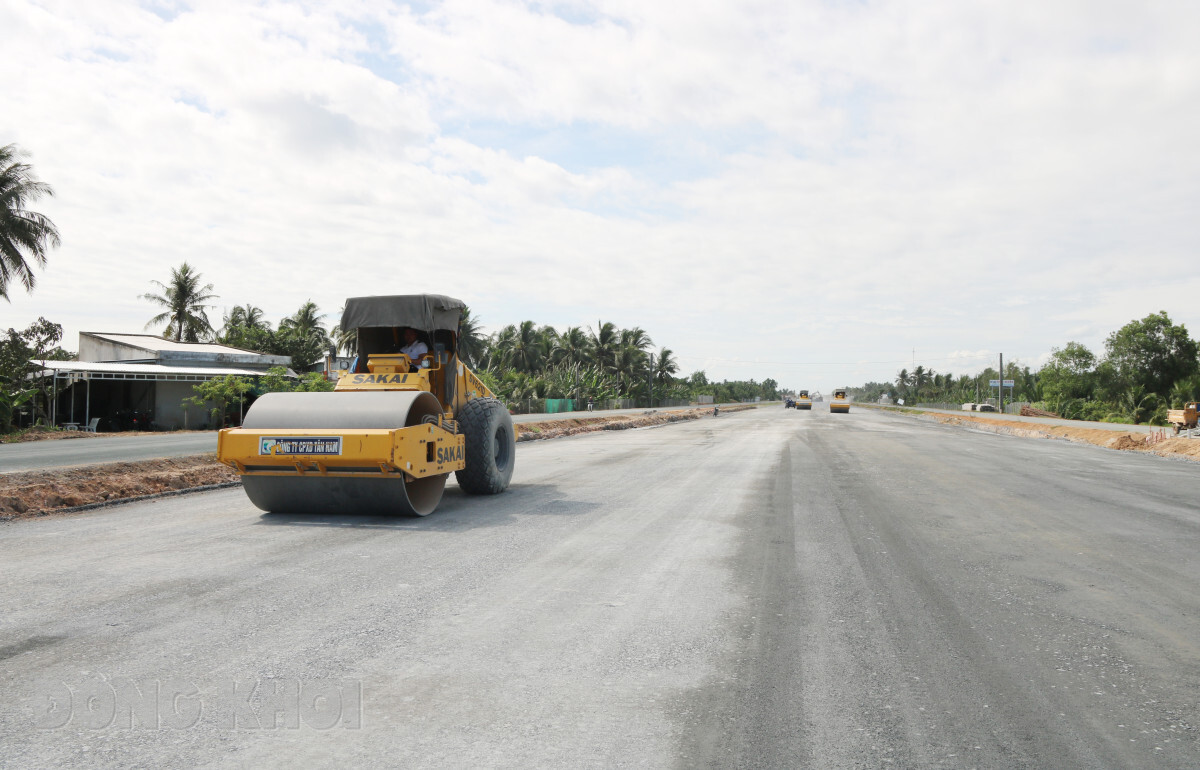
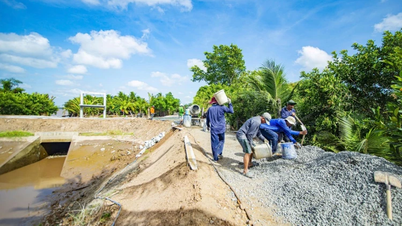
Construction of the asphalt road surface for the Rach Mieu 2 bridge project in Chau Thanh district.
Starting from zero
The province's road network was established hundreds of years ago and is arranged to suit the terrain, consisting of three main roads running along three islands. During the two wars of resistance against France and the United States, Ben Tre was a resilient province and set a shining example in the 1960 Uprising. During the war, the province was heavily bombed, resulting in severe damage to its road infrastructure, including bridges, roads, and ferries.
Before the liberation of South Vietnam on April 30, 1975, the entire bridge system of the province consisted of low-load capacity Eiffel and Bailley steel truss military bridges. The province did not have a single permanent reinforced concrete bridge. The main road system was in a patchwork state. There were no national highways running through the province. Most local roads were dirt or red gravel, making travel very difficult in the dry season and often causing traffic jams in the rainy season, with some sections completely cut off, such as: inter-provincial road 60 (now national highway - QL 60) from Thom - Mo Cay intersection to the Co Chien riverbank; DT.884 from Tien Thuy to the mouth of Ham Luong river; DT.887; QL 57 (formerly DT.888) from Thanh Phu town to Thanh Phong and Thanh Hai; DT.883 from Binh Dai town to Thoi Thuan commune...
Looking at archival images of the state of provincial roads in the early years after liberation, one cannot help but feel saddened by the sight of a passenger bus overloaded with goods on its roof, submerged in mud with no visible wheels, and passengers getting off and wading through the mud with their trousers rolled up... In 1975, the province had nearly 944,000 inhabitants, but by 1978, along with the weakest road transport system in the Mekong Delta, the province's transport system consisted of only 129 vehicles (78 passenger buses, 51 trucks) under the management and operation of the Ben Tre Joint Venture Automobile Transport Enterprise.
The province's transportation history records: "Bus stations were always crowded with people waiting endlessly. During the subsidy period, goods weren't as abundant as they are today, but due to scarcity, everything from rice, potatoes, vegetables, detergent, and school notebooks became extremely essential to the lives of every citizen. Yet, transportation to and from these places was frequently congested and delayed for days on end."
Reaching out and developing
Over the past 50 years, thanks to the profound leadership and guidance of the Provincial Party Committee and the Provincial People's Committee, and the dedicated support and assistance of the Government and central ministries and agencies, the provincial transportation sector has strived to gradually implement its tasks and has achieved very encouraging results.
To date, the province has 284.97 km of national highways. The provincial highway network is formed and arranged appropriately according to the terrain, including: 1 North-South axis and 3 East-West axes. The main external transportation axis, the gateway to and from the province, is the North-South axis (National Highway 60), which cuts through 3 islands, creating a continuous network connecting the provincial center with the districts. This is a vital road connecting the province with provinces in the eastern coastal sub-region of the Mekong Delta. The province's second external transportation axis is the 3 East-West axes (National Highway 57, National Highway 57B, National Highway 57C), which connects Ben Tre province with Vinh Long province via Dinh Khao ferry terminal, and to Can Tho City - the economic center of the Mekong Delta. It also connects with National Highway 60 towards Ho Chi Minh City and other provinces in the Southeast region.
The province has a comprehensive network of provincial and district roads, connecting with the national highway system to ensure transportation and traffic connectivity. The province has 5 provincial roads: DT.881, DT.882, DT.883, DT.885, and DT.886, with a total length of 124.77 km, 77% of which are asphalted, while the remainder are roads and bridges under construction. District roads comprise 43 routes totaling 422.27 km, with over 95% asphalted or concreted. All 100% of communes now have roads accessible by car to their centers.
In April 2025, the people of the province will celebrate the completion of the Rach Mieu 2 Bridge. The Rach Mieu 2 Bridge project has reached 85% completion and is expected to be fully operational by August 2025. The access road to the Rach Mieu 2 Bridge, invested in by the province, will open to traffic on April 27, 2025. This is one of many projects inaugurated or commenced in the province to celebrate the 50th anniversary of the Liberation of Southern Vietnam and National Reunification (April 30, 1975 - April 30, 2025).
At the recent ceremony marking the completion of the Rach Mieu 2 bridge, Chairman of the Provincial People's Committee Tran Ngoc Tam stated: “In recent years, the Government and central ministries and agencies have shown great interest in the province and allocated funds to implement many projects. Especially transportation projects, including the two Rach Mieu bridges. These transportation projects have helped the province resolve traffic congestion and promote development for the province in particular and the Mekong Delta in general. The upcoming inauguration and operation of the Rach Mieu 2 bridge project will have a significant impact on the overall development of the country.”
| In 2025 and the following years, transportation in the province will continue to improve thanks to the government's investment in breakthrough projects such as: the Cua Dai Bridge connecting Tien Giang and Ben Tre provinces; the coastal road connecting Ben Tre, Tien Giang, and Tra Vinh provinces under the PDO program, passing through Ba Tri and Thanh Phu districts; the Co Chien 2 Bridge connecting Tra Vinh and Ben Tre provinces; and the Dinh Khao Bridge connecting Vinh Long and Ben Tre provinces. |
Text and photos: Thach Thao
Source: https://baodongkhoi.vn/cac-the-he-xay-cau-lam-duong-23042025-a145611.html
![[Photo] Close-up of an Australian warship visiting Tien Sa port, Da Nang](https://vphoto.vietnam.vn/thumb/1200x675/vietnam/resource/IMAGE/2026/03/28/1774675489416_tau-5-jpg.)






































































Comment (0)