A lifeline during a shortage of new scripts.
Spoken drama is currently the most active segment in Ho Chi Minh City's theater scene, sometimes leading to a severe shortage of scripts. Therefore, theater producers occasionally "look" at Cai Luong (Vietnamese traditional opera) to find sources for adaptation. In particular, Cai Luong scripts with their "melodramatic" quality, capable of evoking tears from the audience and telling stories of life, love, and family relationships that resonate with audiences of all generations, are favored by many spoken drama theaters.

Hong Anh and Quang Thao in the play "Half a Lifetime of Fragrance and Powder"
PHOTO: HK
The stage that has adapted the most Cai Luong (Vietnamese traditional opera) plays is Hoang Thai Thanh. "Half a Lifetime of Fragrance and Powder," "Long River," "Short and Long Strands of Hair," and "Bach Hai Duong" are examples of Cai Luong adaptations that have left a deep impression. Regarding " Short and Long Strands of Hair ," director Ai Nhu stated: "We didn't take this play from a Cai Luong script but adapted it from the original text, the novel 'Extinguishing the Flame of the Heart ,' so there are some details and character names that are quite different." However, the story of Lan and Diep has been deeply ingrained in the hearts of Cai Luong audiences for decades, so when they watch the play, they automatically think of that famous Cai Luong play.
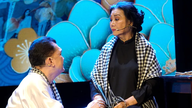


The Truong Hung Minh theater, though only established a few years ago, has already produced two successful adaptations of Cai Luong (Vietnamese traditional opera): " The Daughter of Ms. Hang" and "Then 30 Years Later ." Director Ngoc Duyen staged these two plays with great skill and seriousness, creating a sophisticated image for the theater. Even the most discerning audience members can leave satisfied after watching these two productions. Theater owner Minh Nhi affirmed: "With such famous Cai Luong plays, our theatrical adaptations must be equally impressive, not just a cheap, market-driven production. Interestingly, audiences still need works that make them cry and stir deep, positive emotions." He added that he will continue to invest in Cai Luong adaptations for stage plays, as he himself loves Cai Luong and wants it to "come back to life" in a different form. He suggested that perhaps, after watching the stage version, people will return to listen to or watch the original Cai Luong version.

Tuyet Thu and Viet Huong in the play "Sister Hang's Daughter"
PHOTO: HK
Easy yet difficult
A stage play adapted from a famous Cai Luong (Vietnamese traditional opera) script is more likely to sell tickets. However, there are still challenges involved.
First, the theater producers had to convince the late playwright's family to allow the adaptation, as the family was always worried that future generations might distort the content of their father's work. The second difficulty was adapting the play in a way that suited the artistic characteristics of spoken drama. According to director Ai Nhu: "In Cai Luong (Vietnamese traditional opera), the singing and dancing already 'hypnotize' the audience, while spoken drama needs more conflict, tension, and drama, not just descriptive scenes and emotions like Cai Luong. When adapting, we naturally had to alter and add details and dialogue, but we were still not allowed to stray too far from the original script."



According to director Ngoc Duyen, the third challenge is: "It's quite difficult to choose works with messages that are still relevant today. And sometimes, there are plot points that were topical at the time the cải lương play was created, so we have to carefully adjust and add or subtract them to make them reasonable in order to win over young audiences." Indeed, more than half of the audience were young people, and they have demands that the theater must accept. Therefore, in "Half a Lifetime of Fragrance and Powder ," director Ai Nhu did not have The become a nun as in the cải lương version, but instead had her do volunteer work in a temple, caring for orphaned children, which was very well received by the audience. Similarly, Lan did not become a nun after her heartbreak with Diep; instead, she found a husband, found new happiness, and lived positively. Ai Nhu wanted to emphasize that the path of monastic life is only for those who are truly enlightened and want liberation, not for those who want to escape life and become nuns. Or, in the play " The Daughter of Ms. Hang ," the character Ha was added, allowing artist Viet Huong to showcase her talent. The dancer, with her complex fate and personality, conveyed a message about the difficult path to redemption, but emphasized that deep within every person there is still goodness, and therefore hope. Viet Huong truly excelled in playing a role that was both wicked, seductive, and emotionally charged, eliciting both tears and laughter from the audience.
Overall, cải lương (Vietnamese traditional opera) remains a valuable resource when the stage lacks scripts. The challenge lies in the skill of the new team to transform it into a suitable and engaging version.
Source: https://thanhnien.vn/cai-luong-cua-de-danh-hap-dan-cho-kich-noi-185260624215049104.htm










![[Video] Weather forecast for tonight and tomorrow, June 29, 2026: Northern Vietnam to experience increased thunderstorms, Central Vietnam remains hot and dry.](https://vphoto.vietnam.vn/thumb/402x226/vietnam/resource/IMAGE/2026/06/28/1782651705021_dem-28-png.webp)