

Challenges of development
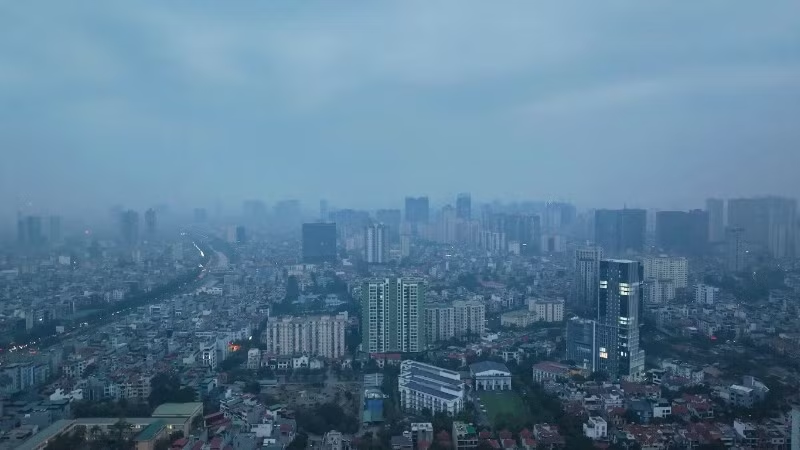
The national environmental status report for the period 2021-2025 shows that pressure on air quality continues to increase with urbanization, industrialization, and the increase in traffic. This indicates that air pollution is not a problem arising from a single source, but rather a cumulative consequence of socio-economic development. Therefore, air quality is not just an environmental indicator, but is increasingly becoming a key indicator reflecting the quality of urban and economic development.
It is noteworthy that the main sources of air pollution emissions are now quite clearly identified through monitoring systems, specialized studies, and environmental assessment reports.
First and foremost is road transport. The national environmental status report identifies road transport activities in Hanoi and Ho Chi Minh City as one of the main causes of air quality degradation. By 2025, the country will have approximately 77 million motorbikes and nearly 7 million cars in circulation; cars over 10 years old alone account for about 30% of the total number of vehicles. Along with the rapid increase in motorized vehicles, especially those that have been in use for many years, the amount of emissions generated continues to put significant pressure on the urban environment.
In addition, construction activities, building materials production, industrial parks, industrial clusters, and scattered production facilities contribute to this. Rapid urbanization and infrastructure development demands have significantly increased the amount of dust generated from construction sites and material transportation.
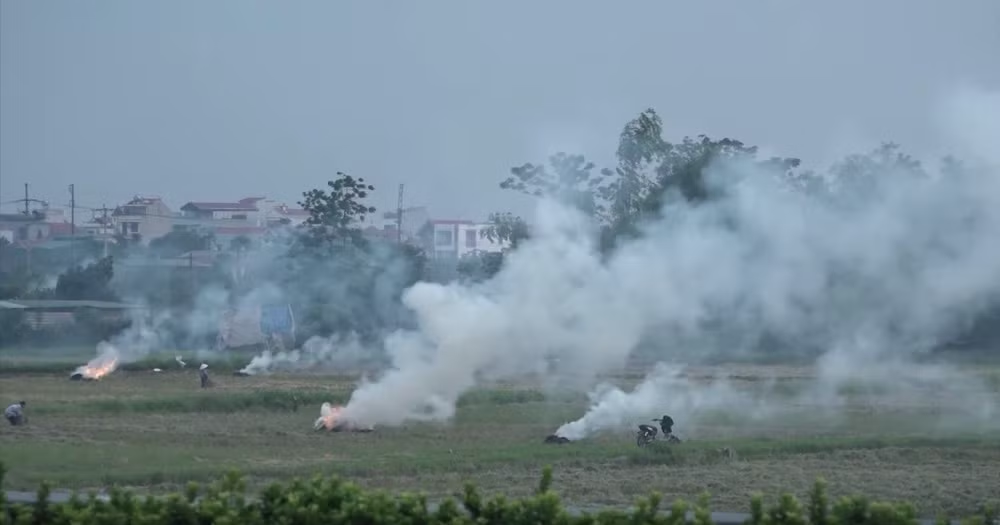
Another often overlooked but significantly impactful source of emissions in many localities is the burning of crop residue after harvest. This practice continues to generate smoke, fine dust, and various polluting gases, directly affecting air quality and public health.
In the energy sector, although the energy transition is being promoted, coal-fired power plants still hold a large share in the power generation structure. In 2024, at many peak load times, coal-fired power plants still accounted for approximately 59-70% of the total electricity production of the entire system.
It could be argued that what is currently lacking is not an understanding of the causes, but rather sufficiently robust solutions to effectively control the main sources of emissions.
The gap between policy and implementation
It cannot be said that Vietnam lacks mechanisms and policies for air quality management. In recent years, the legal system for environmental protection has been continuously improved; many air quality management programs and plans have been issued; the environmental monitoring network has been expanded; and emission standards have become increasingly stringent.
In particular, emission standards for road vehicles have been gradually improved; the roadmap for controlling emissions from motorcycles and scooters in major cities is also being implemented.
However, arguably the biggest gap today lies not in awareness or policy, but in the speed and effectiveness of implementing solutions in practice.
In many localities, the control of burning agricultural by-products is not yet truly effective. The public transportation system is not attractive enough to significantly reduce the number of private vehicles. The transition to green vehicles is still in its early stages. Emission inventory and emission load management at the regional level are only being gradually implemented.
Meanwhile, the rate of urbanization continues to increase. Vietnam's urbanization rate currently stands at approximately 43%, leading to a growing demand for infrastructure development, transportation, construction, and energy consumption.
That is why, despite many efforts, air quality in some major cities has not improved as significantly as expected.
One of the major limitations today is that air pollution management is still primarily carried out on a sectoral, industry-specific, or local basis.
Meanwhile, air has no administrative boundaries. Fine dust generated from one area can affect another; emissions from traffic, industry, construction, or biomass burning coexist in a shared atmospheric space.
Draft regulations and policies currently being developed also require a shift from administrative-boundary environmental management to regional, basin, and ecosystem-based governance; strengthening control over total emission loads and applying data in environmental management. This approach is appropriate given the characteristics of air pollution – a type of pollution not limited by administrative boundaries.
This requires building a synchronized emissions database; conducting periodic emissions inventories; controlling emission loads by region; strengthening inter-provincial and inter-regional coordination; and promoting the application of science and technology, digital transformation, and artificial intelligence in environmental monitoring, forecasting, and warning.
This also represents a shift from traditional environmental management approaches to modern environmental governance based on data, technology, and economic tools.
Clean air - a criterion of development
Air quality reflects not only the effectiveness of environmental management but also the quality of urban development, transportation, energy, and local governance.

Global experience shows that countries successful in controlling air pollution rely not only on technical measures but also on political will, inter-sectoral coordination mechanisms, and the participation of the entire society.
For Vietnam, this requirement becomes even more urgent as the country enters a new phase of development with the goal of higher, greener, and more sustainable growth.
Clean air cannot be achieved simply through periodic warnings or peak inspection periods. More importantly, it requires a modern governance approach where emissions control is integrated into overall development planning, transportation infrastructure, energy, construction, and urban management.
When air quality becomes a criterion for development, new positive changes can be created sustainably. Protecting the air today is not only about protecting the living environment but also about protecting people's health, improving the quality of growth, and strengthening the foundation for the country's sustainable development in the future.
Source: https://nhandan.vn/canh-bao-do-o-bau-troi-do-thi-post966814.html






















![[Video] Weather forecast for tonight and tomorrow, June 5th, 2026: Localized thunderstorms in the North, continued intense heat in the Central region.](https://vphoto.vietnam.vn/thumb/402x226/vietnam/resource/IMAGE/2026/06/04/1780578190589_thum-toi-0406-png.webp)























![[Video] Sunset at Lap An Lagoon – Where the sun sets over the fishing nets](https://vphoto.vietnam.vn/thumb/1200x675/vietnam/resource/IMAGE/2026/05/31/1780192137701_beach-landscape-sea-water-nature-grass-745871-pxhere-com.jpeg)






























Comment (0)