

 |
People admire statues depicting the 12 Chinese zodiac animals at the “Heritage Guardians” project in Kuala Lumpur, Malaysia, to celebrate the 2026 Lunar New Year. Photo: Reuters. |
Julia, a 22-year-old Romanian tourist, had planned a spring trip to Malaysia, traveling from Kuala Lumpur to Sarawak to visit relatives. But the trip fell apart when airfare skyrocketed to 3,000 euros, while numerous flights were disrupted.
"I can't afford that," she told This Week in Asia .
Initially, Julia planned to fly Emirates via Dubai or Abu Dhabi, but the conflict between the US, Israel, and Iran led to the closure of regional airspace, disrupting her schedule and making alternative options prohibitively expensive. Julia's story partly reflects the pressure looming over Malaysia's tourism ambitions ahead of the 2026 promotional season.
A "shock" from the sky.
After welcoming over 42 million international visitors in 2025, an 11.2% increase compared to the previous year, Malaysia enters its “Visit Malaysia 2026” campaign with optimism. The country aims to attract 43 million international visitors this year, as tourism continues to be a pillar of the economy .
According to Statistics Malaysia, tourism generated 291.9 billion ringgit, equivalent to US$74.5 billion , in 2024, contributing 15.1% to GDP. Spending by international visitors also increased by 41.1%.
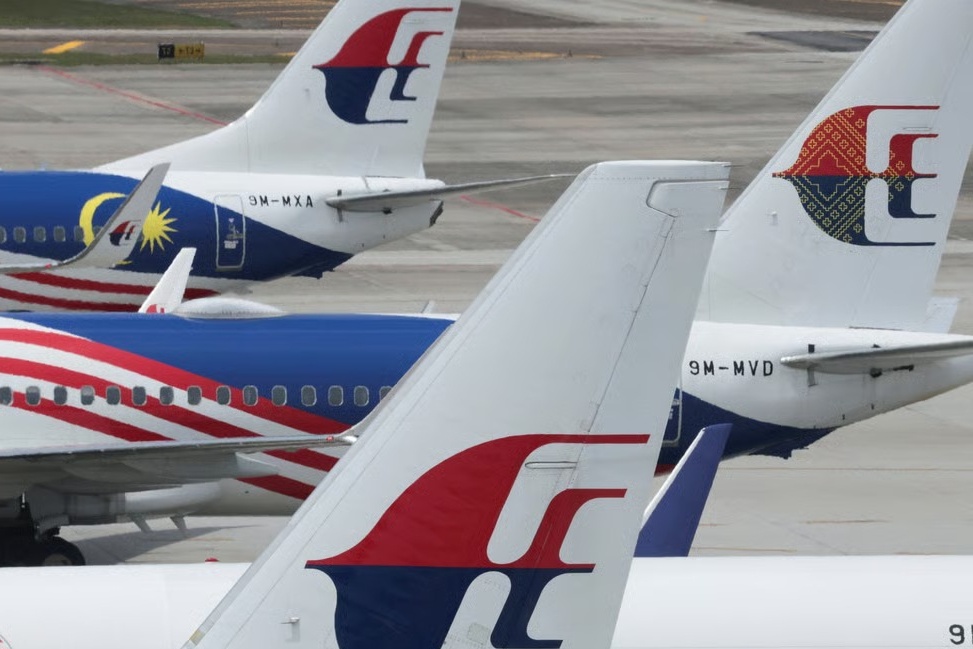 |
A Malaysia Airlines plane is parked at Kuala Lumpur International Airport. Photo: Reuters. |
However, the shock Malaysia is facing comes from the aviation sector. According to the International Air Transport Association, the average global price of jet fuel rose 11.2% in just one week, to $175 per barrel. Reuters also reported that jet fuel prices in Asia have increased by nearly 80% since the conflict with Iran broke out in late February. This pressure has forced airlines to raise fares, impose surcharges, and cut capacity.
Malaysia's weaknesses are also evident in this context. Brendan Sobie, an independent aviation analyst in Singapore, argues that Kuala Lumpur is heavily reliant on Gulf aviation hubs because its long-haul flight network is more limited than that of Bangkok or Singapore.
Before the crisis, Kuala Lumpur had only about 8 flights a day to Europe, but as many as 17 to the Middle East, including 10 to major hubs in the UAE or Qatar. Meanwhile, Singapore had about 28 flights to Europe and 11 to the Middle East.
According to Sobie, other hubs have been unable to fill the void left by the Gulf region, causing demand for long-haul flights to far exceed supply and driving up ticket prices sharply.
 |
Tourists admire the skyline from an observation deck in Kuala Lumpur. Photo: Reuters. |
The advantage of proximity to customers is not enough to alleviate the concerns.
However, Malaysia is not entirely in a passive position. A major advantage for the country is that its international visitor structure strongly favors nearby markets.
According to data from the Ministry of Tourism, Arts and Culture, Singapore alone is expected to bring 21.08 million visitors to Malaysia in 2025, nearly half of the country's total international visitors. China ranks second with 4.66 million visitors, followed by Indonesia with 4.27 million and Thailand with 2.5 million.
This very structure is the basis for Uzaidi Udanis, founder of the Malaysian travel platform Your Inbound Matters and chairman of the Domestic Tourism Alliance, to maintain cautious optimism. According to him, about 75% of visitors to Malaysia are from Southeast Asia, with half of them coming from Singapore.
"High airfares are unavoidable. But if we focus on Southeast Asia, especially Singapore, we can offset the losses we anticipate," he said.
 |
Petaling Street, a popular tourist spot in Kuala Lumpur, Malaysia. Photo: dpa. |
However, Malaysia's challenge isn't just the rising airfare. The bigger concern lies in the risk of a disruption to long-haul travel, as second-quarter flight schedules and summer bookings between Europe and Asia remain highly unpredictable.
In an interview with This Week in Asia , a representative from Malaysia Airports stated that January and February started steadily thanks to strong regional demand and expanded connectivity, but it was too early to draw conclusions about the outlook for the coming months.
Conversely, Shukor Yusof, founder of aviation consulting firm Endau Analytics, argues that Malaysia has "little to no advantage" in the current crisis.
He warned that if the Strait of Hormuz remains closed for an extended period, the impact would not be limited to aviation fuel but would also spread to gasoline, petrochemicals, and food prices, further eroding demand for non-essential travel.
"Be prepared for a trend of rising prices for food, gasoline, and most other things," he said.
Source: https://znews.vn/canh-eo-le-cua-du-lich-malaysia-post1637009.html
![[Photo] Prime Minister Pham Minh Chinh departs for an official visit to the Russian Federation.](https://vphoto.vietnam.vn/thumb/1200x675/vietnam/resource/IMAGE/2026/03/22/1774160262864_vna-potal-thu-tuong-pham-minh-chinh-len-duong-tham-chinh-thuc-lien-bang-nga-8656056-6903-jpg.webp)





























































![[Photo] General Secretary To Lam attends the ceremony commemorating the 80th anniversary of the founding of the Engineering Corps.](https://vphoto.vietnam.vn/thumb/402x226/vietnam/resource/IMAGE/2026/03/22/1774154480574_anh-man-hinh-2026-03-22-luc-11-41-07.png)































Comment (0)