

A sad night missing my wife.
In the late 19th century, many groups of people from My Tho and Tan An left their hometowns to seek a new life in Bac Lieu, including the family of Mr. Cao Van Gioi (Cai Cui hamlet, Chi My village, Tan An province). At that time, Cao Van Lau (Sau Lau) was only 6 years old and had to follow his father onto a boat to wander the land. Initially, they stayed on the land of relatives in Gia Hoi. Working as laborers wasn't enough to make ends meet, so they moved on to Gia Rai and asked to build a hut on the land of Vinh Phuoc An pagoda. Seeing Mr. Gioi's family's difficult circumstances, the abbot of the pagoda, Venerable Minh Bao, suggested that Sau Lau live in the pagoda and learn classical Chinese. A few years later, Mr. Gioi asked for his son to return home to learn the Vietnamese Quốc ngữ script.
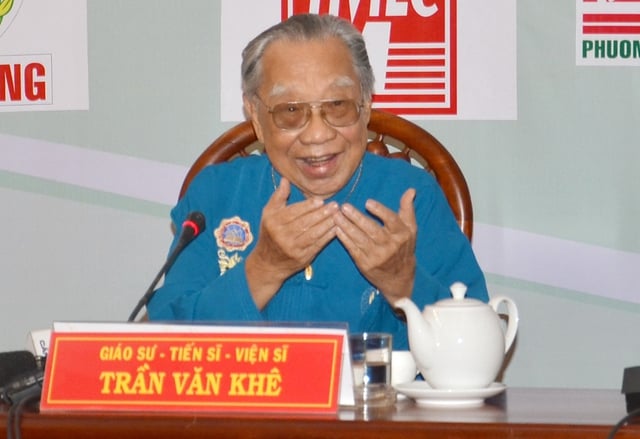
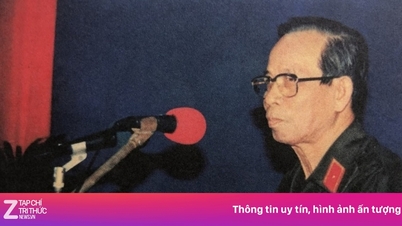
Professor Tran Van Khe at the seminar on 95 years of Cai Luong art (January 2014)
PHOTO: HOANG PHUONG
In the same neighborhood as Mr. Gioi's family lived a blind musician with exceptional musical skills named Le Tai Khi, also known as Nhac Khi. Passionate about music, Sau Lau asked his father to take him to learn from Mr. Gioi. Mr. Gioi, having previously worked as a village musician and being proficient in various musical instruments and ceremonial music, also taught his son. At the age of 21, Sau Lau married, but after eight years his wife did not bear children, so his family forced him to separate. Saddened by his wife's death, he composed the song "Hoai Lang ." Later, many variations of the lyrics of " Da Co Hoai Lang" emerged.
According to composer Nguyen Phuong, the original " Da Co Hoai Lang" was in 2/4 time. Composer Tu Choi added lyrics and extended it to 4/4 time. In 1942, artist Nam Nghia and Ms. Tu Sang sang an 8-time Vong Co song in the play "Hoa Roi Cua Phat" ( Lan and Diep ) by composer Tran Huu Trang. When the Vong Co song increased to 16/4 and 32/4 time, the lyrics became more numerous, the lingering notes sounded gentler, the singing blended with the music, deeply touching the soul of the listener, as in the song "Ganh Nuoc Dem Trang" (Carrying Water Under the Moonlight ), sung by artist Huu Phuoc.
The faint sound of temple bells
Meanwhile, according to journalist Ngành Mai, the song "Dạ cổ hoài lang" was created in 1918 and became widely popular in the six southern provinces of Vietnam by the mid-1930s. At that time, the four-beat version of "Dạ cổ hoài lang " was sung by Năm Nghĩa. Năm Nghĩa, whose real name was Lư Hòa Nghĩa, was from Bạc Liêu and possessed a unique voice that made the folk song even more melodious and soulful. However, the four-beat version of "Dạ cổ hoài lang " was too short, causing Năm Nghĩa's naturally gifted voice to lose its expressiveness.
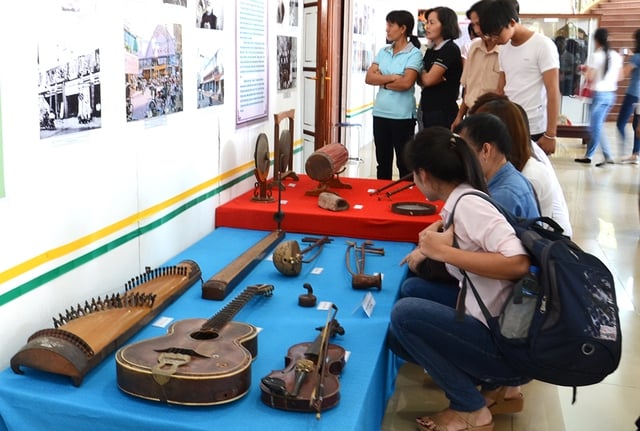
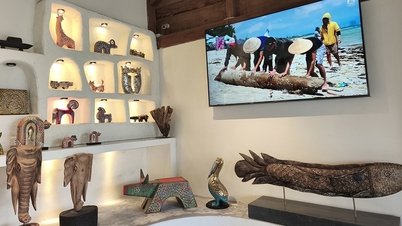
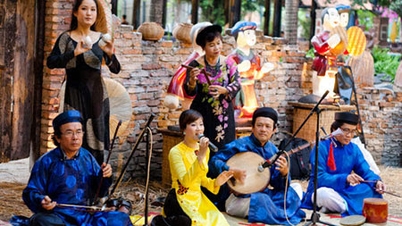
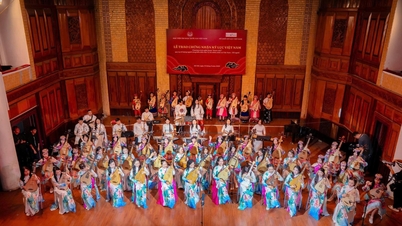
Some musical instruments used in traditional Vietnamese folk music.
PHOTO: HOANG PHUONG
In 1934, during a musical performance at a friend's house near Vinh Phuoc An Pagoda, Nam Nghia was caught in a torrential rain and had to stay overnight, unable to return home. In the dead of night, amidst the quiet stillness, he suddenly heard the temple bells ringing repeatedly. Nam Nghia sat up and, inspired, immediately wrote 20 lines, beginning with the faint sound of the temple bells, in the style of "Da Co Hoai Lang," and titled it " For Money, I Failed in Morality ." The next morning, Nam Nghia went to the house of his teacher, musician Cao Van Lau, sang it for him, and suggested that the teacher add the word "đờn" (musical instrument) to each line.
Finding it reasonable, musician Cao Văn Lầu invited two other musicians, Ba Chột and Mười Khói, to discuss the idea. They extended the melody of Dạ cổ hoài lang, increasing the tempo to 8 beats, giving Năm Nghĩa enough time to comfortably sing the 20-line song " Vì tiền lỗi đạo" (For Money, I Failed the Way) . About a year later, this song became popular in Saigon, known as "Văng vẳng tiếng chuông chùa" (The Faint Sound of Temple Bells ), and from then on, the name Dạ cổ was corrupted by Saigonese people to " Vọng cổ" . According to theater journalist Thiện Mộc Lan, in 1934, " Văng vẳng tiếng chuông chùa" was recorded on a record by Asia Records with Năm Nghĩa's voice sounding melancholic, especially the long, drawn-out "hơ, hơ, hơ" notes at the end of each line.
The origin of multiple theories
At the seminar commemorating the 90th anniversary of the song "Dạ cổ hoài lang" held at the Ho Chi Minh City College of Theatre and Film on July 29, 2009, Professor Tran Van Khe stated: "To this day, many people believe that Mr. Sau Cao Van Lau is the author of the song 'Dạ cổ hoài lang' . However, there are many differences regarding the author's birth year and the year the song was created. Therefore, the origin of this song remains subject to many theories."

Cao Van Lau Theater (Bac Lieu, now part of Ca Mau province)
PHOTO: HOANG PHUONG
Not only are the years of creation and origins of the Dạ cổ hoài lang version different, but the rhythm is also altered, from 2 beats to 8 beats, 16 beats, and many other details.
In the article "Attempting to find the origin of the Vọng Cổ song" published in the Bách Khoa magazine (August 15, 1959), author Nguyễn Tử Quang stated: "This was originally a poem in the form of a 20-line prose poem titled ' Dạ cổ hoài lang ', written in 1920 by the monk Nguyệt Chiếu, a profound scholar of Confucianism, who, due to unfavorable circumstances, temporarily sought refuge in Buddhism. However, deeply attached to his country, he entrusted his feelings to the poem, titled ' Dạ cổ hoài lang ,' meaning ' At night, hearing the drum and remembering my husband ,' and this poem was set to music by Cao Văn Lầu."
Conversely, in his paper presented at the conference "Master Nguyet Chieu and the Traditional Southern Vietnamese Ritual Music," Mr. Tran Phuoc Thuan argued that Master Nguyet Chieu was a master in the field of ceremonial music, having trained many students. He was particularly interested in Cao Van Lau's " Da Co" and worked to popularize it, but he was not the composer. During the Mid-Autumn Festival of the year Mau Ngo (1918), Sau Lau visited Master Nhac Khi, and while there, presented an untitled piece of music. After listening, the master praised it highly. That night, Master Nguyet Chieu was also present, and Master Nhac Khi asked the monk to name the piece. Master Nguyet Chieu then named it "Da Co Hoai Lang ."

Bac Lieu Square
PHOTO: HOANG PHUONG
According to Professor Tran Van Khe, in 1925, Mr. Huynh Thu Trung (Tu Choi) composed lyrics for a four-beat Vong Co song titled "The Sound of Swallows Crying in the Mist" .
"The swallows cry out in the mist of the northern sea."
"I weep bitterly under the southern sky."
In 1934, Năm Nghĩa switched from a 4-beat rhythm to an 8-beat rhythm in the song "The Faint Sound of Temple Bells ". In 1938, musician Vĩnh Bảo played the 16-beat rhythm for Cô Năm Cần Thơ's Vọng Cổ performance. In 1948, artist Út Trà Ôn sang the 16- beat rhythm song "Tôn Tẩn Pretending to Be Mad", and from 1955 onwards, the 32-beat Vọng Cổ rhythm became widely popular and remains so to this day.
Source: https://thanhnien.vn/cao-van-lau-va-da-co-hoai-lang-185250706225655327.htm


![[Photo] General Secretary and President To Lam receives Amazon's Senior Vice President David Zapolsky](https://vphoto.vietnam.vn/thumb/1200x675/vietnam/resource/IMAGE/2026/05/22/1779466547770_a1-bnd-3513-6601-jpg.webp)
























































































Comment (0)