

From August 1st, 2024, projects that are behind schedule will be revoked without compensation. This regulation will create a "purification" of investors, prevent land speculation, and address stalled projects.
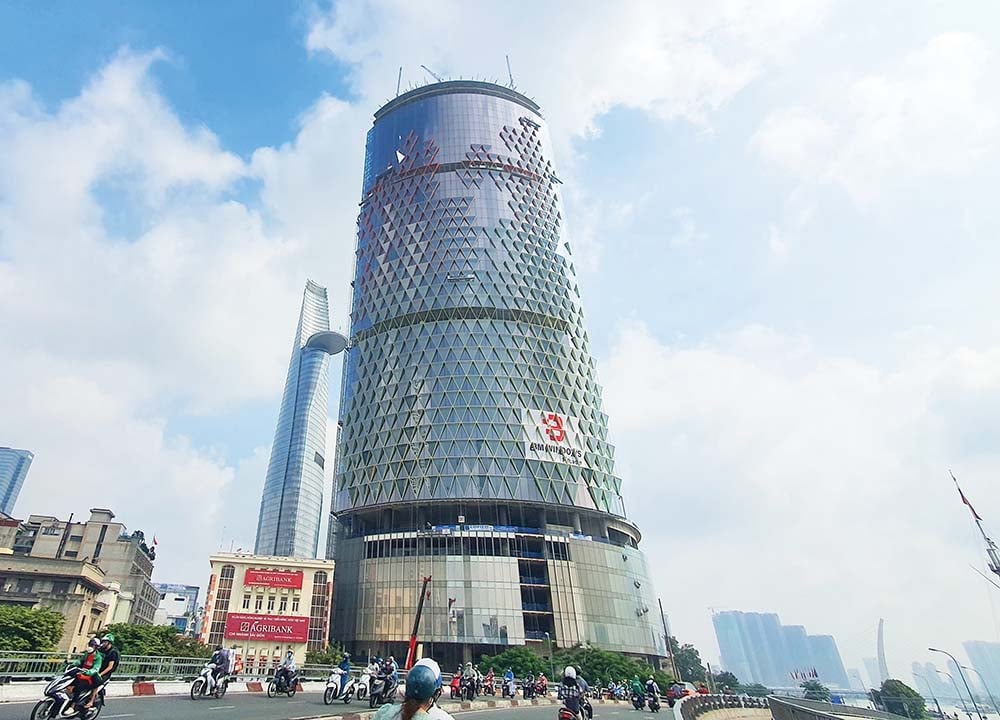 |
| The IFC One Saigon project (District 1, Ho Chi Minh City) remains unfinished after 17 years. |
Take strong action to curb land speculation and stalled projects.
Located on prime real estate at the corner of Ham Nghi and Ton Duc Thang streets (District 1, Ho Chi Minh City), the IFC One Saigon project (formerly known as Saigon One Tower) remains unfinished despite a brief period of high-profile relaunch.
Built on a 6,672 m2 plot of land, with a scale of 5 basement floors, 3 technical floors and 41 above-ground floors, IFC One Saigon started construction 17 years ago, but after 5 years of sluggish implementation, the project officially stopped construction in 2011. Despite several changes of ownership, IFC One Saigon remains unfinished. This building has been repeatedly named in lists of projects that mar the city's appearance.
Opposite Ben Thanh Market (Ho Chi Minh City), right next to the bustling Metro Line 1 station, stands a rough concrete structure called One Central Saigon (formerly known as The Spirit of Saigon). This is a mixed-use complex comprising a shopping mall, offices, apartments, luxury apartments, and a 6-star hotel, covering a total land area of over 8,500 m2. It occupies a prime location in the heart of District 1, with four street frontages. The project has changed hands several times, but there is no completion date in sight.
Similarly, the Lancaster Lincoln Project (District 4), invested by Trung Thuy Lancaster Co., Ltd., was started in 2017, but after the underground construction was completed, it stalled. And the D-One Saigon Project (Go Vap District) by DHA Company, approved in 2016, remains just an empty plot of land to this day.
One of the new features of the 2024 Land Law is the application of sanctions to projects involving land use conversion, recognition of land use rights, and transfer of land use rights, whereas previous laws only applied land reclamation due to violations in projects where land was allocated or leased.
The above are just a few examples of projects that have been stalled for many years in Ho Chi Minh City. The 2013 Land Law stipulates that after an investment policy decision is approved, a project has 12 months to implement, or 24 months if extended. If it is not implemented within this period, the project will be revoked. However, revoking these projects is not simple, especially when the enterprise has already made basic investments on the land.
The 2024 Land Law (effective from August 1, 2024) contains stricter regulations. For example, investment projects that are not used for 12 consecutive months from the date of handover, or whose land use progress is 24 months behind schedule as stated in the investment decision, will be revoked.
In cases where the land is not put into use or the project is behind schedule, the investor may be granted an extension of no more than 24 months and must pay the State an additional amount corresponding to the extension period. After the extension period, if the land is still not put into use, the State will reclaim it without compensation for the land, assets attached to the land, and investment costs.
The possibility of "force majeure" must be taken into account.
Reclaiming stalled projects to revitalize land resources is essential, but experts believe that force majeure circumstances, such as lengthy legal procedures, should be taken into account. This is because businesses themselves want to complete legal procedures as quickly as possible to begin construction, sales, and capital recovery.
Speaking with a reporter from Investment Newspaper, Mr. Angus Liew, Chairman of the Board of Directors of Gamuda Land Vietnam, assessed that the regulation on land reclamation for projects that are not implemented after the extension period expires in the 2024 Land Law aims to avoid wasting land resources. However, in some cases, the extension period can be longer, for example, during the Covid-19 pandemic.
Based on his business experience, Mr. Le Huu Nghia, General Director of Le Thanh Construction Co., Ltd., said that in reality, there are many cases of force majeure. For example, businesses cannot implement projects due to delays in procedures related to relevant authorities. Therefore, according to Mr. Nghia, the decree guiding the Land Law needs to supplement and clarify this content; otherwise, in many cases, businesses will be unjustly "killed off."
"As soon as we submitted the project application, we had to specify a timeline, but even after the investment was approved, we couldn't start implementation immediately because obtaining investment licenses and other procedures takes many years," Mr. Nghia shared.
A positive development for businesses wishing to pursue project implementation when delays occur is that the law provides conditions for delays due to force majeure events such as natural disasters or war. Furthermore, if it can be proven that the delay was due to the fault of the authorities or those responsible for enforcing the law, the project will not be revoked. However, businesses also suggest that the guiding decrees should provide more detailed regulations and specific sanctions for individuals and organizations indirectly responsible for project delays.
Along with stricter regulations in the 2024 Land Law, the 2023 Real Estate Business Law introduces many changes related to the financial requirements of investors. For example, real estate businesses must have equity capital of no less than 20% of the total investment capital for projects with a land area of less than 20 hectares, and no less than 15% of the total investment capital for projects with a land area of 20 hectares or more, and must ensure the ability to raise capital to implement the investment project.
In cases where a real estate business simultaneously undertakes multiple projects, it must have sufficient equity capital allocated to ensure the aforementioned ratio for each project in order to complete all projects. Furthermore, the 2023 Law on Real Estate Business also stipulates conditions such as credit limits, corporate bonds, etc.
With such strict regulations, businesses must carefully consider all factors before embarking on a project, avoiding inefficient and scattered investments that could lead to project delays and wasted resources.
Source: https://baodautu.vn/batdongsan/chan-dau-co-dat-du-an-treo-d220831.html

![[Image] "Journey of Hope" promotes the organ and tissue donation movement in Vietnam.](https://vphoto.vietnam.vn/thumb/1200x675/vietnam/resource/IMAGE/2026/05/20/1779294400833_1-8910-jpg.webp)




















































































Comment (0)