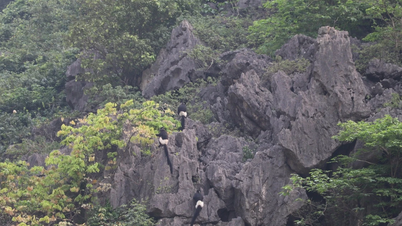
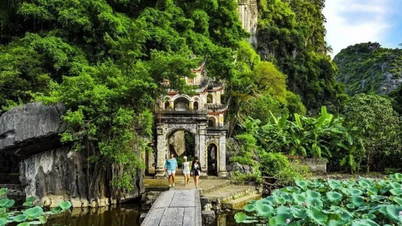
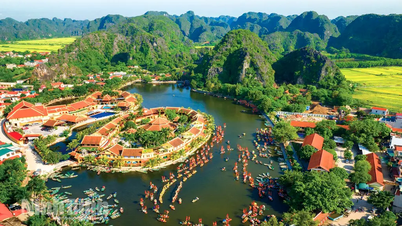
Located about 2 km from Bai Dinh Pagoda, Thung Ui is surrounded by towering limestone mountains, characteristic of the Trang An karst landscape. The enclosed space creates a vast valley, where the forest remains green all year round, and the crystal-clear lake reflects the clouds and sky.
In the past, this place was a "survival zone" for the indigenous people. The old-growth forest provided forest products and wild animals, the lake was rich in fish and shrimp, and the fertile land allowed rice, corn, and potatoes to grow. That valley silently sustained many generations during difficult times.
.jpg) 
|
Thung Ui is not just a newly emerging tourist destination, but a place where nature, history, and human depth converge. |
The name "Thung Ui" (Ui Valley) originates from the arduous journey of conquering the rugged terrain. To reach the heart of the valley, people in the past had to climb steep mountains and traverse treacherous forest paths. The exclamations of exhaustion that arose from this journey have become part of their linguistic memory, and then transformed into a simple yet meaningful place name.
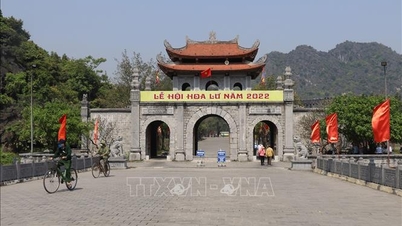
The unique value of Thung Ui lies in its historical significance. More than 1,000 years ago, this area, formerly part of the Hoa Lu capital, was chosen as the site of the Altar of Heaven, a place associated with the achievements of Dinh Bo Linh.
Here, he performed a ritual to the heavens before leading his army to quell the rebellion of the 12 warlords. After unifying the country in 968, he continued to offer sacrifices to heaven and earth, proclaimed himself Emperor, established the national name of Dai Co Viet, ushering in a period of independence and laying the foundation for Vietnam's first centralized feudal state.
.jpg) 
|
Many unique cultural and spiritual activities were vividly showcased during the first days of Spring in the year of the Horse 2026 at Thung Ui. |
The altar was reconstructed according to the philosophy of "Three Powers": Man - Earth - Heaven, with three layers of gates symbolizing the harmony between humanity and the universe. The architectural space not only has a ceremonial character but also reflects the profound cosmological thinking of ancient Vietnamese people.
In the heart of the vast Mộc Hoàn valley, spanning approximately 270 hectares, lies Mục Long Lake – the deep blue "dragon's eye," considered a place where water and energy converge. According to feng shui principles, the mountainous terrain surrounding the lake in the center creates a sacred landscape, suitable for important national affairs.
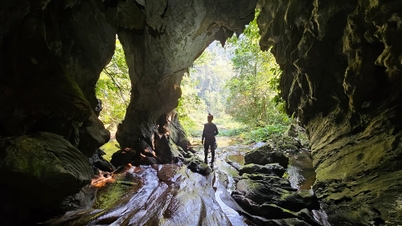
Beyond its historical significance from the Dinh Dynasty, Thung Ui also holds exceptional archaeological value. Over two decades of research, scientists have discovered prehistoric human remains dating back 13,000 to 50,000 years.
.jpg) 
|
Tourists explore Thung Ui Valley by boat. |
This discovery proves the very early presence of humans in Trang An - Hoa Lu, showing that this area was a continuous habitation space through many periods. From prehistoric inhabitants surviving amidst the mountains and forests to the founding emperor, all of this creates a rare and continuous historical thread.
Therefore, Thung Ui is not just a newly emerging tourist destination, but a place where nature, history, and human depth converge. Visitors can feel the movement of time here: from prehistoric sediments to the turning point of nation-building, and then step into a modern eco-tourism space.
In a tourist landscape already renowned for its caves, rivers, mountains, and ancient relics, Thung Ui offers a different perspective: a journey of discovery to the origins of the nation amidst sacred spaces and picturesque scenery.
.jpg) 
|
Tourists experience and enjoy cultural activities at Thung Ui. |
The systematic investment has helped preserve the pristine beauty of this place while creating favorable conditions for tourists to have a pleasant experience. Not noisy or overly commercialized, Thung Ui is attractive precisely because of the depth of the story it holds.
In the heart of Trang An, Thung Ui stands as an echo from the past – a reminder of our origins, our aspirations for nation-building, and the resilience of our people throughout thousands of years of history.
Source: https://baodautu.vn/giua-trang-an-co-mot-thung-ui-day-huyen-tich-d527100.html




![[Photo] General Secretary and President To Lam presides over a meeting with the Central Organizing Committee.](https://vphoto.vietnam.vn/thumb/1200x675/vietnam/resource/IMAGE/2026/06/03/1780482764658_a1-bnd-4741-3342-jpg.webp)
![[Photo] Secretary of the National Assembly Party Committee, Chairman of the National Assembly presides over the meeting of the Standing Committee and Executive Committee of the National Assembly Party Committee.](https://vphoto.vietnam.vn/thumb/1200x675/vietnam/resource/IMAGE/2026/06/03/1780480353201_ndo_br_bnd-2585-jpg.webp)
![[Photo] First session of the 14th Congress of the Vietnam Trade Union](https://vphoto.vietnam.vn/thumb/1200x675/vietnam/resource/IMAGE/2026/06/03/1780465947883_ndo_br_img-3852-jpg.webp)



































![[Video] Sunset at Lap An Lagoon – Where the sun sets over the fishing nets](https://vphoto.vietnam.vn/thumb/1200x675/vietnam/resource/IMAGE/2026/05/31/1780192137701_beach-landscape-sea-water-nature-grass-745871-pxhere-com.jpeg)























Comment (0)