

The Ho Dynasty Citadel, located in Vinh Tien and Vinh Long communes, Vinh Loc district (Thanh Hoa province), was once the political , economic, cultural, and social center of Vietnam. Although it only existed for seven years (1400-1407) under the Ho Dynasty, it is a unique architectural masterpiece and an outstanding symbol of ancient citadels.
|
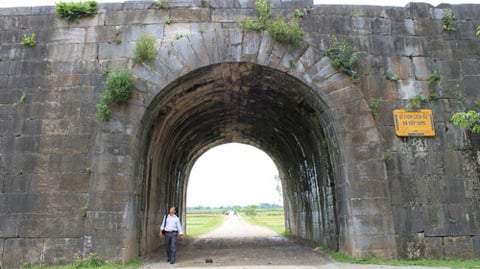
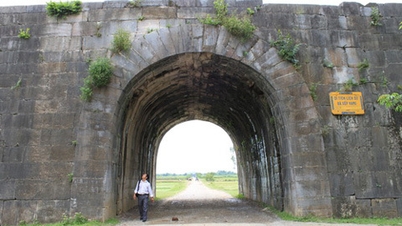
The outer facade of the north gate of Ho Dynasty Citadel. |
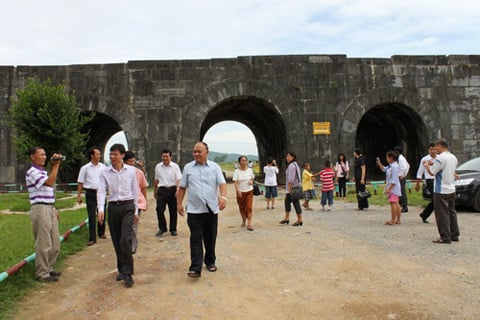

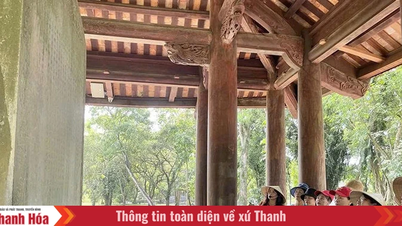
A group of Lao tourists - the first international group to visit the Ho Dynasty Citadel heritage site on the morning of June 28th, after the Ho Dynasty Citadel was recognized as a world cultural heritage site - Photo: Ha Dong
At the beginning of the 20th century, the French researcher L. Bezacier - specializing in Indochinese culture - commented on Ho Citadel as follows: "We must state clearly that this citadel is a unique example of the use of massive limestone blocks, skillfully carved and fitted together...".
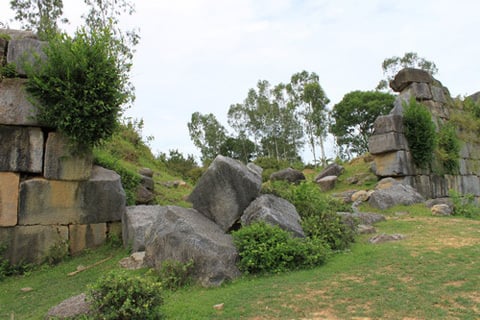
The Ho Dynasty Citadel, built by Ho Quy Ly in 1397, is truly unique. The exterior is constructed of solid stone blocks, while the interior is primarily built of earth mixed with gravel and loose stones for reinforcement. Built on a nearly square architectural plan, the citadel's north and south sides are nearly 900 meters long, while the east and west sides are over 800 meters long, surrounded by walls. The average height of the citadel is 7-8 meters, with some sections, such as the southern gate, reaching 10 meters. This is significant evidence of the labor and skillful craftsmanship of the Vietnamese people at that time. |
Visiting Ho Dynasty Citadel, we will find it very interesting to admire artifacts related to the Ho Dynasty, such as: fired clay bricks used to build the brick wall section on top of the stone wall to create height for the citadel, and also to facilitate soldiers' observation of the surroundings. Stone blocks used in conjunction with rollers to transport large stone blocks for building the citadel walls.
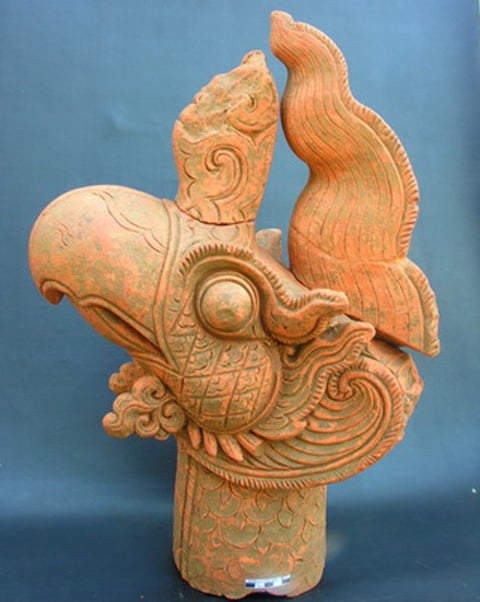
Terracotta roof tiles and ridge tiles were used to decorate the roofs of palace architecture during the Ho Dynasty. Weapons such as stone projectiles, four-sided iron spikes, knife tips, arrowheads, and boat nails were found here, demonstrating the Ho Dynasty's strong emphasis on military defense. Ceramic kilns used for firing glazed materials and earthenware jars and containers – common household items during the Ho Dynasty – were also found. Various terracotta materials with intricate patterns, such as curved tiles and dragon heads, were used to decorate the corners of the palace roofs during the Ho Dynasty.
|
Precious earthenware artifacts recently discovered at Ho Dynasty Citadel. |
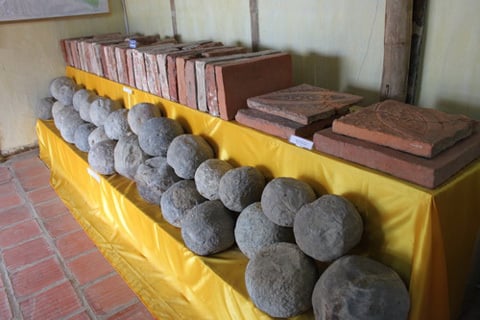
Stone blocks and fired bricks date back to the Ho Dynasty.
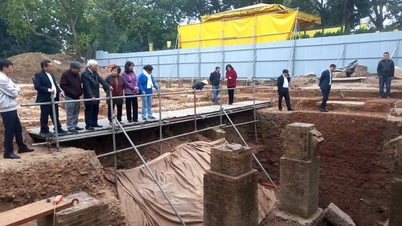
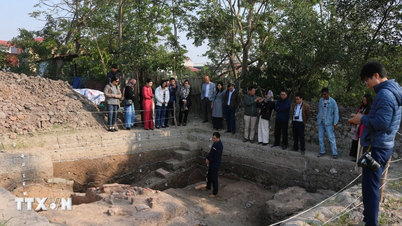
These are artifacts unearthed by archaeologists in recent times at the Nam Giao sacrificial altar area, part of the Ho Dynasty Citadel heritage complex.
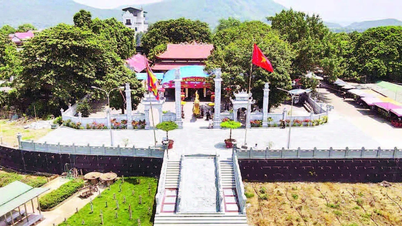
These artifacts are currently on display at the Ho Dynasty Citadel Heritage Conservation Center (under the Thanh Hoa Department of Culture, Sports and Tourism) in Vinh Tien commune, Vinh Loc district. The Ho Dynasty Citadel is one of the first relics to be recognized as a national historical and cultural relic by the State in 1962. Over more than 600 years, through many historical events and weather conditions, some parts of the Ho Dynasty Citadel have deteriorated.
Mr. Vuong Van Viet, Vice Chairman of the Thanh Hoa Provincial People's Committee and Head of the Steering Committee for the construction of the Ho Dynasty Citadel heritage dossier, affirmed: "The Provincial People's Committee and the people of Thanh Hoa are committed to strictly preserving and promoting the cultural and historical value of the Ho Dynasty Citadel; gradually investing so that this unique architectural work can be effectively utilized in all aspects, worthy of being a world cultural heritage site." |




![[Photo] First session of the 14th Congress of the Vietnam Trade Union](https://vphoto.vietnam.vn/thumb/1200x675/vietnam/resource/IMAGE/2026/06/03/1780465947883_ndo_br_img-3852-jpg.webp)









































![[Video] Sunset at Lap An Lagoon – Where the sun sets over the fishing nets](https://vphoto.vietnam.vn/thumb/1200x675/vietnam/resource/IMAGE/2026/05/31/1780192137701_beach-landscape-sea-water-nature-grass-745871-pxhere-com.jpeg)



































Comment (0)