Learn to accept failure.
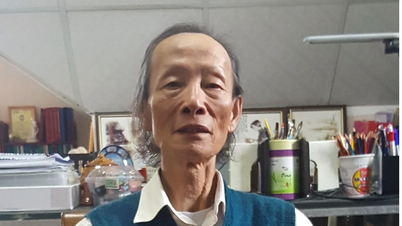
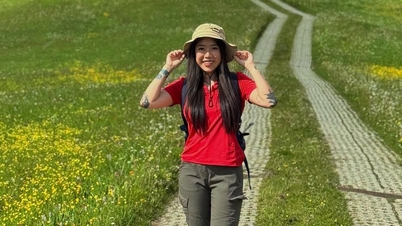
Under the guidance of Professor Nguyen Nam Trung - ranked among the top 2% of scientists worldwide by Stanford University in 2024 - Huynh Minh Anh (Griffith University, Australia) is passionately researching silicon carbide (SiC) semiconductor materials and bioelectronic devices that can be implanted in the human body to monitor signals and destroy cancer cells that have existed in the body's environment for decades.
Minh Anh went through manufacturing processes that lasted many days, but a single small error meant the entire prototype had to be redone from scratch. “Some experiments had to be repeated dozens of times before yielding stable results. After each failure, I tried to encourage and comfort myself to continue with new experiments,” Minh Anh shared.
In the research of semiconductor materials and bioimplants, the biggest challenge faced by researchers in the field of biomedical electronics is proving that the device can operate stably, safely, and for a long time in a real biological environment. To apply the device to cancer cells, Minh Anh had to go through many steps, from fabricating electrodes in a cleanroom to applying it to cancer cells on a petri dish in the laboratory, and applying it to mice...
“Science is not a journey of seeking perfect results immediately, or continuous success. It is a journey of learning to accept the unknown, failure, persevering with long-term goals, and continuing to move forward even when the results are not always as expected.” Dr. Huynh Minh Anh (Griffith University, Australia)
Because a device might work perfectly on a laboratory electrophysiological analyzer, but when placed in a biological environment, it will face many factors such as humidity, biological fluids, immune responses, and material degradation over time.
"I learned that in scientific research, failure is very normal, and in a cleanroom, precision and adherence to manufacturing procedures are absolute requirements. Those experiences taught me patience and meticulousness," the young doctor shared.
Dynamic in a "dual" role


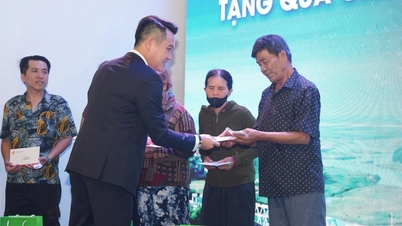
Dr. Huynh Minh Anh is called a "two-in-one" guy because he takes on two seemingly contradictory roles: a diligent Minh Anh in the laboratory and a dynamic, enthusiastic Minh Anh in the community. He is very active in the Association's work, connecting Vietnamese students in Australia through academic, professional, and cultural activities.
For Minh Anh, a researcher needs not only knowledge but also empathy, networking skills, and a spirit of community service. Upon being elected President of the Vietnamese Student Association in Queensland (AVSQ) for the 2023-2024 term, he led over 30 Executive Committee members in implementing numerous large-scale activities aimed at the Vietnamese student community in Queensland.
During his tenure, he collaborated with AVSQ to organize six diverse programs, ranging from integration support and academic and career guidance to promoting Vietnamese culture. Highlights included the "Future Queenslanders" series of events, with three activities in Hanoi and Brisbane, providing information about life, study, and work in Queensland, while also helping new students adapt to their new environment. He also organized the "Career Compass" career guidance series, connecting professionals with students and young people in fields such as finance and accounting, computer science and software engineering, and design.
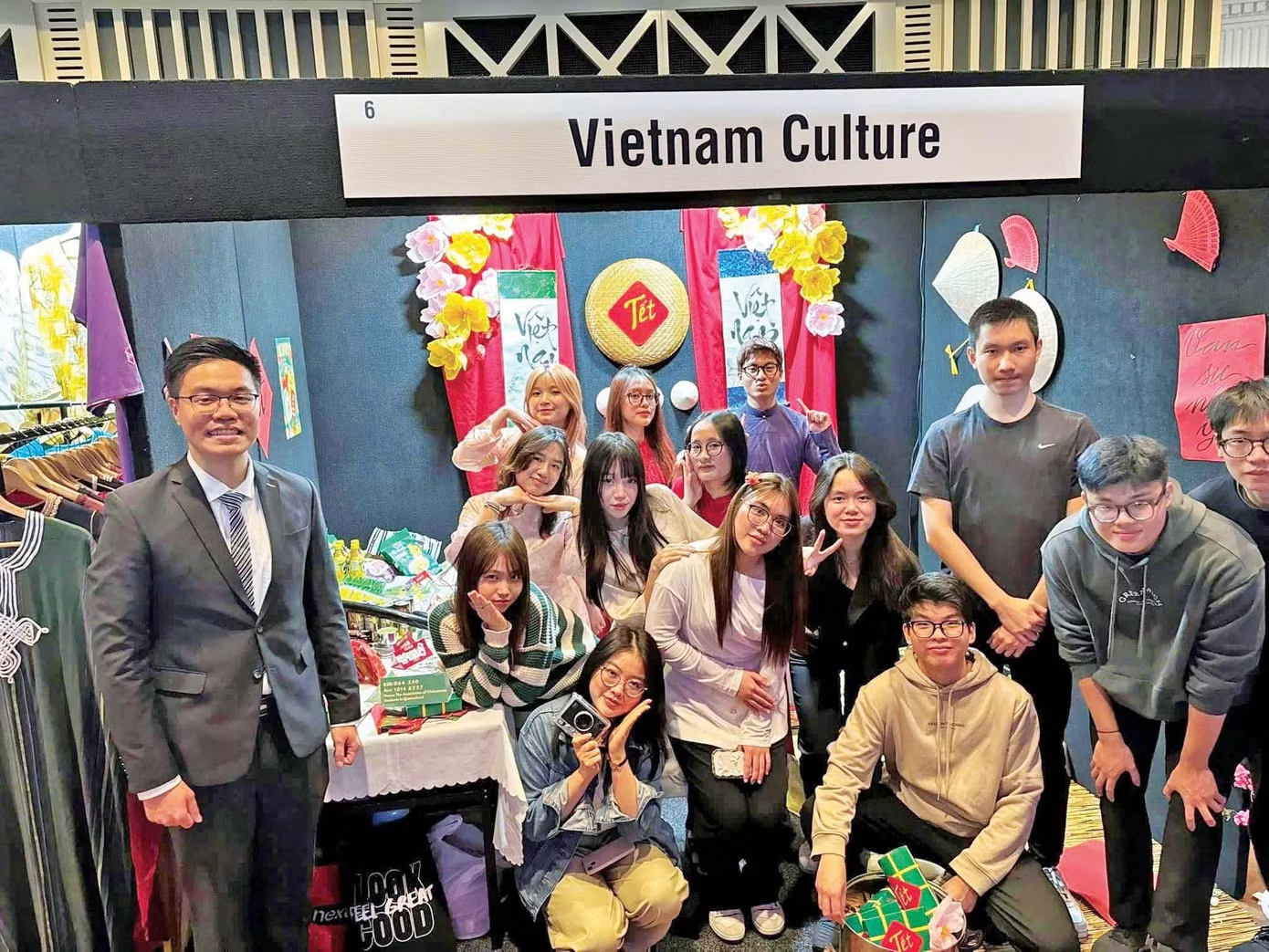
In addition, he also coordinated the organization of the Vietnamese Culture Exhibition at Brisbane City Hall, the "Cultural Flowers" program with games inspired by traditional Vietnamese crafts... These activities attracted hundreds of participants from Vietnamese students, international students and young workers, receiving positive feedback from the multicultural community as well as the Brisbane City Council.
“The moment that made me feel most strongly that the Association's efforts truly touched the community was when the students asked: When will AVSQ organize the next professional development event? When will there be the next cultural performance event? Or are there any other programs AVSQ has coming up?...”, Minh Anh shared.
What makes Minh Anh happiest isn't organizing a big event, but seeing new students in Australia become more confident and find companions. Or seeing a recent graduate find a full-time job in software programming after participating in the Association's programs.
Proposing an "Open Laboratory" model.
Drawing from her experience as a young, dynamic researcher involved in youth union activities, and looking forward to the 13th National Congress of the Youth Union, Dr. Huynh Minh Anh hopes that the Youth Union will pilot an "Open Laboratory" model for young people to connect young scientists, students, businesses, and localities to jointly solve practical problems using science and technology.
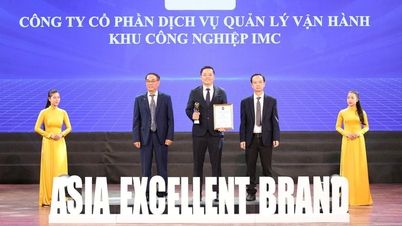
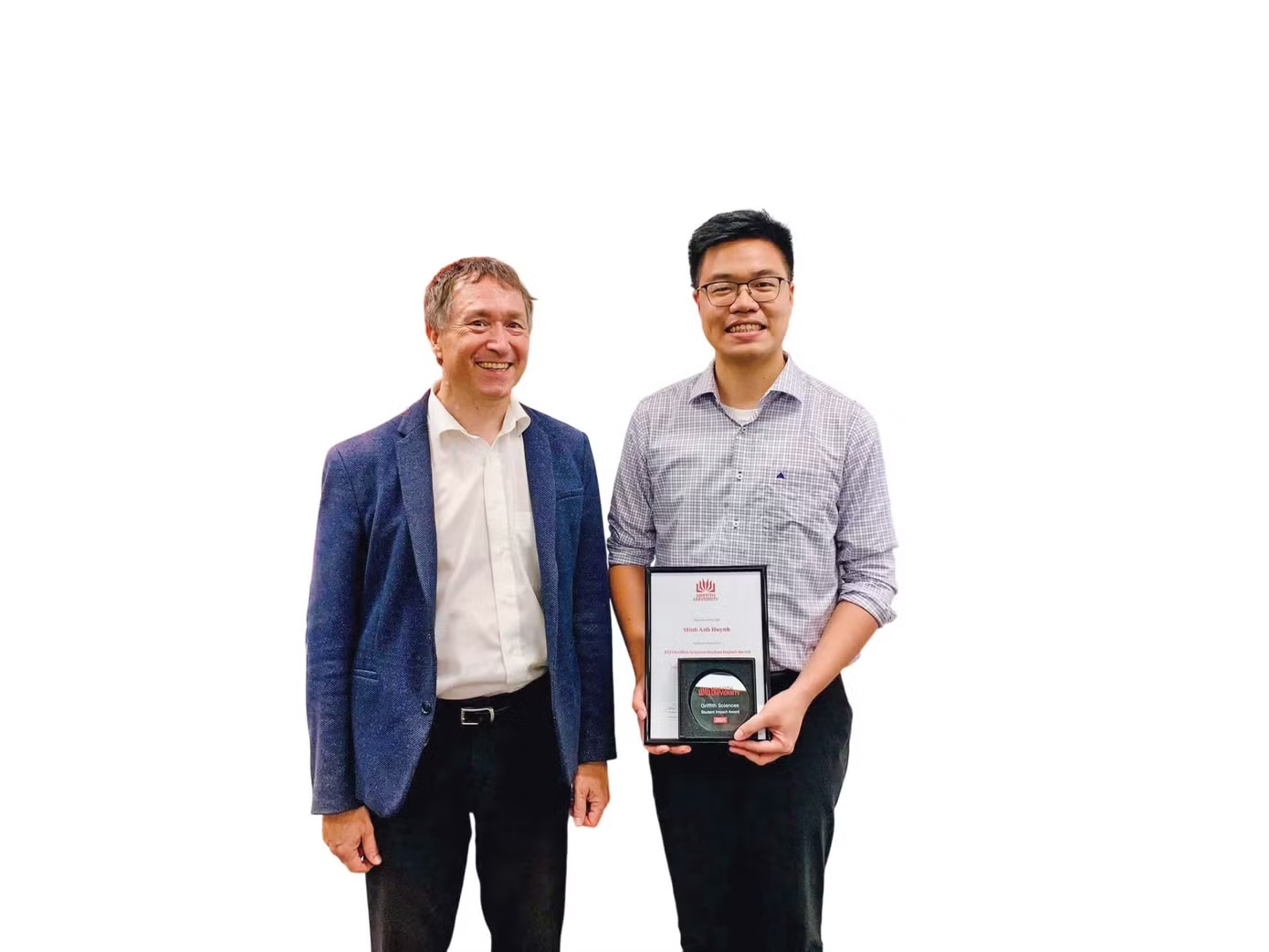
Dr. Minh Anh has received numerous awards, including: Second Prize at the Vietnam Young Intellectuals Forum in Australia in 2026; First Prize at the AURORA Scientific Research Award in 2025; Outstanding Scientific Publication Award from the School of Engineering and Construction Environment, Griffith University in 2025; and the Get Down Under Award at the 29th International Conference on Miniaturized Systems for Chemistry and Life Sciences (UTAS 2025). In her work with the Youth Union and Student Association, Minh Anh was honored with a Certificate of Merit from the Central Committee of the Vietnam Student Association for the 2022-2024 term…



According to him, the Youth Union could select interdisciplinary research groups comprising young scientists, engineers, students, and local Youth Union members. Each group would be mentored by an expert, supported by a product user organization, and provided with a "testing space" to verify the solution under real-world conditions. Effective products would receive support for intellectual property registration, business connections, or transfer to the local area.
Minh Anh proposed that each provincial and city Youth Union select 1 to 3 priority problems annually. The Central Youth Union should consider building a bank of experts and acting as a coordinating unit to connect these problems with laboratories, businesses, and young Vietnamese intellectuals abroad. Young scientists overseas could participate in online mentoring, design review, data analysis support, or technology transfer.
The "2-in-1" PhD believes that, if implemented properly, an "open laboratory" for young people could become a place where young intellectuals can work together to solve the country's problems using knowledge and technology.
Source: https://tienphong.vn/chang-tien-si-2-trong-1-post1852761.tpo
![[Image] A look back at the capital's preparations for the century-long master plan.](https://vphoto.vietnam.vn/thumb/1200x675/vietnam/resource/IMAGE/2026/06/29/1782750453122_quy-hoach-100-nam-minh-duy-1-2118-jpg.webp)

![[Photo] National Assembly Chairman Tran Thanh Man attends the Conference to announce the Master Plan for Hanoi Capital City with a 100-year vision.](https://vphoto.vietnam.vn/thumb/1200x675/vietnam/resource/IMAGE/2026/06/29/1782709639728_ndo_br_1-jpg.webp)


![[Photo] General Secretary and President To Lam works with the Party Committee of the Government on the work of preventing and combating storms, floods, extreme natural disasters and climate change.](https://vphoto.vietnam.vn/thumb/1200x675/vietnam/resource/IMAGE/2026/06/29/1782729441945_a1-bnd-0385-9454-jpg.webp)