According to Live Science , citing a report from the Geological Society of London, a large rift valley (the Great Rift Valley) is gradually splitting Africa – the second largest continent on Earth – into two. This rift valley is also known as the East African Rift Zone.
The East African Rift is a network of valleys stretching approximately 3,500 km from the Red Sea to Mozambique.
The question currently on the minds of geologists is whether Africa will be completely divided, and when this will happen?
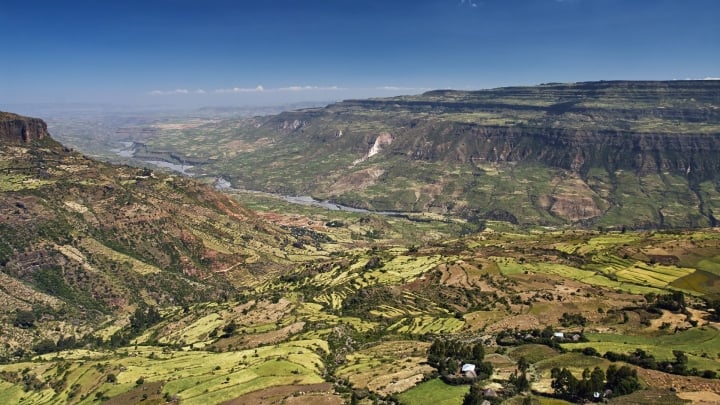
The East African Rift is a network of valleys stretching from the Red Sea to Mozambique. Pictured is Ethiopia's Rift Valley, part of this rift. (Photo: LuCaAr/Getty Images)
According to NASA's Earth Observatory, the East African Rift runs along the Somali tectonic plate eastward toward the Nubian tectonic plate.
The Somali and Nubian plates are also separating from the Arabian plate to the north. The Geological Society of London suggests that these tectonic plates intersect in the Afar region of Ethiopia, creating a Y-shaped rift system.
The East African Rift began forming about 35 million years ago between Arabia and the Horn of Africa in the east of the continent, according to geologist Cynthia Ebinger, chair of the geology department at Tulane University in New Orleans and scientific advisor to the U.S. State Department's Africa Bureau.
Ms. Ebinger stated that the rift zone in East Africa has been extending southward over time and slowed down in northern Kenya around 25 million years ago.



This rift zone comprises two parallel, wide rift zones located beneath the Earth's crust.
The Geological Society of London states that the eastern rift passes through Ethiopia and Kenya, while the western rift runs in an arc from Uganda to Malawi. The eastern branch is arid, while the western branch lies on the border of the Congo rainforest.
The existence of eastern and western rift zones, as well as the discovery of offshore earthquake and volcanic areas, suggests that Africa is gradually opening up along several lines. Estimates suggest this is at over 6.35 mm per year.
Ken Macdonald, professor emeritus of Earth sciences at the University of California, Santa Barbara, told Live Science: "The fracturing is happening very slowly, about the same rate as an adult's toenail grows."
According to the Geological Society of London, the East African Rift Zone most likely formed due to heat radiating from the asthenosphere—the hotter, weaker, upper part of the Earth's crust—between Kenya and Ethiopia. This heat caused the upper crust to expand and uplift, leading to the stretching and fracturing of brittle continental rocks. This resulted in significant volcanic activity, including the formation of Mount Kilimanjaro, the highest mountain in Africa.
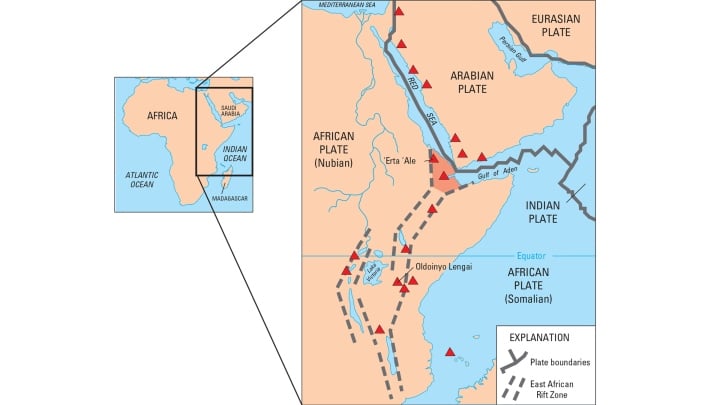
A map showing the boundaries of tectonic plates (gray lines) as well as the East African Rift Zone (dotted lines).
There are varying opinions on how Africa was actually split and what process occurred. One scenario is that a large portion of the Somali tectonic plate separated from the rest of the African continent, with a sea forming between them.
This new territory would include Somalia, Eritrea, Djibouti and the eastern parts of Ethiopia, Kenya, Tanzania and Mozambique. Another scenario would involve only eastern Tanzania and Mozambique separating.
According to Ms. Ebinger, if the African continent were to fracture, "the fissures in Ethiopia and Kenya could separate from the Somali plate within the next 1 million to 5 million years."



Nevertheless, many geologists still argue that the African continent cannot split in two because the geological forces driving the rift are too slow to separate the Somali and Nubian tectonic plates. A notable example of unsuccessful rifting elsewhere in the world is the 3,000-kilometer-long Central Rift running through the Upper Midwest of North America.
According to the Geological Society of London, the eastern branch of the East African Rift is an unsuccessful rift. However, the western branch remains active.
Tra Khanh (Source: Live Science)
Beneficial
Emotion
Creative
Unique
Source





![[Image] National conference summarizing one year of operation of the overall organizational model of the political system, the three-tiered government model.](https://vphoto.vietnam.vn/thumb/1200x675/vietnam/resource/IMAGE/2026/07/01/1782882811691_ndo_br_1-jpg.webp)