

"When the country needs them, they know how to live apart."
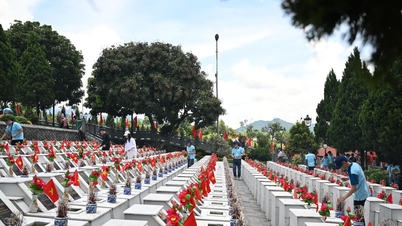
Every year, on the anniversary of the Battle of Vi Xuyen (July 12th), Ms. Nguyen Thi Nhung (born in 1963, from Gia Lam district, now Gia Lam commune, Hanoi ) travels hundreds of kilometers to the Vi Xuyen National Martyrs' Cemetery (Ha Giang province, now Tuyen Quang province) to light incense and commemorate the heroic martyrs. Among thousands of graves, she always lingers for a long time at the resting place of martyr Truong Quang Quy (born in 1962, died in 1985, from Quang Binh province, now Quang Tri province), her first love whom she cherished throughout her life.
Recalling the past, Mrs. Nhung's voice choked with emotion as she recounted: "In 1984, Mr. Quy's unit (Company 1, Battalion 64, Regiment 76, Research Department, General Staff, now General Department II) came to train at Gia Lam Airport (Hanoi). My grandmother's house was opposite the airport, so we saw soldiers every day, but back then, I didn't pay attention to anyone. Later, Mr. Quy confided that he had noticed me from the first time he saw me. He said I was simple and charming, and he only hoped to entrust his fate to me."
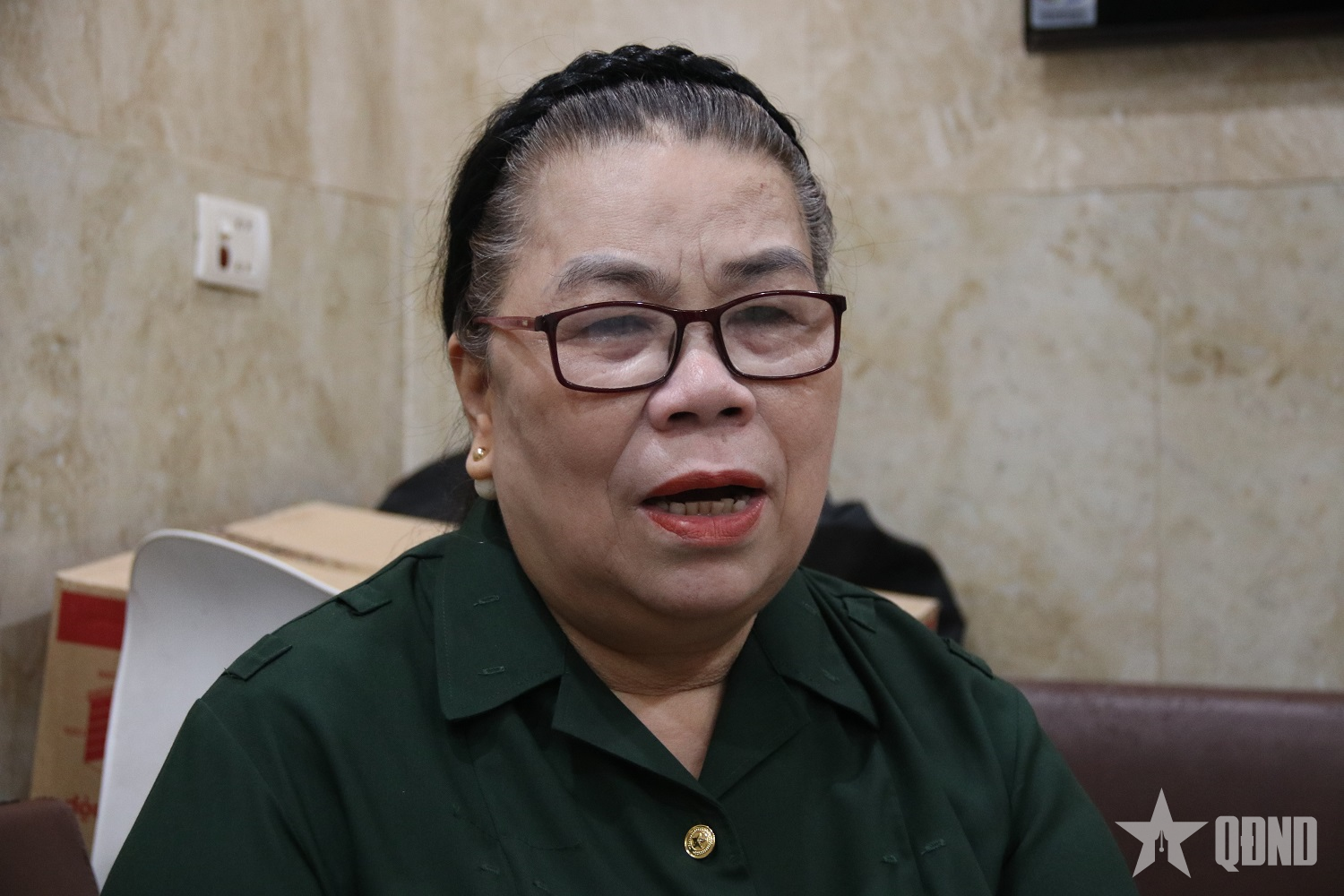 |
| Ms. Nhung recounted, with tears in her eyes, her love story with the fallen soldier Truong Quang Quy. |
From those fleeting encounters, Quy proactively sought ways to get closer to the girl he admired. After training, he and his teammates went to the fields to help the villagers harvest rice. "When I came home from work, I saw him rolling up his sleeves to help the family. As soon as he saw me, he ran over to help with my motorbike and asked if I was tired. From those small gestures of care, I gradually started to notice him," Mrs. Nhung recalled.
In the days that followed, the young soldier seized every opportunity to chat, telling her about his family, his childhood, and his dreams of a home of his own. It was this simplicity and sincerity that gradually touched the heart of the girl from Hanoi.
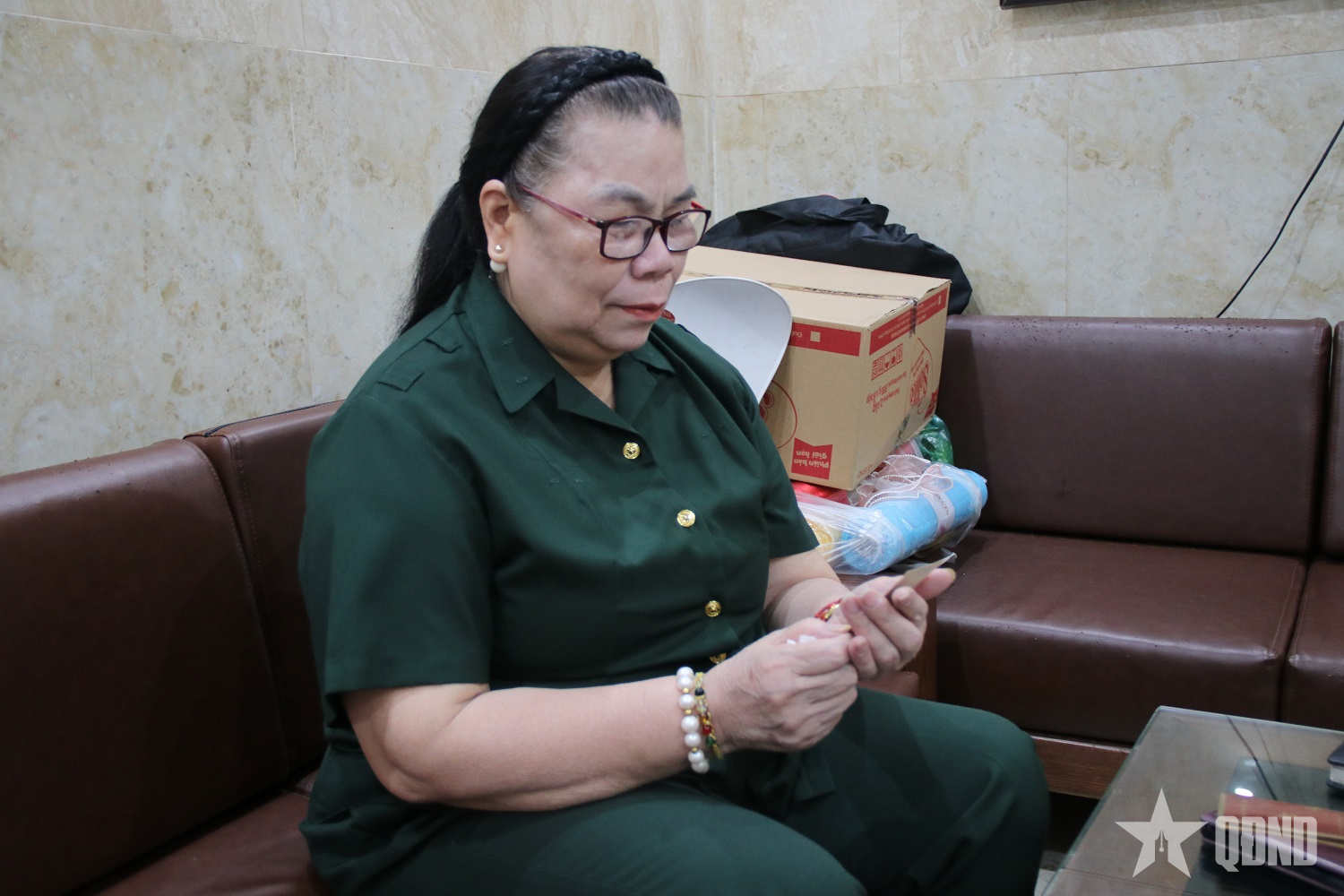
Before his unit left Gia Lam airport for a new assignment, Quy confessed his love to her, and she accepted. “That day, he told me he was so happy, that he could leave with peace of mind as long as I accepted. He gave me a ring made of a type of grass and said, ‘My family is poor, we don’t have gold or silver rings, only this ring as a promise for the future,’” Mrs. Nhung happily recounted.
After Quy's unit moved to Ba Vi district (now Ba Vi commune, Hanoi) for training, the two kept in touch through handwritten letters. Every four days, he would send a letter, recounting stories from the training ground, inquiring about her health, and reminding her of their promise. Nhung also replied regularly, sharing small details of their daily lives. Through these simple letters, their love grew stronger over the years.
 |
In March 1985, young soldier Truong Quang Quy was assigned to the Vi Xuyen front (Ha Giang province, now Tuyen Quang province). Before leaving, he took the opportunity to visit his girlfriend. During a family meal, he asked Nhung's parents for permission to marry her after completing his mission. Seeing the sincere feelings between the two, Nhung's parents nodded in agreement.
On the day he left, promises and handwritten letters became the link between the home front and the battlefield. In Hanoi, Nhung prepared her wedding bed, bought peacock-patterned blankets, and counted the days until his return. In his letters, Quy promised that after completing his mission, he would take her back to Quang Binh (now Quang Tri province) to pay respects to his parents, and then to Nhat Le beach for their honeymoon. Together, they nurtured their dream of a small home filled with the laughter of children.
A love story left behind in the "century-old lime kiln".
But the letters became less frequent. A month passed without news, then a month and fifteen days. Nearly two months went by, and the mailbox in front of the house remained empty. Nhung was anxious, but reassured herself: "Perhaps he's on a military campaign."
One afternoon in December 1985, the young woman received a letter from her brother's comrade, informing her that Comrade Truong Quang Quy had died at Hill 772 while on duty. "Reading the letter, I felt faint and then passed out. Even now, 40 years later, I still feel immense sorrow for him because he died without even having a proper kiss with his fiancée," Mrs. Nhung said, her voice choked with emotion.
Since the day Quy sacrificed his life, Nguyen Thi Nhung has followed every clue in the hope of finding his resting place. “In 2016, by chance, I went to the Vi Xuyen National Martyrs Cemetery (Ha Giang, now Tuyen Quang province). When I inquired, the cemetery caretaker gave me a register of fallen soldiers. As soon as I opened it, the name Truong Quang Quy appeared before my eyes. I was speechless, tears welled up. After so many years of waiting, I finally found him,” she recounted.
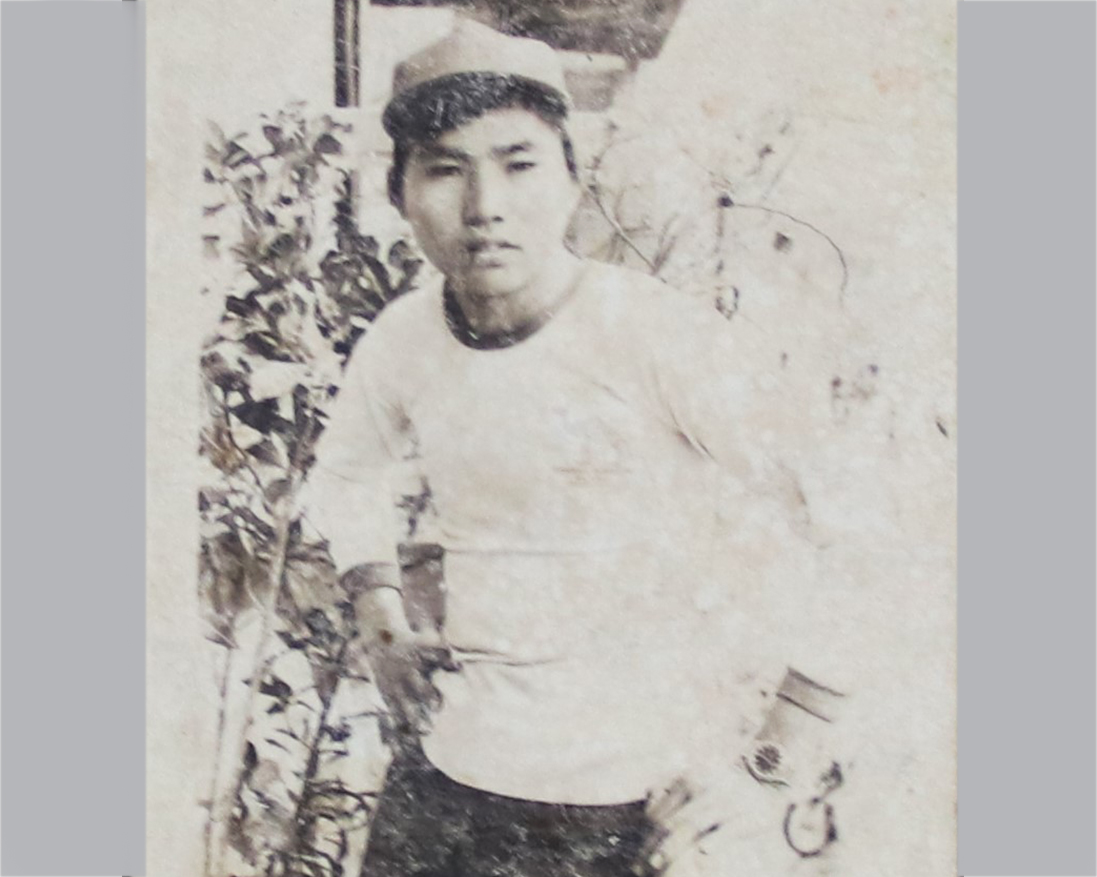 |
Character photo provided |
Forty years have passed, but the pain in her heart has never subsided. Every July, she is restless. During sleepless nights, sitting silently beside the graves of her loved ones, she tells herself that she must live in a way that is true to the past.
“I only hope I still have enough health to do many things, to share the pain with those who were affected by the war. Because I understand very well what the war took away from me,” her eyes, marked by the passage of time, still sparkle whenever she talks about her youth and a person she can never forget. Every year, on the anniversary of the battle on July 12th, Mrs. Nhung makes arrangements to go to Vi Xuyen to hold a memorial service for martyr Truong Quang Quy and his comrades.
In July, on the borderlands, the clouds of Vi Xuyen seem to shyly bow before the stone monuments that have become markers of patriotism. In the rustling wind, we clearly hear the reminder from the previous generation: their youth, their love, and even their lives were entirely dedicated to the Fatherland. Peace does not come naturally; it was bought with the blood of soldiers and the silent waiting of those left behind. In the face of such losses, every step we take today must carry gratitude. Living decently and responsibly is the way to continue what was left unfinished, so that the sacrifices of the past do not fade into oblivion.
Text and photos: TRAN HAI LY
Source: https://www.qdnd.vn/phong-su-dieu-tra/phong-su/chi-con-em-giua-thang-bay-vi-xuyen-836135

![[Photo] General Secretary and President To Lam meets with National Assembly delegates from ethnic minorities.](https://vphoto.vietnam.vn/thumb/1200x675/vietnam/resource/IMAGE/2026/04/20/1776696701056_a1-bnd-8331-3342-jpg.webp)



![[Image] National Assembly discusses the implementation of the socio-economic development plan.](https://vphoto.vietnam.vn/thumb/1200x675/vietnam/resource/IMAGE/2026/04/20/1776696707422_ndo_br_img-20260420-185419-jpg.webp)






























































Comment (0)