

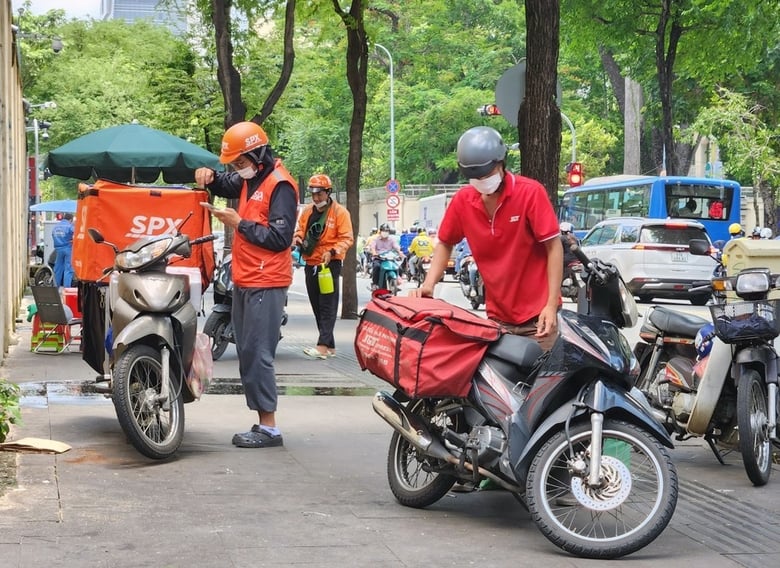
Everyone has been a "victim" at some point.
Ms. Vu Yen (residing in Useful apartment building, Tan Binh district, Ho Chi Minh City) recounted being scammed into transferring money for an online order. After exchanging messages over the phone and seeing that the amount matched an order she had placed, and since she couldn't receive the goods in person, she asked the shipper to deliver the order and sent her bank account number for the transfer. However, when she asked her family that evening, they said there was no such order. She tried calling but received no answer. The next morning, she received a message saying the order was to be delivered to… Tan Uyen (Binh Duong). When she requested a refund, she only received a link with a message saying clicking on it would get her money back.
“I knew that clicking on that link could very likely lead to my account being hacked, and I might even lose a larger sum of money, because some friends had experienced similar situations. Thinking back, I realize it was my own fault for being distracted. Although I had suspicions during the phone conversation, I didn't think much of it,” said Ms. Vu Yen. Ms. Yen's story was shared on her personal Facebook page to warn her friends. Many others also revealed similar situations, with some even being scammed twice in a single day.
Another customer in Hanoi, who didn't lose any money unfairly, also complained about the attitude of a delivery driver. After ordering a box of fresh seafood, the driver initially accepted the order but then arbitrarily canceled it. The driver contacted the customer directly to arrange delivery and demanded a higher price. The customer eventually paid the full amount, but still received abusive and vulgar messages.
There are also situations where delivery drivers become victims. A rice restaurant in Ho Chi Minh City once caused outrage because a delivery driver had to wait 30 minutes, while a customer who arrived later was served first, with the reason being, "How can you compare yourself to the customer?" Afterward, the restaurant representative had to publicly apologize to the delivery drivers, customers, and the community, as well as impose strict disciplinary action on the employee. Another story involves a delivery driver in Ho Chi Minh City who was called back, beaten, verbally abused, and accused of fraud because the buyer mistook the driver for an employee of the restaurant.
Finding a balance to satisfy both sides.
Along with the general development of society, culture, especially consumer culture, must also develop in a similar way. Clearly, the rapid development of e-commerce is causing the online buying and selling culture of buyers, sellers, and even intermediaries to lag behind.
Everyone understands that online shopping is an inevitable trend in society as technology develops, especially after the Covid-19 pandemic. Besides its many advantages, the rise of online transactions necessitates building a culture of online shopping. In fact, this has happened many times throughout history, from the buying and selling culture at traditional markets and supermarkets to now online. Beyond the principle of fair trade, there are countless different regulations, some very strict, to ensure the interests and responsibilities of both buyers and sellers.
Currently, e-commerce platforms and social media sites have regulations regarding product quality, business practices, and seller commitments. However, many of these are merely формаl (formalistic) in nature. Customer returns and complaints often stem from the problem of counterfeit, fake, and low-quality goods, as online and physical products differ significantly. Customers have the right to report and complain about product quality and the attitude of delivery personnel. However, because the "market" now takes place online, it's not easy to control everything from all sides. The customer isn't always right and always satisfied in every situation.
As online shopping methods have changed with the times, building a harmonious online shopping culture requires compromise from both sides. From the seller's perspective, sensitivity, skill, and appropriate behavior are essential to find mutually beneficial solutions. Product quality will persuade and attract customers, but equally important is the accompanying service, with shipping being paramount. In many cases, the attitude of the delivery driver—from phone calls and product information to communication with customers—significantly impacts the customer's experience and subsequent purchase decisions, as well as their positive reviews.
Conversely, customers should be both smart consumers, equipping themselves with knowledge to avoid falling into scams and fraud, and also showing respect and understanding. "Canceling" orders, for any reason whatsoever, or actions like those described above towards delivery drivers, should definitely not happen. Customers have many rights and legal tools at their disposal; they should use them appropriately to protect themselves and warn others. This is how we can create an increasingly civilized online marketplace culture.
Source



































































































Comment (0)