


The waterway route was shortened.
According to writer Son Nam's research in "History of Land Reclamation in Southern Vietnam ," around 1908-1909, the Can Tho fish market was completed, and the new Cai Rang market building was assembled. The Cai Rang market building was sold to the O Mon market, and the O Mon market building was sold to the smaller Rach Goi market. Also from 1908, the governor of Outrey province planned to transform Phung Hiep into a trading port.

The Nga Bay market was very bustling in 2001.
Therefore, many canals were dug to connect the small waterways in the province. Most importantly, the road expansion project in the Phung Hiep plain, which the French called Plaine des Roseaux, was completed. Prior to this, the canal connecting Phung Hiep with Soc Trang had also been dug since 1901. In 1909, another practical project was undertaken: the digging of a short canal across May Island, allowing boats carrying rice from Phung Hiep to bypass the Tra On estuary, avoiding the detour around half the island as before. Gradually, many canals in the Phung Hiep plain converged into a central point, called Nga Bay.
By the end of 1910, the banks of the Can Tho River (at the mouth of the Cai Khe canal) were paved with stones. In 1911, several "ship-shaped" sections of the Cai Von Lon and Cai Von Be canals and the banks of the Tra On canal were reorganized, which served as the route for transporting rice from the Hau River to the Tien River. Before that, rice from Ca Mau was transported to My Tho and then Saigon along a winding route: from Ca Mau by waterway to Bac Lieu, through Co Co, Soc Trang, to Dai Ngai, crossing the Hau River and then along the Tieu Can canal to Lang The (Tra Vinh), crossing the Tien River to Mo Cay, through Ben Tre and then My Tho.
In 1914, the plan to dig the Quan Lo canal was implemented urgently, connecting Ca Mau directly to Phung Hiep, then through Cai Con and Tra On, significantly shortening the route. After the French completed digging seven canals, creating a seven-way river mouth at Phung Hiep, the place name Nga Bay (Seven-Way Junction) originated from that time.
Nga Bay Market no longer exists.
Perhaps many people in Southern Vietnam, especially in the Mekong Delta, are familiar with the vọng cổ (traditional Vietnamese folk song) " Tình anh bán chiếu" (The Mat Seller's Love) by the late composer Viễn Châu, sung by artist Út Trà Ôn, with the line: "The mat-selling boat from Cà Mau has anchored on the bank of the Ngã Bảy canal, why doesn't the girl from yesteryear come out to greet it?" Now, the girl from yesteryear still doesn't come out to greet it, and the bustling boats on the Ngã Bảy canal as before are now a thing of the past.
The old Nga Bay market used to be held on boats and canoes amidst seven river junctions, starting at dawn and stretching for several kilometers. Despite being on the river, the market offered a wide variety of goods, from rice, livestock, poultry, and fruits and vegetables from the orchards to general merchandise, technology, and ceramics transported from Saigon and Lai Thieu. Besides the boats and canoes used by merchants, there were also ferry boats and passenger ships traveling to Can Tho, Soc Trang, Rach Gia, and Ca Mau, which would stop to pick up and drop off passengers. There were hundreds of trips to and from the market every day and night.
The market opens in the morning, but continues to operate until evening with various goods such as handicrafts, household items, dried fish, fish sauce, salt, charcoal, firewood, honey, mats, roofing leaves, etc., including food and drinks served on the river.
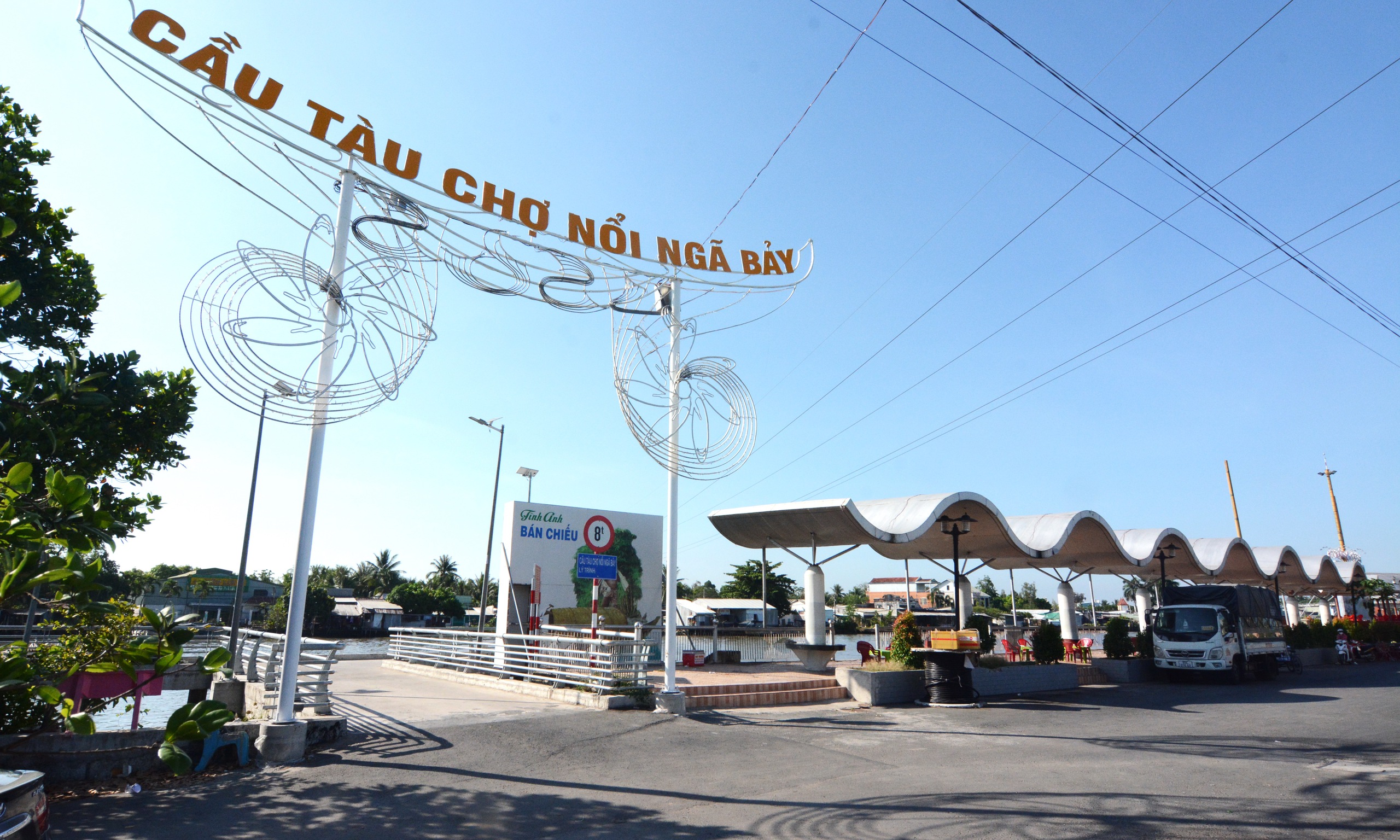
The Nga Bay floating market pier is in a new location but is deserted.
The new floating market is deserted.
In fact, officially, the Nga Bay Floating Market still exists and has not been disbanded. However, according to local residents, around 2001, the government decided to move the market to a new location at the mouth of the Ba Ngan canal, in Dai Thanh commune, Phung Hiep district, about one kilometer from the old location.
Following the locals' directions, we went to the newly opened floating market to check it out. There was a concrete pier by the riverbank with a large sign that read "Nga Bay Floating Market Pier." Next to it was a concrete sign with a painting of the song "The Mat Seller's Love ." The waiting area, along with two boats built of cement and some other impressive structures, was quite grand. Unfortunately, the floating market was deserted; there were no boats or customers.
Relocating the Nga Bay floating market to a new location, if for the purpose of waterway safety, has been achieved, as the Nga Bay canal mouth is now very clear. Standing on the canal bank, at the old market location, one only occasionally sees a boat passing by. However, the Ba Ngan canal – the new location of the Nga Bay floating market – is only a branch canal, with a connection from the Cai Con canal towards the Hau River, about a kilometer from the center of Dai Thanh commune, which may not be as convenient as the old location.
A local fisherman on the riverbank near the Nga Bay Floating Market pier said that even though the Covid-19 pandemic has long passed, the place is still deserted. Occasionally, on Saturdays and Sundays, a few boats carrying tourists come by. Sitting at a riverside cafe, Mr. Ut, who used to make a living trading at the floating market but has now left the dock to work as a construction worker on land, commented: "In my opinion, since it's already been shut down, even if it were to be revived, it probably wouldn't work. Because the market is a place for buying and selling, not for tourists to watch, and buying and selling on land is much more convenient than on the river." (to be continued)
Source: https://thanhnien.vn/nhung-ngoi-cho-doc-dao-cho-nga-bay-con-trong-ky-uc-185240522224857453.htm
![[Photo] General Secretary To Lam presides over a meeting with the Editorial Teams to summarize 100 years of the Party's leadership of the Vietnamese revolution and 40 years of implementing the National Construction Program.](https://vphoto.vietnam.vn/thumb/1200x675/vietnam/resource/IMAGE/2026/03/04/1772601288977_a1-bnd-8134-7576-jpg.webp)















































































Comment (0)