Some researchers have pointed out that Hoi An is the "origin" for the settlement and livelihood activities of ethnic Chinese Vietnamese in Vietnam. Even after several hundred years, the Chinese community has never forgotten this. Every year during the Lantern Festival, their thoughts turn towards this land, to express gratitude to the first ancestral roots of their Vietnamese homeland.
From the Indian ship to the Five Kingdoms…
Before the Chinese arrived in Hoi An, the Japanese were already present. Throughout centuries of economic development, Japan chose new lands to build its commercial strength after numerous periods of war and upheaval.
With the permission of the Nguyen Lords, the first Japanese began establishing villages and towns in Hoi An, launching a major trading port capable of connecting and trading with the outside world. The first and later Japanese ships chose Hoi An as a stopover point for goods, exchanging products and bringing commercial value to Japan.

People in Hoi An and tourists line up to offer incense on the Lantern Festival.
However, Hoi An's economic and cultural landscape only truly changed significantly with the arrival of the Chinese. The Chinese officially took over the entire town of Hoi An after the Japanese left, returning to their homeland at the call of the Japanese Emperor.
Hoi An town, established by the Japanese, was later handed over to the Vietnamese-Chinese community living there, who implemented further innovations and transformations, most importantly the deep penetration and dissemination of Chinese culture and civilization into the local population.
The Chinese, starting with the first refugee boats that left their homeland with the political will to "rebel against the Qing and restore the Ming," came to Vietnam seeking opportunities to live. The Nguyen Lords of Dang Trong (Southern Vietnam) accepted them, settling them in the Hoi An area for easier management and supervision.
Gradually, the Chinese population grew, and they established economic and social organizations, with the strongest forces belonging to the Five Clans of Hoi An. 1741 marked the founding of the Five Clans Guild Hall, with contributions from merchants from Chaozhou, Fujian, Hainan, Guangdong, and Jiaying. From then on, the Chinese community in Hoi An became more closely connected, creating more distinctive cultural imprints, blending local culture from their ancestral homelands.
The term "Minh Huong Chinese" is associated with the migrations of Chinese people who left their homeland and headed south in search of a new home. They always set foot in Hoi An before continuing south and gathering around the Dong Nai - Gia Dinh area to participate in the reclamation of land in the southernmost region.
Naturally, the Chinese remember Hoi An as the place where their business ventures began. This is why, every Lantern Festival, many ethnic Chinese from the south return to Hoi An to respectfully light incense and commemorate their ancestors. The Lantern Festival has become a spiritual holiday for many Chinese people in Hoi An and the south.
A journey alongside heritage.
Many people in Hoi An have tried to explain the reciprocal relationship between the residents of Hoi An and the historical and cultural space, the community space that is recognized as a world intangible cultural heritage.
The people of Hoi An, a blend of Japanese, Chinese, and Vietnamese cultures, form a unique community with distinct Quang Nam cultural characteristics and customs, yet they are also remarkably flexible and diverse. It's no coincidence that many Europeans feel a sense of closeness and friendliness "as if returning home" upon arriving in Hoi An. The Hoi An people possess a strong yet tolerant personality, readily engaging and shaking hands with anyone who sets foot on this land.
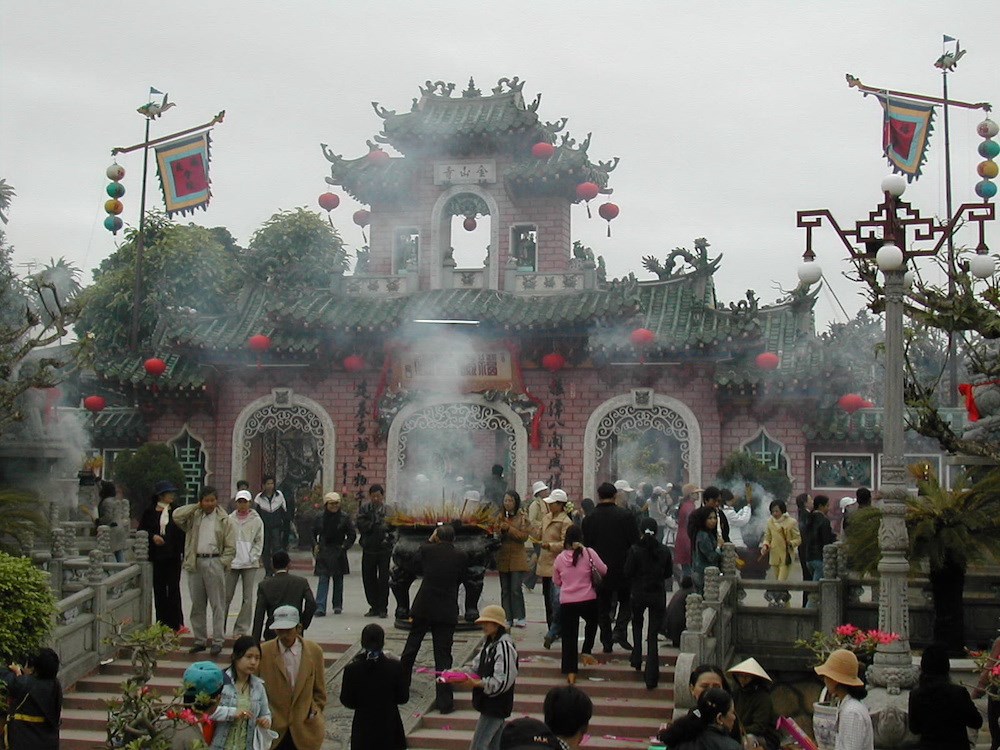
Images of the Lantern Festival in Hoi An before 1999
For a long time, the spirit of cultural integration and diversity has contributed to shaping the unique character of Hoi An. When Hoi An was recognized as a World Heritage site, the opportunities for exchange and connection expanded even further, making it an attractive destination and a natural center of international cultural exchange.
In Hoi An, the influence of the Chinese community remains intact through customs and traditions, with the Lantern Festival being one of the notable milestones.
On the full moon day of the first lunar month, the people of Hoi An hold a very solemn Lantern Festival ceremony, and the influx of tourists to the ancient town increases sharply, especially groups of ethnic Chinese residents from other places returning to their ancestral homeland to express their spiritual devotion.
The Hoi An Lantern Festival has become a national intangible cultural heritage thanks to these diverse contributions, the seemingly nonexistent yet very real relationship between the residents of Hoi An and Chinese tourists and people of Chinese descent…
This spring of the Year of the Horse, the government and people of Hoi An are once again organizing the Lantern Festival, further highlighting the unique cultural values, following the merger of Quang Nam into Da Nang, in the journey of reviving and promoting heritage values.
The story of cultural origins is therefore given even more attention, through traditional ceremonies solemnly organized at destinations such as Ong Pagoda, Ba Pagoda, Ngu Bang Assembly Hall, village communal houses, and ancestral churches...
The entire town of Hoi An has become a magnificent spiritual sanctuary, with the Lantern Festival and ancestral commemoration ceremonies taking place in many locations. This not only reflects the principle of "drinking water, remembering the source," preserving the spiritual heritage of the Hoi An community through centuries, but also vividly reflects the modern and integrated spirit of Hoi An's living heritage.
Source: https://baovanhoa.vn/van-hoa/ngay-tet-van-hoa-di-san-208362.html






![[Podcast] Capital City Law 2026: Increased penalties for violations in the fields of culture and advertising](https://vphoto.vietnam.vn/thumb/402x226/vietnam/resource/IMAGE/2026/06/03/1780487283783_4522222.png)
































![[Video] Sunset at Lap An Lagoon – Where the sun sets over the fishing nets](https://vphoto.vietnam.vn/thumb/1200x675/vietnam/resource/IMAGE/2026/05/31/1780192137701_beach-landscape-sea-water-nature-grass-745871-pxhere-com.jpeg)































Comment (0)