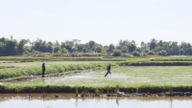
These days, Mr. Tran Chi So, a farmer from My Pho hamlet, My Duc commune, regularly goes to the fields to check on his rice crop. According to Mr. So, heavy rains easily lead to disease outbreaks, so he has to go to the fields frequently. The winter-spring crop was bountiful, but prices were unstable, so he is determined to recoup his losses with the summer-autumn crop. “ Agricultural officials advised me to pay attention to brown planthoppers, small leaf-rolling caterpillars, rice stem borers, whiteflies, stem borers, blast disease, leaf blight, and grain discoloration. However, I observed that the amount of brown planthoppers and whiteflies is not yet a cause for concern, so I mainly spray pesticides to prevent stem borers and blast disease,” Mr. So said.

Farmers in Thanh My Tay commune are dealing with pests and protecting their summer-autumn rice crop. Photo: THANH TIEN
With many years of experience in rice cultivation, Mr. So assessed that the summer-autumn rice crop is more laborious for farmers. However, at the current stage, when the rice is over 30 days old, he and other farmers are applying about 14-16 kg of fertilizer per hectare, more than half the amount used in the winter-spring crop, so they are quite satisfied. “Seeing the rice growing well makes me feel reassured. I cultivate 70 hectares of rice, so I've significantly reduced the amount of fertilizer. Now that rice prices are volatile, farmers are happy to see a reduction in fertilizer and pesticides. Most farmers hope to recoup their losses this season and have the motivation to stay committed to farming,” Mr. So said.
Ms. Tran Thi Mong Tuyen, an official at the Chau Phu Commune General Service Center, is in charge of crop cultivation and plant protection and regularly visits the fields with farmers. According to Ms. Tuyen, brown planthopper infestations peak from early to mid-June, causing mild to moderate damage. The second peak occurs from mid to late July, coinciding with the rice heading to ripening stage, with high densities. These pests also transmit rice yellow dwarf and rice leaf curl diseases, causing serious damage if not properly managed. “Currently, the infestation rate of brown planthopper and rice stem borer is at 2-3%, so we advise farmers to regularly inspect their fields. In the coming days, if these pests appear in greater numbers, farmers will need to take action, especially on the approximately 3,000 hectares of rice in the heading stage throughout the commune,” Ms. Tuyen stated.

Currently, the entire province has planted nearly 200,000 hectares of summer-autumn rice, reaching approximately 40% of the planned area. To stabilize production area, improve efficiency, and ensure the growth target for 2026, the provincial agricultural sector advises farmers to manage water rationally, apply alternating wet-dry irrigation (AWD), and limit localized drought or flooding. At the same time, farmers need to apply balanced fertilizers, reducing nitrogen and increasing potassium. In addition, farmers are encouraged to use organic fertilizers and domestically produced fertilizers to reduce input costs. Deputy Director of the Department of Agriculture and Environment, Tran Thanh Hiep, advised: “What is essential now is for farmers to apply rice cultivation processes according to the Project on 1 million hectares of high-quality, low-emission rice cultivation to reduce costs, effectively manage diseases, and ensure profitability. The agricultural sector will work alongside farmers on technical matters and support them in achieving the best possible summer-autumn rice yields.”
According to Mr. Hiep, the Department of Agriculture and Environment has requested the Sub-Department of Rural Development and Quality Management, the Sub-Department of Crop Production and Plant Protection, the Sub-Department of Irrigation, and the Agricultural Extension Center to strengthen support for farmers according to their respective positions and professional functions. Specifically, the Sub-Department of Rural Development and Quality Management should promote policies encouraging production and consumption linkages, calling on businesses to invest in production along the value chain. Simultaneously, it should support and strengthen cooperatives and agricultural associations to ensure they are strong enough to represent farmers in linkages with businesses. The Sub-Department of Crop Production and Plant Protection needs to strengthen monitoring and forecasting of pest outbreaks, inform and guide farmers in timely and effective control measures; and regularly organize inspection teams to visit fields and promptly detect pests to help farmers proactively control them.
The Department of Agriculture and Environment requested that the People's Committees of communes, wards, and special zones proactively allocate local budgets to reinforce dikes, sluices, and dams, and develop drainage plans to prevent and control flooding during the 2026 summer-autumn crop season; organize inspections and reviews of the inland irrigation system and infrastructure serving production, and promptly address any issues affecting harvesting. “Farmers should use rice varieties according to market signals, implement concentrated sowing in each sub-region, and space out harvesting to avoid overloading harvesting machines. At the same time, pay attention to field sanitation, land preparation, canal dredging, and reinforcement of irrigation works to ensure a successful summer-autumn crop this year,” Mr. Hiep said.
Given the current complex weather patterns, farmers need to proactively implement pest control measures and effectively respond to the rainy and stormy season. At the same time, they should apply scientific farming practices and participate in production linkages to ensure market access and mitigate the negative impacts of fluctuating rice prices, as seen in the recent winter-spring crop.
| According to the plan, for the 2026 summer-autumn rice crop, the entire province will plant 505,500 hectares, striving for a yield of over 3 million tons. The agricultural sector recommends that farmers plant high-quality varieties that meet export standards such as OM 18, OM 5451, Dai Thom 8, Jasmine 85, ST24, ST25… |
THANH TIEN
Source: https://baoangiang.com.vn/chu-dong-bao-ve-lua-he-thu-a489218.html
![[Photo] The 13th National Congress of the Youth Union conducts personnel work.](https://vphoto.vietnam.vn/thumb/1200x675/vietnam/resource/IMAGE/2026/06/24/1782299943080_ndo_br_1-6868-jpg.webp)

![[Photo] General Secretary and President To Lam attends the Central Public Security Party Committee Conference](https://vphoto.vietnam.vn/thumb/1200x675/vietnam/resource/IMAGE/2026/06/24/1782302063612_a1-bnd-9302-9166-jpg.webp)
![[Photo] Opening Ceremony of the 13th National Congress of the Ho Chi Minh Communist Youth Union](https://vphoto.vietnam.vn/thumb/1200x675/vietnam/resource/IMAGE/2026/06/24/1782286753905_ndo_br_1-8510-jpg.webp)