

For the 2026 summer-autumn crop season, Hue City will plant approximately 25,008 hectares of rice. To date, the rice has been largely sown and is currently in the seedling and tillering stage.
According to the Hue City Department of Agriculture and Environment, due to the prolonged hot weather and high temperatures, combined with the decomposition of rice straw after the winter-spring harvest, toxic gases such as H2S, CH4, CO2, and organic acids like acetic acid and butyric acid are generated in the soil, causing organic poisoning. Some areas show signs of soil acidification, causing rice plants to grow slowly, with dark, underdeveloped roots and yellow leaves.
In addition, thrips are causing localized damage in some areas of rice fields that are dry, lack base fertilizer, and are poorly cared for, affecting the growth of the rice plants.
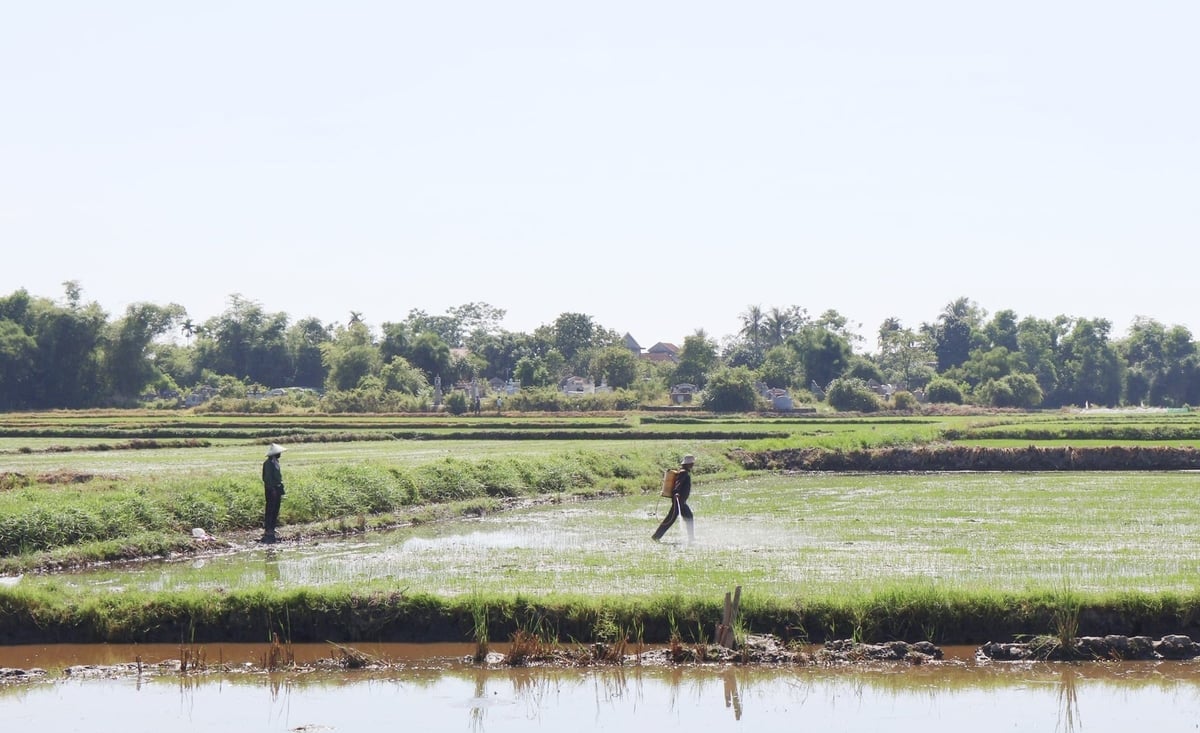
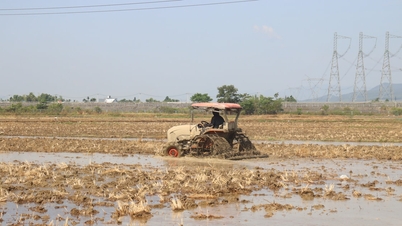
Hue City has requested local authorities to intensify field inspections and guide farmers in timely care and pest control to protect the yield of the 2026 summer-autumn rice crop. Photo: Van Dinh.
To proactively respond to complex weather developments, ensure good growth and development of the 2026 summer-autumn rice crop, minimize damage, and strive to complete the production plan, the Department of Agriculture and Environment of Hue City requests the People's Committees of communes and wards to direct specialized departments to assign staff to coordinate with cooperatives to closely monitor the fields, regularly inspect and review the growth of the rice crop, and promptly guide farmers in applying appropriate care measures.
Disseminate information and guide farmers on implementing measures to remedy organic poisoning and soil acidity in rice, regulate water properly, drain water from areas severely affected by organic poisoning and acidity, then introduce fresh water into the fields, and supplement with fertilizers containing calcium and silicon to improve soil. Apply fertilizers in a balanced manner, absolutely avoiding excessive nitrogen application, prioritizing NPK fertilizers specifically for rice, and combine with foliar fertilization to help rice plants recover quickly.
In coordination with specialized agencies, strengthen the organization of inspections to detect pests early, especially thrips, which damage rice fields that are dry and poorly cared for. Simultaneously, guide farmers on the safe and effective use of herbicides. Organize rodent and golden apple snail control to limit their population density from the beginning of the season.
The Hue City Department of Agriculture and Environment has requested the Plant Protection and Crop Production Sub-Department to strengthen the investigation, monitoring, and forecasting of pest and disease situations on rice, especially thrips and other pests and diseases that may arise in hot weather conditions, in order to guide farmers in timely, safe, and effective control measures.
Furthermore, the regional crop cultivation and plant protection stations are directed to coordinate closely with local authorities and cooperatives to inspect fields and guide farmers on technical measures to overcome organic poisoning and soil acidification. At the same time, they are to strengthen propaganda and guidance for farmers on selecting and using fertilizers and pesticides that are of good quality, technically correct, and suitable for production conditions.
Source: https://nongnghiepmoitruong.vn/khac-phuc-hien-tuong-ngo-doc-huu-co-chua-phen-tren-lua-d814605.html
![[Photo] First session of the 14th Congress of the Vietnam Trade Union](https://vphoto.vietnam.vn/thumb/1200x675/vietnam/resource/IMAGE/2026/06/03/1780465947883_ndo_br_img-3852-jpg.webp)
![[Photo] General Secretary and President To Lam presides over a meeting with the Central Organizing Committee.](https://vphoto.vietnam.vn/thumb/1200x675/vietnam/resource/IMAGE/2026/06/03/1780482764658_a1-bnd-4741-3342-jpg.webp)
![[Photo] Secretary of the National Assembly Party Committee, Chairman of the National Assembly presides over the meeting of the Standing Committee and Executive Committee of the National Assembly Party Committee.](https://vphoto.vietnam.vn/thumb/1200x675/vietnam/resource/IMAGE/2026/06/03/1780480353201_ndo_br_bnd-2585-jpg.webp)








![Transforming from Resolution 57: [Part 3] High-tech agricultural center](https://vphoto.vietnam.vn/thumb/402x226/vietnam/resource/IMAGE/2026/06/03/1780491765550_2928-4922-img_7193-010813_454-010814.jpeg)



























![[Video] Sunset at Lap An Lagoon – Where the sun sets over the fishing nets](https://vphoto.vietnam.vn/thumb/1200x675/vietnam/resource/IMAGE/2026/05/31/1780192137701_beach-landscape-sea-water-nature-grass-745871-pxhere-com.jpeg)

























Comment (0)