

Alarm!
In recent years, the combined impact of hydrological conditions, coastal currents, sediment levels at river and sea estuaries, and extreme weather events has led to increasingly serious sedimentation in the navigation channels leading to fishing ports and storm shelters for fishing vessels in Ha Tinh province.
Significantly, the annual rate of sedimentation is increasing exponentially, making it extremely difficult for fishermen to accommodate ships and venture out to sea for fishing. In particular, during low tide, ships are often unable to enter or leave the port, or access the mooring area, posing a risk to maritime safety and failing to fulfill the approved storm shelter function.

The entire system of fishing ports, storm shelters for fishing vessels, and coastal shipping lanes in Ha Tinh province is severely silted up. Photo: Thanh Nga.
According to the Management Board of Fishing Ports and Storm Shelters for Fishing Vessels in Ha Tinh Province (abbreviated as the Management Board of Fishing Ports), the unit currently manages and operates 3 fishing ports and 4 storm shelters for fishing vessels with a total water surface area of approximately over 179,000 hectares. All ports and shelters are experiencing alarming levels of sedimentation.
First, we must mention Xuan Hoi fishing port in Dan Hai commune. This fishing port was put into operation in 2015, with a water area of 3.8 hectares and a design elevation of -4.1m. Since its completion, it has not undergone any dredging or maintenance. Survey results from early 2026 showed that 2/3 of the length of the wharf is constantly shallow, with an estimated sediment volume of about 117,800 m³, seriously reducing the fishing depth. The entrance area and inside the mooring area also have accumulated a layer of silt and sand of about 380,180 m³.
At Cua Sot fishing port in Loc Ha commune, despite dredging and channel rectification during the 2016-2019 period, limited funding has rendered the dredging efforts ineffective. Currently, the average sediment thickness at this fishing port is approximately 1.4m, with a volume of about 171,000 m³. In the future, the annual sedimentation rate is projected to fluctuate between 0.3 and 0.5m, corresponding to approximately 61,200 m³.
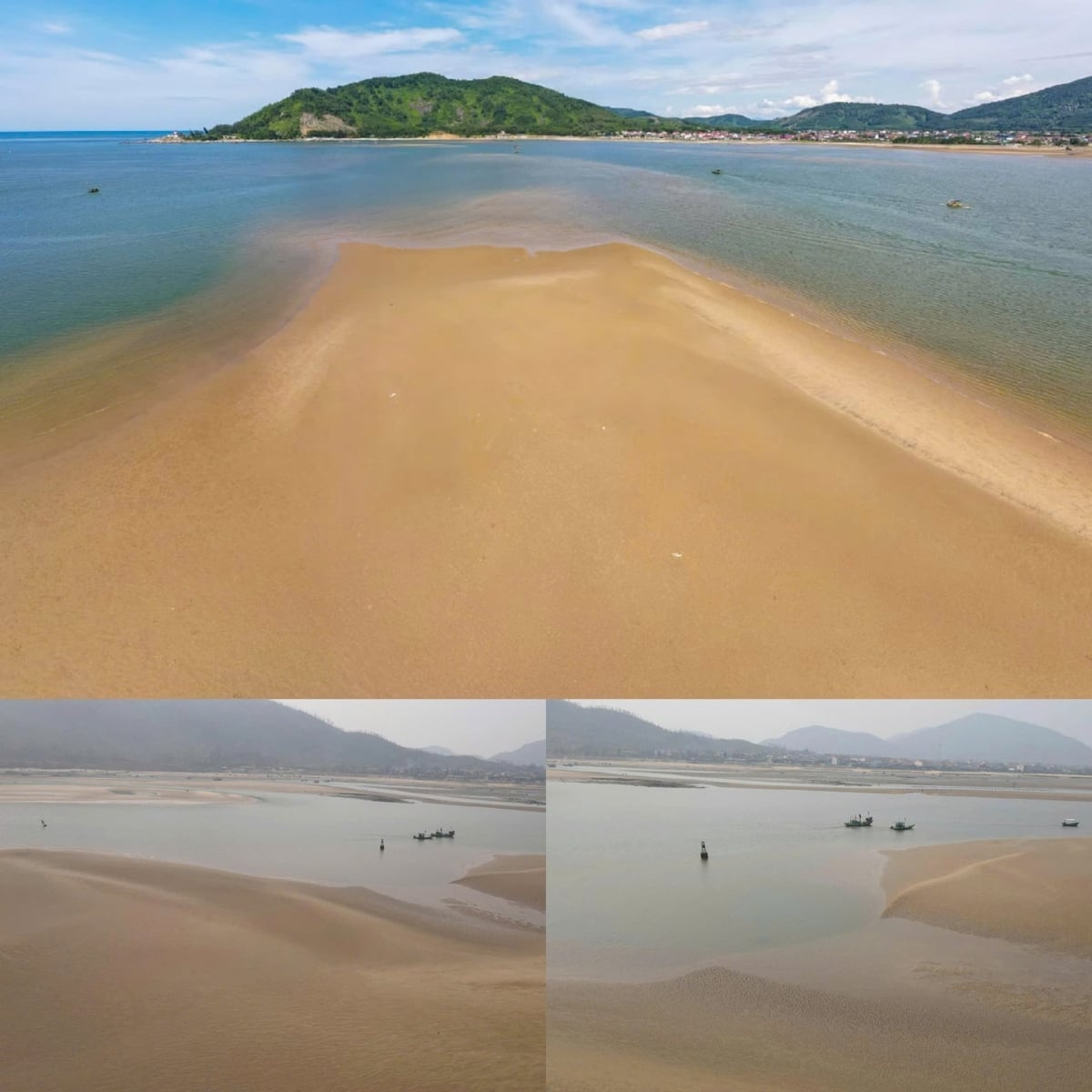
Millions of cubic meters of sand dunes block the waterway, making it difficult for ships to enter and leave Cua Nhuong port. Photo: Thanh Nga.
Most concerning is the Cua Nhuong fishing port area. Despite only being put into operation at the end of 2024, many areas in the waters in front of the port now only have a depth of about 1.3-1.5m at average tide, making it unsafe for large fishing vessels to enter and exit. The volume of sediment in this area is estimated at over 404,000 m³. The channel connecting the port to the national inland waterway is also almost completely silted up, with many sandbars appearing, forcing large vessels to anchor far from the port, incurring additional costs for bringing seafood ashore for sale.
Mr. Nguyen Van Thanh, Chairman of the Cam Nhuong Fishermen's Union, believes that dredging approximately 500 meters of the Rao Cai River waterway, currently managed by the Vietnam Maritime and Inland Waterways Administration, is extremely necessary. For a long time, fishermen entering the port have frequently experienced propeller "runaway" issues on this section of the waterway (the section from the lighthouse out to sea). Many boats have lost 20-30 million VND overnight due to damaged propellers.

Approximately 70% of the length of the wharf at Xuan Hoi fishing port has been covered with mud and sand. Photo: Thanh Nga.
The Cua Nhuong storm shelter and anchorage area, covering a water area of 71 hectares, has never been dredged or maintained since its completion in 2010. Surveys indicate that this area has suffered particularly severe siltation, with approximately 1.02 million cubic meters of silt and sand deposited, significantly reducing its capacity to accommodate fishing vessels seeking shelter from storms. The annual siltation rate is projected at around 0.3-0.5 meters, corresponding to over 158,000 cubic meters of deposited material per year – the highest rate in the entire fishing port and anchorage system of Ha Tinh province.
Significant impact on combating IUU fishing.
According to expert assessments, the entire system of fishing ports and coastal anchorages in Ha Tinh province is located in an area heavily impacted by the transport of sediment along the shore, tidal currents, and waves. This is the reason why shipping channels are continuously silted up despite previous dredging efforts. In particular, the negative impacts of climate change, most clearly demonstrated after typhoons No. 5 and No. 10 in 2025, have accelerated the rate of siltation. This necessitates the urgent implementation of large-scale, coordinated dredging projects for ports, anchorages for fishing vessels, and inland waterways to thoroughly address the siltation problem.

The sedimentation of fishing ports and storm shelters significantly impacts the traceability of seafood and the fight against IUU (Illegal, Unreported, and Unregulated) fishing. Photo: Thanh Nga.
Fisherman Nguyen Van Minh, from Loc Ha commune, Ha Tinh province, owns a fishing vessel over 12 meters long. Following the recommendations of the European Commission (EC) and guidance from relevant authorities on combating illegal, unreported, and unregulated (IUU) fishing, his vessel consistently complies with port entry and exit regulations for reporting catch and tracing seafood origins. However, due to severe siltation in the inland waterways and waters surrounding Cua Sot fishing port, entry and exit to the port are only possible when the tide is rising, slowing down his family's subsequent fishing trips.
“Not only is it difficult to enter and exit the port, but there are times when the ships arrive at extremely low tide, forcing me to anchor far offshore and hire smaller boats to transport the fish and squid ashore for sale. This increases fuel costs, transportation time, and reduces the quality of the harvested seafood,” Mr. Minh said, while also suggesting that higher authorities should develop large-scale dredging projects to completely clear the port's entrance and exit channels and the waters in front of the port, avoiding piecemeal dredging which is both ineffective and wasteful of state budget.
From a state management perspective, Mr. Than Quoc Te, Deputy Director of the Management Board of Fishing Ports and Storm Shelters for Fishing Vessels in Ha Tinh province, also acknowledged that the current situation and rate of sedimentation at fishing ports and shelters in the area are very serious. This greatly affects the fishing activities of local fishermen. Especially in the context of the whole country striving to remove the IUU "yellow card," the difficulties faced by fishing vessels in entering and leaving ports will affect product traceability; larger vessels incur additional costs for transporting products ashore, reducing the quality of seafood after harvesting, and thus reducing fishermen's income.

Sedimentation in fishing port areas makes it difficult for fishing boats to enter and exit during the rainy and stormy season. Photo: Thanh Nga.
With the 2026 rainy and stormy season approaching, maintaining clear waterways and ensuring the designed depth is more urgent than ever to guarantee the safety of people and vessels in the short term, while also contributing to improving port operational capacity and promoting the sustainable development of fisheries logistics services.
Source: https://nongnghiepmoitruong.vn/cap-bach-nao-vet-cac-cang-ca-o-ha-tinh-d813144.html

![[Photo] General Secretary and President To Lam presides over a meeting with the Central Organizing Committee.](https://vphoto.vietnam.vn/thumb/1200x675/vietnam/resource/IMAGE/2026/06/03/1780482764658_a1-bnd-4741-3342-jpg.webp)
![[Photo] Secretary of the National Assembly Party Committee, Chairman of the National Assembly presides over the meeting of the Standing Committee and Executive Committee of the National Assembly Party Committee.](https://vphoto.vietnam.vn/thumb/1200x675/vietnam/resource/IMAGE/2026/06/03/1780480353201_ndo_br_bnd-2585-jpg.webp)
![[Photo] First session of the 14th Congress of the Vietnam Trade Union](https://vphoto.vietnam.vn/thumb/1200x675/vietnam/resource/IMAGE/2026/06/03/1780465947883_ndo_br_img-3852-jpg.webp)













![Transforming from Resolution 57: [Part 3] High-tech agricultural center](https://vphoto.vietnam.vn/thumb/402x226/vietnam/resource/IMAGE/2026/06/03/1780491765550_2928-4922-img_7193-010813_454-010814.jpeg)

































![[Video] Sunset at Lap An Lagoon – Where the sun sets over the fishing nets](https://vphoto.vietnam.vn/thumb/1200x675/vietnam/resource/IMAGE/2026/05/31/1780192137701_beach-landscape-sea-water-nature-grass-745871-pxhere-com.jpeg)



































Comment (0)