

Gloomier than expected.
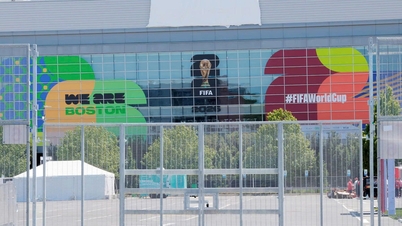
Global fans are eagerly awaiting the official start of the 2026 World Cup in North America in the coming days. However, in the two co-hosting nations, the United States and Mexico, the atmosphere is somewhat more subdued than expected.

The World Cup may not be a top priority for Americans (Photo: FIFA)
In the United States, the spirit of the world's biggest football festival remains rather weak. This is partly due to the country's sporting characteristics, where American football and basketball are truly the top priorities for the majority of the population.
According to statistics, the 2025 Super Bowl final attracted 127.7 million television viewers, more than the entire population of Vietnam.
The NBA playoffs are also entering their most dramatic phase. Therefore, the World Cup, despite its global significance, is just one of many other sports entertainment options.
Even for the American players, the feeling that "the 2026 World Cup is approaching" doesn't come naturally. Many players admit that they only truly feel the pressure and significance of the tournament after their club season has ended.
Bournemouth midfielder Tyler Adams told The Guardian : "Last week, I was still playing in the Premier League. I think the 'World Cup 2026 is coming' feeling will come when we start training properly to prepare for the 2026 World Cup."
Many host cities were affected.
On the other hand, co-host Mexico is facing its own challenges as many of its host cities are affected by social unrest. Earlier this week, protests by retired teachers and judges in Mexico City created a chaotic scene across the North American nation.

Decorative mannequins set up in preparation for the 2026 World Cup were vandalized by protesters in Mexico (Photo: The Guardian).

Although they weren't directly targeting the upcoming tournament, the slogan "Without better pensions, the ball won't roll" worried many fans. The National Coordinating Union of Education Workers of Mexico (CNTE) even threatened large-scale protests at the opening match of the 2026 World Cup between Mexico and South Africa at the Azteca Stadium.
Football is the most beautiful sport in the world.
In stark contrast to the lukewarm reception in North America, soccer in many South American countries carries a meaning far beyond simply being a sport. Fans in Argentina, Brazil, and Chile view their love of the beautiful game as part of their identity, beliefs, and spiritual life.
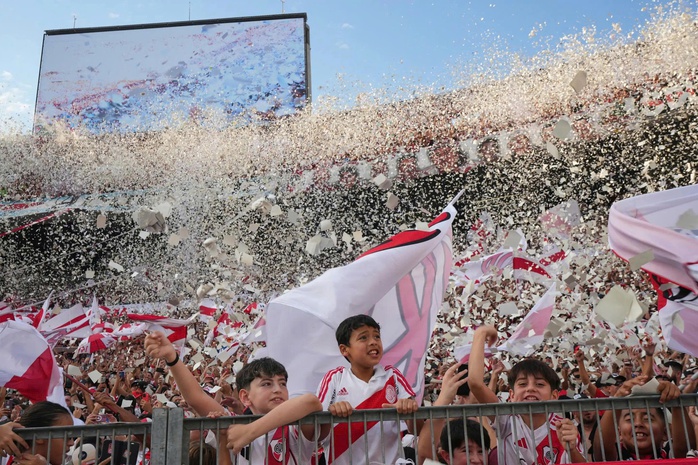
The El Clásico match between River Plate and Boca Juniors in Argentina always attracts a large number of fans (Photo: AP)
In Lionel Messi's homeland, the passion for football is often passed down through generations, and loyalty to clubs grows stronger. Pope Francis, who was born in Argentina and is a supporter of the San Lorenzo club, once stated that he agrees with the view that football is the most beautiful sport in the world.
In Brazil, football has become a collective joy after a hard day's work. At the same time, it is also associated with symbolic rituals.
The plane carrying the Brazilian national team to North America was recently approved by the Brazilian Football Confederation (CBF) for a "baptism" before departure.
"Selecao" fans believe this ritual will bring good luck to coach Carlo Ancelotti and his team at the 2026 World Cup.

The plane carrying the Brazilian national team to the 2026 World Cup was "baptized" before takeoff.

The difference in atmosphere surrounding the upcoming 2026 World Cup between the two regions lies not only in the level of football played but also in how football is perceived. The World Cup is just a major sporting event in North America, but it's a place where emotions, beliefs, and identities merge in South America.

Source: https://nld.com.vn/chu-nha-lanh-nhat-voi-world-cup-2026-196260604135703492.htm






















































![[Video] Sunset at Lap An Lagoon – Where the sun sets over the fishing nets](https://vphoto.vietnam.vn/thumb/1200x675/vietnam/resource/IMAGE/2026/05/31/1780192137701_beach-landscape-sea-water-nature-grass-745871-pxhere-com.jpeg)


































Comment (0)